


Gridlock on Chávez Avenue: A Mirror to Global Urban Fragility
POLICY WIRE — Albuquerque, N.M. — It’s usually the big, bold proclamations that seize headlines, the geopolitical chess moves, the seismic shifts in global alliances. But sometimes, the sharpest...

POLICY WIRE — Albuquerque, N.M. — It’s usually the big, bold proclamations that seize headlines, the geopolitical chess moves, the seismic shifts in global alliances. But sometimes, the sharpest insights into a nation’s—or indeed, the world’s—vulnerabilities come from the mundane: a snarl of steel and rubber on a New Mexico interstate named for an iconic labor leader. Today, I-25 at Avenida César Chávez became just such a metaphor, its northbound lanes choked by something far more elemental than policy debates.
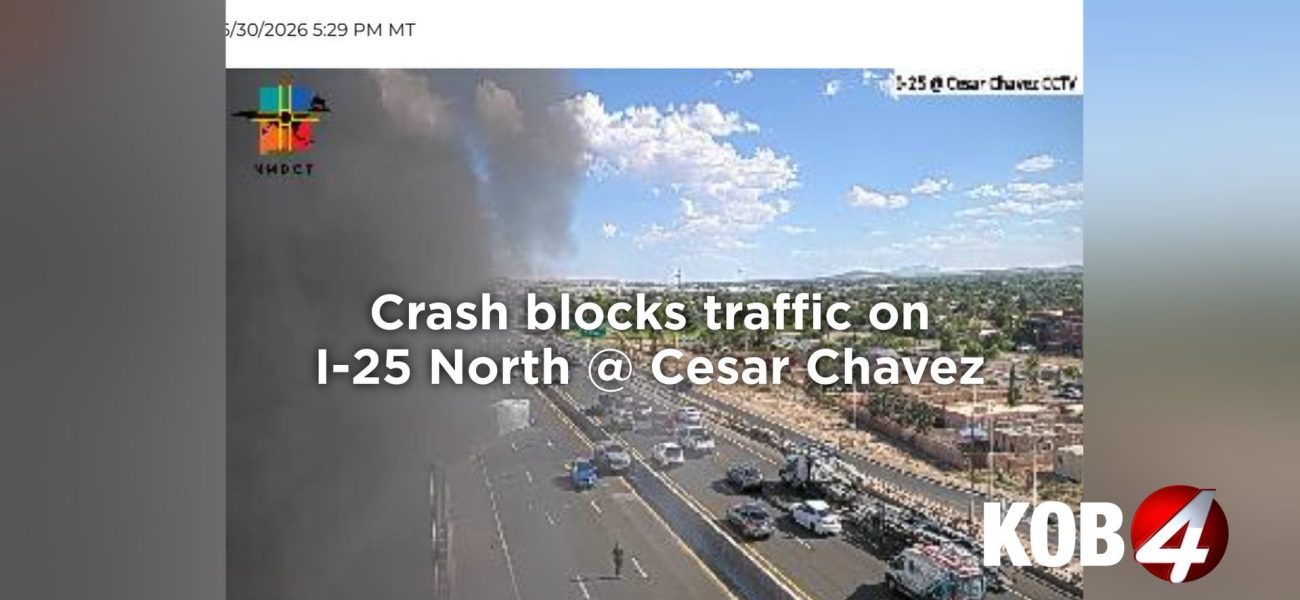
It began as it often does, with an incident that turned everyday commuting into a grueling exercise in civic frustration. Early reports indicated traffic is blocked at I-25 at Avenida César Chávez due to a crash.
Not the stuff of diplomatic cables, you’d think. But stay with me. An initial glimpse, likely from an NMDOT camera feed, offered a telling vignette: smoke and what appears to be a vehicle blocking two of the northbound lanes.
The consequence was immediate, brutal. First responders are shutting down northbound traffic at Gibson,
sealing off an escape route, transforming the main artery into a stagnant pool of engines and exasperated drivers. It’s a development that underscores the often-unacknowledged fragility of the very systems that underpin our urban existences. One unfortunate misstep, one mechanical failure, — and a sprawling metropolis grinds to a halt. The details remain sketchy; KOB 4 has reached out to Albuquerque Fire Rescue for details
and confirmed This is a developing story.
You can bet they’ll provide more details as they become available.
For those stranded, however, the precise mechanics of the event are less pressing than the lost time, the missed meetings, the sheer inconvenience. [QUOTE_PLACEHOLDER]
But the true policy implication here isn’t just about local traffic management. No, it’s far broader. Consider how even minor disruptions cascade through complex systems. A trucker held up on I-25 isn’t just late for dinner; a delivery could be missed, a supply chain link stressed, leading to minor price hikes or product delays further down the line. It’s a localized echo of the global shipping crises — and Suez Canal blockages we’ve witnessed. And for a city like Albuquerque, attempting to brand itself as a tech hub or logistical crossroads, such interruptions aren’t just inconvenient; they’re reputational dents. Nobody wants their just-in-time inventory stuck in the Land of Enchantment because of an unanticipated freeway bottleneck. This isn’t just about asphalt — and tires; it’s about the nervous system of modern commerce, exposed and fraying. They’re telling folks to just grin and bear it, probably.
The name César Chávez, commemorating the relentless fight for farm workers’ rights, carries a powerful legacy. Here, on an interstate bearing his name, we see a different kind of struggle—the constant battle between humanity’s demand for rapid movement and the inherent limitations of infrastructure. You’ve got to wonder if those stuck in the gridlock, staring at exhaust pipes, were reflecting on the deeper meanings, or just calculating how late they’d be for work. (Probably the latter.) Yet, in many ways, the fight for efficient infrastructure is just as foundational to economic well-being as the labor rights Chávez championed.
And these disruptions aren’t isolated to the American Southwest, not by a long shot. They’re a universal groan of the modern urban condition. From the perpetual congestion of São Paulo to the grinding commutes in Cairo, or indeed, the labyrinthine traffic of Karachi, where the population has soared to over 16 million, outstripping even Mumbai, these kinds of bottlenecks are not exceptions but the harsh, daily reality. There, just one fender-bender on, say, Shahrah-e-Faisal—Karachi’s main arterial road—can paralyze swathes of the city for hours. Because there, too, the infrastructure struggles to keep pace with an explosively growing populace and economic demands. It’s an age-old story, just retold on different continents.
📄 POLICY WIRE WHITEPAPER PUBLISHED: PAKISTAN'S NATIONAL SECURITY POLICY PRIORITIES
👉 READ BY CLICKING HEREThe cost, globally, is staggering. A report from Texas A&M Transportation Institute and INRIX in 2019 estimated that traffic congestion costs the average U.S. urban commuter 99 hours — and $1,424 annually in wasted time and fuel. Imagine amplifying that for mega-cities across the developing world, where robust public transit options are often limited and the vehicle-to-road ratio is far less forgiving. Those lost hours don’t just evaporate; they chip away at productivity, health, — and national GDPs. But then again, maybe this crash reminds us all just how interconnected things are. A breakdown on I-25, even in the abstract, impacts everyone.
It’s clear now: there’s a real demand for smarter urban planning, for resilience, and for continued investment in not just roads, but multi-modal transportation options. It’s what happens when you let the asphalt decay — and ignore the population growth. The world watches, in its own way. Check out more stories on global economic shifts and infrastructure challenges, like EU Steel Shield Rises: Brussels Rewrites Trade Rules, Stoking Global Anxieties, or perhaps another take on disruptions, World Cup’s Colossal Cash Grab: Geopolitics on the Pitch, to see just how intertwined local incidents can be with global economics.
What This Means
This Albuquerque incident, though local, functions as a micro-crisis reflecting macro-challenges that plague cities worldwide, particularly those in rapidly urbanizing regions like South Asia. Politically, sustained traffic failures can erode public trust in governance, highlighting neglected infrastructure investment and the urgent need for integrated urban planning strategies. Economically, beyond the immediate delays, such incidents incur hidden costs through lost productivity, increased fuel consumption, and stressed supply chains, potentially impacting local economies trying to attract industry or maintain growth. For developing nations—Pakistan notably among them—where population growth often outpaces infrastructure development, such a breakdown is a daily occurrence, with far more dire economic implications for trade, worker mobility, and overall quality of life. The U.S. faces challenges, certainly, but countries with fewer resources face an existential fight against gridlock. You can’t just ignore it — and expect prosperity, can you? Policymakers, from city councils to national planning commissions, simply can’t afford to see a highway closure as an isolated event; it’s a diagnostic sign for systemic vulnerabilities.