


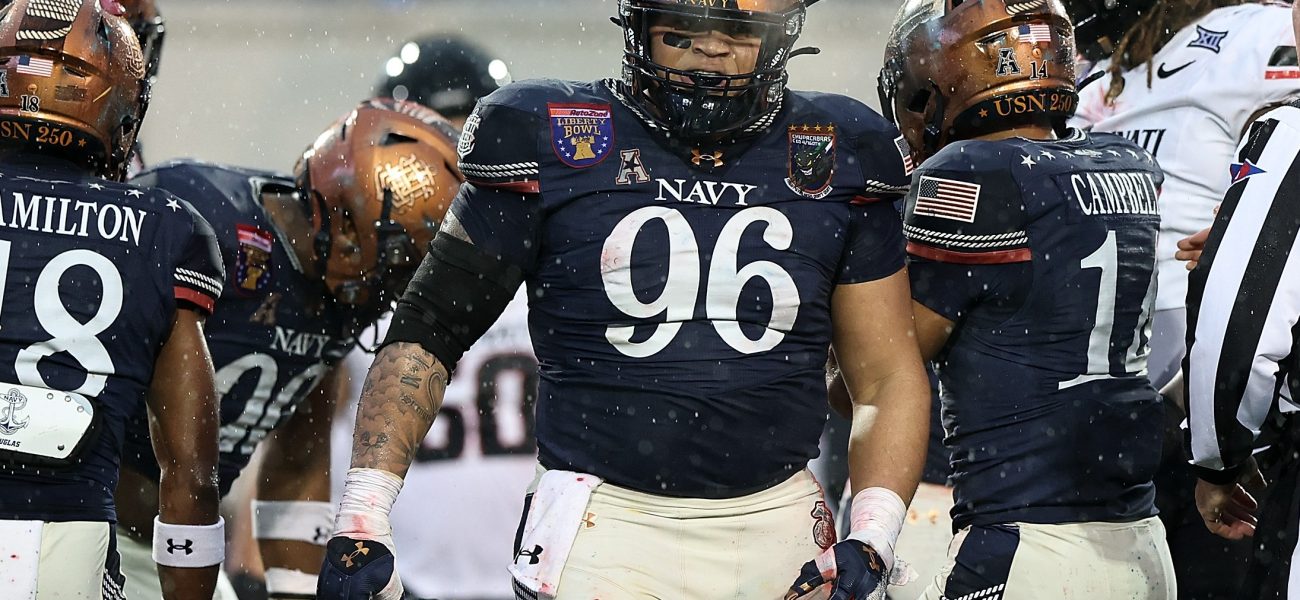
Gridiron Grit: Former Marine Cadet’s Unorthodox Playbook for NFL Survival
POLICY WIRE — Cincinnati, Ohio — For Landon Robinson, the battle for a professional football roster spot isn’t just about athletic prowess or playbook memorization. No, sir. For...

POLICY WIRE — Cincinnati, Ohio — For Landon Robinson, the battle for a professional football roster spot isn’t just about athletic prowess or playbook memorization. No, sir. For him, the struggle—every gruelling drill, every film session—is a strategic exercise, honed over years in an institution that shapes minds for warfare and national service. The former Naval Academy defensive lineman isn’t just trying to make the Cincinnati Bengals; he’s deploying principles drilled into him long before he ever eyed an NFL salary.
It was a stark image during April’s NFL draft. While millions fixated on prime-time glitz and million-dollar contracts, a live television moment captured two men, newly minted pro athletes, whose recent reality involved crisp uniforms and a binding commitment to the nation. Robinson and his Navy teammate, Eli Heidenreich, drafted within two picks of each other, offered a poignant reminder: some of these athletes are on a fundamentally different trajectory. Their dreams aren’t just about tackles; they’re about duty. This unusual blend of battlefield preparedness and athletic ambition presents a compelling narrative, especially for a squad like the Bengals. [QUOTE_PLACEHOLDER]
Because, let’s be honest, getting drafted in the seventh round usually means you’ve got a steeper climb than most. Cincinnati, following that perplexing Dexter Lawrence trade that sent their No. 10 pick to the Giants, created some late-round excitement picking Robinson. But make no mistake, despite that pre-draft darling status—the solid workouts, the impressive interviews—the team has dumped a significant amount of cash into its defensive line. Robinson’s gotta fight. He’s wading into a brutal scrum for a spot come Week 1, — and no one’s handing out medals for just showing up.
He’s betting his four years at the Naval Academy taught him how to handle exactly this kind of pressure. “I was here for two weeks before going back for commissioning, so being able to go back and see my friends and my family and everybody there — after a long four or five years that we were at the Naval Academy — and being able to celebrate that with them was super special,” Robinson noted, fresh off becoming a Second Lieutenant in the Marine Corps. This isn’t just about physical conditioning; it’s a profound mental framework.
But how does a system built for commanding troops translate to chasing quarterbacks? Simple. It instils a kind of raw, almost unyielding resilience. “The discipline, the perseverance — I mean, football is a hard game,” he elaborated, reflecting on the Naval Academy’s unique rigor. “It’s hard on your body; it’s hard on the mental side. When you go through something like the Naval Academy, it’s truly crucial to stay focused, stay disciplined. That’s how you continue to get better.” That’s the playbook for life — and the NFL, apparently.
This steadfast commitment isn’t unique to American military academies. Throughout the Muslim world, and particularly in nations like Pakistan, military training academies such as the Pakistan Military Academy Kakul are revered institutions. They’re seen not merely as feeders for the armed forces but as elite pathways forging disciplined leaders. Much like the Naval Academy, these institutions demand a complete dedication to duty, often instilling values that extend beyond the battlefield into civil society, government, and even competitive industries. The expectation is that graduates will bring a higher degree of structure and self-control to whatever field they enter next, a cultural parallel that offers some context to Robinson’s mindset. It’s about earning your place through a combination of intellect — and sheer grit.
“The structure of the Naval Academy — having to wake up at a certain hour, be where you need to be on time and get the job done every single day — helped me,” Robinson added. This relentless scheduling, cramming in formations, classes, homework, — and football practice, forged an internal clock. “At the Naval Academy, you have formations, school and homework, and to be able to fit football in there, that structure helped me when I got here. I know I have to set aside time for film, eat at a certain time and get in as much work as possible.” One can only imagine the kind of focus that schedule demands.
And that sort of focused hustle fits snugly into Head Coach Zac Taylor’s desired locker room culture. Taylor, notoriously picky, prioritizes players with former team captain designations, solid academics, and a track record of high achievement. Robinson hits all those marks, bringing military discipline as a welcome bonus. But even with that robust background, Robinson faced some catching up after taking time for his graduation and commission ceremony. Still, it’s not some insurmountable challenge, is it?
For context, making the NFL is an astronomical long shot regardless of background. According to the National Collegiate Athletic Association (NCAA), only about 1.6% of NCAA football players get drafted by NFL teams. Factor in Robinson’s multi-year service commitment after graduation, which means many more highly-touted college players had a clear run at the pros while he was navigating military protocol. His journey is a deviation from the well-worn path. It really is. Yet, Robinson’s embrace of the unconventional isn’t new: “I like being different and doing something that’s special, and being at the Naval Academy is special.” That ethos might just be his most potent weapon.
What This Means
Landon Robinson’s narrative isn’t just a sports story; it’s a fascinating look at how highly specialized, regimented training—like that provided by a military academy—translates, or doesn’t, to entirely different high-stakes environments. His struggle reflects a broader societal push-and-pull between traditional civic duties — and individual ambition. In a nation often criticized for its fleeting attention spans and demands for instant gratification, the sheer grit and delayed gratification required of a Naval Academy graduate choosing to pursue an NFL career offers a potent counter-narrative.
Economically, the value placed on these “soft skills” like discipline, time management, and resilience, cultivated in demanding institutions, is often overlooked in favor of pure technical ability. Yet, as Robinson’s journey suggests, these attributes can make the difference in hyper-competitive fields. From a political standpoint, his story could even serve as a microcosm of public service values. The military, by design, seeks individuals capable of sacrificing personal comfort for a greater goal. When such an individual successfully navigates the cut-throat world of professional sports, it inadvertently highlights the potential and versatility of leaders trained for national duty. This intersection of military precision and pro sports spectacle isn’t just good television; it offers a glimpse into the diverse wellsprings of national character and the qualities we often aspire to see in leadership, whether on the field or in the halls of power. It’s a reminder that some fights are won long before the first snap.
It’s an interesting concept, this blending of orders — and game plans. It begs the question of whether similar rigorous institutions, from global military academies to intensely competitive engineering programs in say, Tokyo or Singapore, might inadvertently produce more adaptable, resilient leaders across various sectors than traditionally focused curricula alone. Because when you’ve been taught to lead under fire, what’s a defensive line scramble?