

Gridiron Gauntlet: QB’s Political Play Ignites Locker Room Firestorm, Challenges Unity
POLICY WIRE — New York, USA — It wasn’t the cheers from the political rally that echoed loudest last week, but the resounding silence from an NFL locker room. Quarterback Jaxson Dart, fresh off...

POLICY WIRE — New York, USA — It wasn’t the cheers from the political rally that echoed loudest last week, but the resounding silence from an NFL locker room. Quarterback Jaxson Dart, fresh off introducing former President Donald Trump, tried to sidestep a self-inflicted media pile-up with a carefully worded statement. But the real story, as it often is, festered in the uncomfortable glances and unasked questions among his teammates, whose reactions speak louder than any PR-spun prose. And this isn’t just about football; it’s a stark snapshot of America’s fractured body politic bleeding into its most lucrative arenas.
Dart, the signal-caller for the New York Giants, found himself squarely in the crosshairs after his stage appearance, a move that surprised many—not least of all, his own colleagues. He issued a rote explanation, framing his actions as mere reverence for the Oval Office and a nod to his family’s military heritage. He even allowed that “the world of politics can be a sensitive matter.” Because, you know, just an astute observation. However, when pressed about how this very sensitive matter might sit with teammates—particularly those who might’ve felt marginalized or outright attacked by the very figure Dart championed—he simply clammed up. “My statement would be his only response,” was the official line. Convenient, isn’t it?
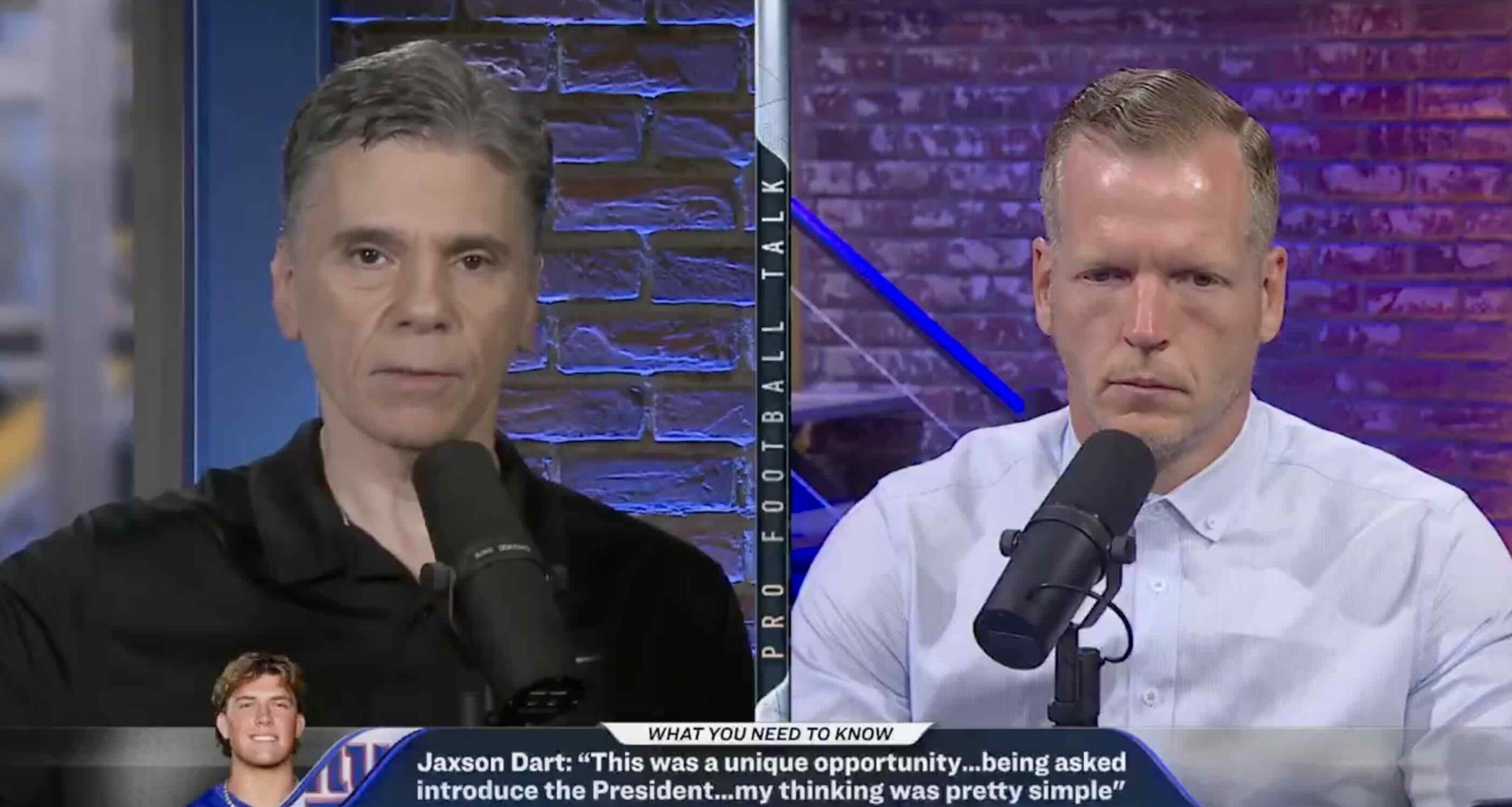
Mike Florio, the veteran sports media analyst for PFT, saw right through the charade. “Somebody came up with the bright idea,” Florio observed on Monday’s PFT Live, though his tone suggested otherwise, “‘How are we going to deal with this? All right, let’s just say this isn’t about politics, it’s about the office.’ And he means the guy whose former office, incidentally, happens to define a highly partisan era. ‘I respect the office of the president,’ was Dart’s narrative. But then he got the most important question. ‘Do you realize how this is going to be viewed by your teammates, given the unique, to say the least, personality of this president?’ And he punted. He punted.”
Florio nailed it: the optics, the real-world impact, that’s what truly mattered here. Approximately 58% of NFL players identify as Black or African American, according to 2023 league data, representing a rich diversity of backgrounds and experiences. Many hail from communities that have faced the sharp end of political rhetoric, making such gestures far from abstract. Teammate Abdul Carter, for one, didn’t pull any punches, reportedly expressing his “profound disappointment” immediately after the rally news broke. “This isn’t about free speech,” Carter is said to have told a close confidante, his voice laced with palpable frustration, “it’s about loyalty. And trust. It’s hard to stand shoulder-to-shoulder with someone on the field when you feel like they don’t stand with you off it, you know? Like, really stand with you.”
It’s an entirely different dynamic, for example, from simply voting or holding private political views. This was a public endorsement, a performance. And it’s incredibly difficult to wave away that kind of political theater as “apolitical.” But Dart tried. And Florio didn’t miss that, either. “That’s where I think we need to be realistic,” he scoffed, “and anybody who would say it’s not political is trying to advance their own agenda to excuse Dart and criticize Abdul Carter.” The truth often lives in those messy, unspoken gaps between official statements and actual consequences.
Even the league itself isn’t immune to these swirling tensions. “Player unity and mutual respect are foundational to any successful team,” remarked DeMaurice Smith, Executive Director of the NFL Players Association (NFLPA), in an email responding to a query about the incident. “We encourage dialogue and understanding, but players must always remember that their platforms carry significant weight, both on and off the field. Navigating that responsibility, especially in politically charged times, requires careful consideration of its broader impact on all stakeholders.” That’s code for, ‘Don’t upset the apple cart, son, it costs us money.’
What This Means
Dart’s episode, however fleeting it might appear in the breathless news cycle, actually throws a rather harsh spotlight on the increasing burden placed on athletes in an era of hyper-partisanship. Their physical prowess is celebrated, yes, but their individual consciences are expected to remain neatly compartmentalized when it conflicts with team harmony or, crucially, public perception. Economically, a fractured locker room can—and often does—translate into a fractured performance on the field. That, in turn, impacts endorsements, viewership, and the entire gridiron-capitalism complex that treats athletes as both heroes and highly leveraged assets.
But the reverberations aren’t just domestic. For a league with global ambitions—think NFL Europe, or the increasing international popularity of American sports among, for example, younger audiences in places like Pakistan and other parts of the Muslim world—such internal divisions highlight a perception of America that isn’t always aspirational. When figures in positions of influence appear to casually embrace figures known for divisive, sometimes xenophobic, rhetoric, it chips away at the soft power America has historically wielded. It feeds a narrative of internal strife, an unravelling fabric, which resonates with global citizens already wary of U.S. political turbulence. It’s hard to sell the American dream of unity and opportunity abroad when your athletes can’t even unify within their own locker rooms.
So, no, this wasn’t just a quarterback being “apolitical” — and respecting an office. It was a stark reminder that in today’s landscape, silence is a statement. And when the questions that matter most go unanswered, everyone hears it. That noise? That’s the sound of something breaking.