


Gridiron Evasion: Are Elite College Football Programs Forfeiting More Than Games?
POLICY WIRE — Austin, TX — There’s a quiet epidemic festering within American institutional giants. It’s not a pathogen you can isolate in a lab, but a strategic sickness that gnaws at the very...

POLICY WIRE — Austin, TX — There’s a quiet epidemic festering within American institutional giants. It’s not a pathogen you can isolate in a lab, but a strategic sickness that gnaws at the very concept of open competition: the calculated avoidance of risk, often cloaked in corporate jargon. And what better place to observe this malaise than the gilded, blood-sport arena of college football?
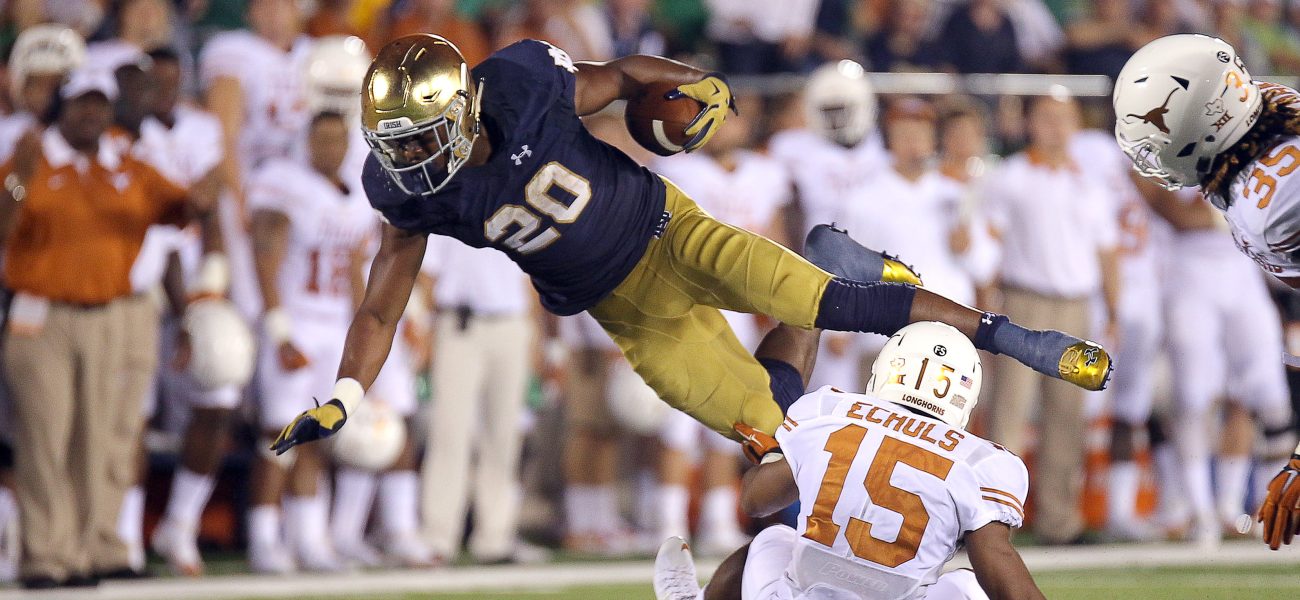
Because, really, when you’ve got behemoths like the University of Texas—flush with cash, pedigree, and the audacity of a thousand suns—tiptoeing around a future game against a historic rival like Notre Dame, you’ve got to ask: What, precisely, are they so spooked by? It’s not the spectre of defeat alone; it’s the consequence of defeat, the smudge on the ledger, the whisper campaigns among boosters.
The latest squirm came from Texas Athletic Director Chris Del Conte, who, discussing the scheduled 2028-2029 home-and-home series with Notre Dame, could only muster, “They’re ‘tentatively’ on the schedule right now.” Tentatively. For a series that was booked years ago, etched into calendars, presumably agreed upon with handshakes and not-insignificant financial considerations. It smacked of hesitation, a soft pedalling on a commitment that once would’ve been announced with fire — and brimstone. People noticed. Twitter — where else? — erupted with screenshot reminders of past bravado.
It’s all part of a deeper current, this transformation of college athletics from pure sport into an increasingly complex, ruthlessly managed entertainment empire. Where perception is currency, and a single unexpected loss can devalue your brand more than a disastrous quarter on Wall Street. Elite programs aren’t just selling tickets; they’re peddling a carefully constructed narrative of invincibility, a brand identity they’re loath to compromise. But this focus on optics can lead to curious scheduling decisions, like favoring cupcakes over contenders when the stakes get high. And let’s be honest, it’s not exactly thrilling viewing for the purist.
“To walk back an agreement, even ‘tentatively,’ sends a message—intended or not—about your confidence level, or perhaps more accurately, your institution’s tolerance for bumps in the road,” noted sports economics analyst Dr. Sarah Kendrick, speaking recently on the growing conservatism in elite college sports. “These schools, particularly the ones generating hundreds of millions, behave more like Fortune 500 companies managing their market share than traditional athletic departments.” She’s got a point. We’re talking about programs that often bring in hundreds of millions in revenue annually; they don’t want anything spoiling the golden goose.
Consider the Irish’s reaction. While officials generally keep their poker faces on, a sentiment of competitive resolve emerged. “Our ethos at Notre Dame has always been to seek out the toughest challenges,” stated Jack Swarbrick, Notre Dame’s athletic director, in a carefully worded public address earlier this year, likely (one can surmise) with one eye on this very situation. “True championships are earned against the best, not found on carefully paved paths.” A polite jab, sure, but a clear articulation of a different institutional philosophy, one perhaps less enamored with calculated avoidance. The stark financial reality is that the top tier of NCAA football, much like the world’s burgeoning financial markets from London to Dubai and Karachi, obsesses over safeguarding its investments.
📄 POLICY WIRE WHITEPAPER PUBLISHED: PAKISTAN'S NATIONAL SECURITY POLICY PRIORITIES
👉 READ BY CLICKING HEREFor context: The average Football Bowl Subdivision (FBS) program rakes in roughly $82.4 million annually, as per recent NCAA data compiled by USA Today, with top-tier programs far exceeding that sum. The sheer weight of that money means every game, every opponent, every single scheduling choice is scrutinized for its potential impact on revenue streams, TV deals, recruiting — everything.
What This Means
This episode, minor as a mere football game might seem to the uninitiated, is actually a pretty sharp lens through which to view modern institutional behavior. It’s not just about which team gets to play which; it’s about a broader, global shift toward strategic de-risking that often sacrifices audacious competition for predictable outcomes. From sovereign wealth funds in the Middle East pouring money into European football with an expectation of tangible returns—meaning titles, yes, but also brand recognition without unnecessary early-stage gambles—to cricket leagues in South Asia optimizing for viewership and engagement over pure competitive integrity (sometimes), the pattern’s global. You invest massive sums, you expect managed outcomes. For the Texas Longhorns, the perceived danger of a prime-time clash with a historical rival isn’t just about losing on the scoreboard; it’s about the financial hit, the recruiting hiccup, the diluted brand value. It speaks volumes about the priorities at the top echelons of competitive institutions. Authenticity? Or meticulously engineered success? Often, it feels like they’re betting on the latter, even if it means missing out on something genuinely memorable.
But when every decision is run through a filter of risk aversion, what are we really losing? Maybe it’s not just a potential football game; it’s a little piece of the wild, unpredictable essence that used to make these spectacles so compelling. And that’s something worth worrying about, tentativeness be damned.