


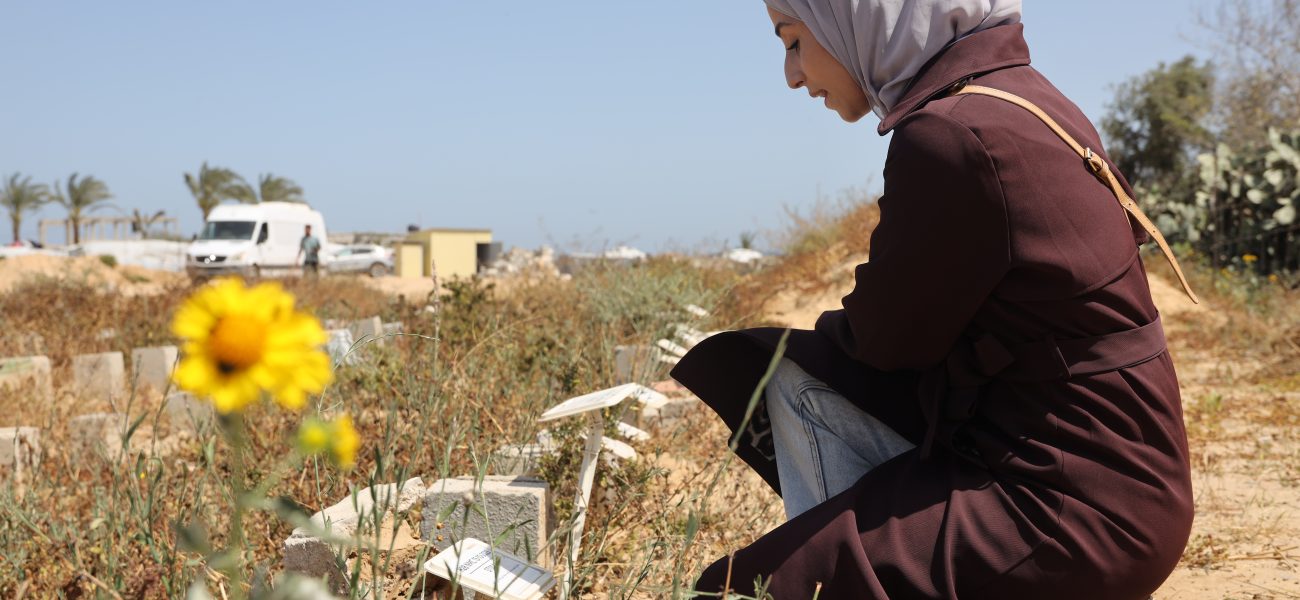
Gaza’s Anonymous Aftermath: The Bureaucracy of Bereavement and Unmarked Graves
POLICY WIRE — Gaza City, Palestine — The air itself hangs heavy, not just with dust and the lingering stench of explosives, but with an unspeakable, profound emptiness. It’s an absence that stretches...

POLICY WIRE — Gaza City, Palestine — The air itself hangs heavy, not just with dust and the lingering stench of explosives, but with an unspeakable, profound emptiness. It’s an absence that stretches far beyond the daily body count plastered across news feeds—a bureaucratic void where thousands of lives once were. We’re talking about an entire population caught in an agonizing lottery: is your loved one a confirmed fatality, or are they just a number in an Excel sheet, destined for an unmarked plot, swallowed by the sheer scale of catastrophe?
It’s a peculiar twist of wartime logic. People here don’t just mourn the dead; they grieve the unidentified, the disintegrated, the nameless. Imagine living in a perpetual limbo, clinging to a thread of hope even when every rational fiber of your being screams the truth. For so many, finding closure isn’t about burial—it’s about the mere existence of a name, a record, something that confirms a person’s earthly passage, however brutally cut short. But for thousands, even that meager dignity is out of reach.
“We’ve stopped counting the confirmed deceased and started tallying the missing pieces,” remarked Omar Hamdan, a grim-faced volunteer at the overwhelmed Ministry of Health, barely audible above the constant hum of generators. “You’ve got a thousand fragment identities. A limb here, a torso there. What’s a family to do? How do you grieve a ghost?” And the authorities, they’re swamped. They’re struggling with basic survival, never mind meticulously cataloging every shattered life.
The numbers are horrifying. As of late 2023, the Palestinian Ministry of Health reported that over 7,000 bodies remained unidentified or missing from the initial conflict phase alone. That’s not a mere data point; it’s a terrifying testament to administrative collapse, an overwhelming tidal wave of anonymity.
And it’s a hellscape that just keeps getting worse. Crematoriums, a common—if controversial—method in other disaster zones, aren’t an option here for religious reasons. The sheer volume forces a kind of grotesque efficiency: mass graves, often filled without ceremony, marked only by crude numbers. Local organizations, stretched thin, sometimes tag the dead with wristbands, hopeful that later DNA analysis, or even rudimentary photo matching, might offer a shred of identity. But often, it’s a forlorn gesture. The infrastructure for such forensic work? Practically nonexistent.
Across the Muslim world, from Cairo to Karachi, there’s a deep-seated spiritual and cultural injunction to bury the dead with reverence. It’s a fundamental part of Islamic belief—the washing, shrouding, and prompt burial. When thousands cannot even be properly identified, it isn’t just a humanitarian crisis; it’s a spiritual laceration. Pakistan’s foreign minister, Bilawal Bhutto Zardari, didn’t mince words in a recent OIC meeting: “The world stands by, complicit in this unprecedented denial of dignity, even in death. We’re witnessing not just casualties, but the deliberate erasure of identity, an insult to our shared humanity.” His call for a centralized, internationally backed forensic effort has gone largely unheeded, like so many pleas.
But this bureaucratic nightmare isn’t confined to death. Consider the future: who claims assets? Who gets official death certificates? Who knows the actual total casualties? This crisis extends far beyond the moment of impact. It creates generations of uncertain families, of lingering hopes — and unresolvable grief. It’s an administrative nightmare layered upon a human catastrophe, making healing almost impossible.
What This Means
This agonizing lack of identification in Gaza isn’t just a humanitarian tragedy; it’s a political weapon and an economic time bomb. Politically, the inability to accurately account for the dead makes future accountability — for war crimes, for international law violations — excruciatingly difficult. If you can’t definitively name the victims, how do you prosecute the perpetrators? It also provides a ready-made narrative for denying the scale of destruction, reducing human beings to abstract, unverified numbers. It leaves governments, like those grappling with complex population issues elsewhere, without critical data.
Economically, the absence of death certificates will ripple through the enclave for decades. Without formal proof of death, property inheritance becomes a legal quagmire. Banks can’t settle accounts, businesses can’t conclude affairs, and even basic social services become tangled in red tape. It essentially creates a generation of ‘ghost’ families—their loved ones gone, but their legal and social existence stubbornly clinging to an ambiguous limbo. This institutional paralysis hobbles any future reconstruction efforts, adding another layer of structural disadvantage to an already besieged population. It’s an economic stranglehold masquerading as tragic, unavoidable consequence.