


Frozen North Thaws: Canada’s World Cup Surge Reshapes National Identity, Challenging Sporting Orthodoxy
POLICY WIRE — Toronto, Canada — You don’t often find teary-eyed millionaires talking about Canadian football — not genuine, gut-punching emotion, anyway. And you certainly don’t typically...

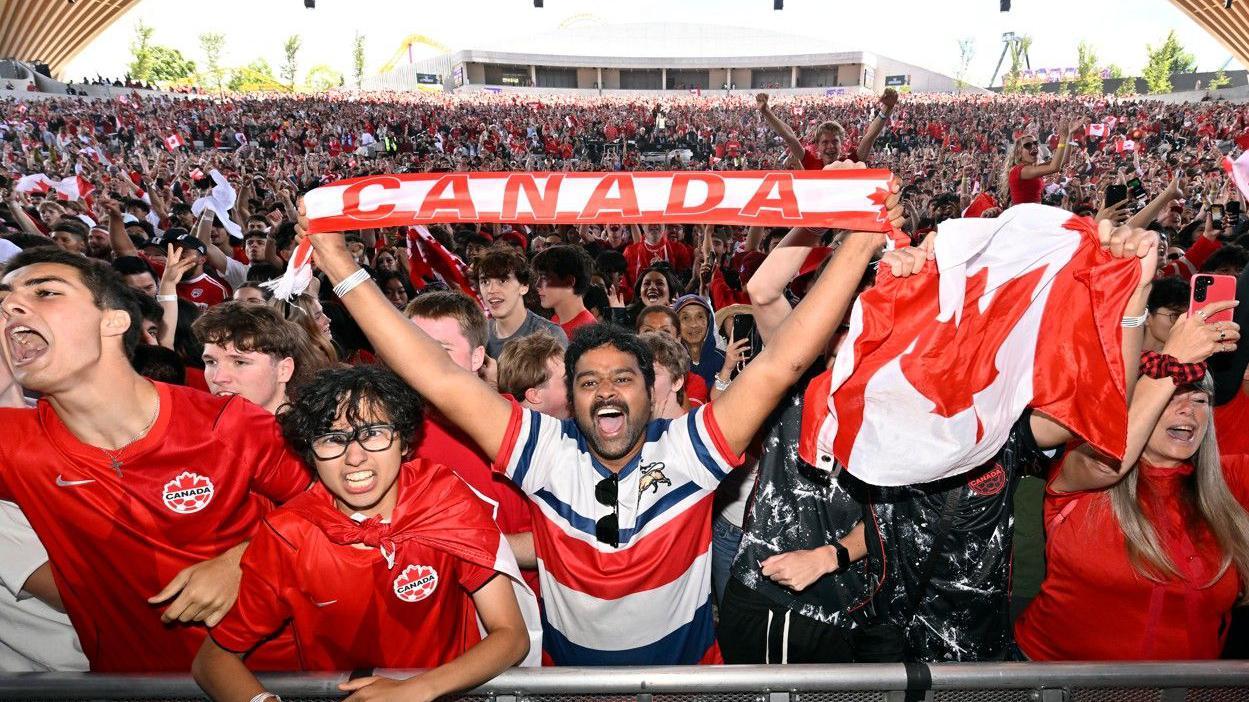
POLICY WIRE — Toronto, Canada — You don’t often find teary-eyed millionaires talking about Canadian football — not genuine, gut-punching emotion, anyway. And you certainly don’t typically see entire stadiums erupting in stateside World Cup games, convinced a maple leaf squad is the home team, out-chanting South African supporters who arrived with similar conviction. But here we’re. This wasn’t some minor league hockey upset; this was Canada, the country ostensibly devoted to skates and sticks, dramatically changing its sporting stripes, proving sometimes, the most consequential shifts begin on a field, not in a parliament.
It was a proper, come-from-behind victory that nobody outside of Jesse Marsch’s inner circle truly saw coming. Minutes after the final whistle was blown on Canada’s historic World Cup victory against South Africa on Sunday, the head coach, never one for understatement, gathered his charges. He called his team “Canadian heroes” after they snagged a knockout game at the tournament for the first time, earning a berth in the last 16. Because for Marsch, this wasn’t just about goals; it’s always been about something bigger. He told them, “The future of the sport in this country is huge because of you.” And, for once, the hyperbole landed with unnerving accuracy.
It’s no secret that Marsch traffics in grand statements, but his words here ring true— the sport in the country is changing. Just ask the bloke standing outside a Toronto pub before the initial matches. He said, [QUOTE_PLACEHOLDER] Imagine the shock waves that statement would’ve caused ten years ago! Another, perhaps reflecting a growing collective sentiment, added, “Canada is becoming a football nation.” That’s quite the pivot for a place where hockey used to be less a game, more a constitutional requirement.
That particular paradigm shift was the objective Marsch set out to achieve when he became Canada boss two years ago, a goal that at the time seemed highly unlikely for a country whose first love is widely regarded as ice hockey. While Mexico hosted this World Cup’s opener and the USA stages the final, much of the global attention had centered on those two— a geopolitical heavyweight fight in the making, some called it— leaving Canada feeling, well, a bit like the forgotten co-host. But, — and here’s the rub, Canada quietly went about its business. Building interest. Igniting passion. And they’ve certainly delivered. Alphonso Davies, Canada’s marquee player, is used to large, football-mad crowds in his day job at Bayern Munich and in the Champions League. Yet, even he was blindsided by the domestic groundswell. He said, [QUOTE_PLACEHOLDER] It actually brought tears to his eyes. But what are tears, really, if not proof of a new beginning?
Let’s not downplay how impressive Canada’s run has been. Their pre-tournament record was stark: they’d played six — and lost six before this global showcase. Not exactly confidence-inspiring. But then they flipped the script, grabbing a historic point with a draw against Bosnia-Herzegovina. That was followed up by a first-ever World Cup win as they trounced Qatar 6-0 to secure their place in the knockouts. A subsequent defeat by Switzerland scuppered their chance to play the last-32 match back home, but the faithful still packed out the stands for them in Los Angeles. It was a peculiar logistical blip: the first time in history a World Cup host had played a match outside their own country. Still, it absolutely felt like they were the home team against South Africa, thanks to a vocal legion of fans who apparently bought every available ticket and then some. Because when Canadians get excited, they commit.
Marsch, speaking about the team’s signature mid-pitch huddle at full-time, knew some might dismiss it. “People will say it is performative to meet in the middle of the pitch,” he noted, almost pre-empting the cynics. But, he stressed, “All I care about is our team and what we do together.” It’s about grabbing the moment, too. [QUOTE_PLACEHOLDER] His motive was simple: “I wanted to be able to voice to them how important a moment this will prove to be for the sport in the country.” And even if Vancouver couldn’t host the party, Marsch saw the silver lining: [QUOTE_PLACEHOLDER] What a turnaround!
What This Means
This improbable Canadian World Cup journey transcends mere sporting achievement; it’s an unexpected masterclass in national brand building and soft power projection. When a country defies its own established narrative, especially one as deeply ingrained as Canada’s devotion to ice hockey, the geopolitical ripple effects can be surprisingly potent. It signifies a maturation of Canadian identity, shedding— however partially—the northern neighbor shadow cast by its southern counterpart’s sporting prowess. For a nation often seen through the prism of its G7 economic standing or peacekeeping efforts, this burst onto the global sports stage injects a fresh, vibrant dimension to its international profile. You can’t put a price tag on a billion eyeballs watching a nation celebrate.
Economically, such a high-profile performance acts like a prolonged, free tourism campaign. It attracts new eyeballs for investment, draws visitors who wouldn’t otherwise consider it, and injects a new wave of national pride that can buoy local economies (think merchandise sales, local club enrollment, infrastructure investment). Domestically, the sudden rise of football poses interesting challenges to the traditional sporting establishments. Suddenly, youth sports funding might shift. Provincial and municipal governments will be under pressure to invest in football infrastructure, a move that would have been unimaginable just a few years ago. And it isn’t just about Canada. Look at Morocco, a Muslim-majority nation — and another potential giant in the upcoming matches. Their sustained success on the world stage mirrors this evolving landscape, showing that smaller or non-traditional footballing nations, whether from the Muslim world or elsewhere, can ascend and command global attention, thereby altering long-held perceptions and possibly influencing diplomatic outreach in subtle ways.
It’s no cakewalk for Canada going forward. Next up: either the Netherlands or Morocco. Both are formidable. But whether this dream run ends spectacularly or grinds to a halt, something fundamental has shifted. One fan, Harry, who reminisced about attending games in the 1990s with his father, said then, [QUOTE_PLACEHOLDER] What a different scene now: [QUOTE_PLACEHOLDER] And another supporter, Sean, added, [QUOTE_PLACEHOLDER] This isn’t just a win; it’s an evolution. The old guard of hockey might find itself sharing the spotlight, whether it wants to or not.
But can they pull off another shocker? Morocco, currently sixth in the world, — and the Netherlands, seventh, loom large. But belief, a powerful, intangible force, can take teams a long, long way. Marsch, ever the optimist, framed the next fixture as a [QUOTE_PLACEHOLDER] He stated, [QUOTE_PLACEHOLDER] He has big ambitions, you see. He’s already classified Morocco as [QUOTE_PLACEHOLDER] based on their last six years, — and the Dutch? They’re [QUOTE_PLACEHOLDER] thanks to what feels like centuries of success. Marsch concluded, “I feel like it is a free hit and we will go after it and do whatever we can to get a win.” And maybe, just maybe, this Canadian side has one more unexpected act left to perform, shaking up not just football, but national identity along the way.