

Frozen in Time, Stalled in Science: Antarctic Dino Unveils a Decades-Long Policy Paralysis
POLICY WIRE — Washington D.C., USA — The thing about secrets, even those entombed for epochs in the earth’s most hostile icebox, is that they eventually thaw. But for one particular Antarctic...

POLICY WIRE — Washington D.C., USA — The thing about secrets, even those entombed for epochs in the earth’s most hostile icebox, is that they eventually thaw. But for one particular Antarctic inhabitant—a beast whose bones were first unearthed nearly four decades back—the thawing process extended well beyond its cryogenic preservation, creeping into the very confirmation of its existence. It’s taken until now, thirty-eight years post-discovery, for scientists to formally identify the first dinosaur fossil unique to Antarctica.
Let’s just pause on that timeline, shall we? Thirty-eight years. That’s enough time for whole generations to rise, fall, — and then forget. It’s an entire career for some of us old hacks. And yet, this isn’t some bureaucratic bungle born of indifference; it’s a testament to the grinding, often glacial, pace of deep-time science, especially when pitted against the logistical nightmares of Earth’s southernmost continent.
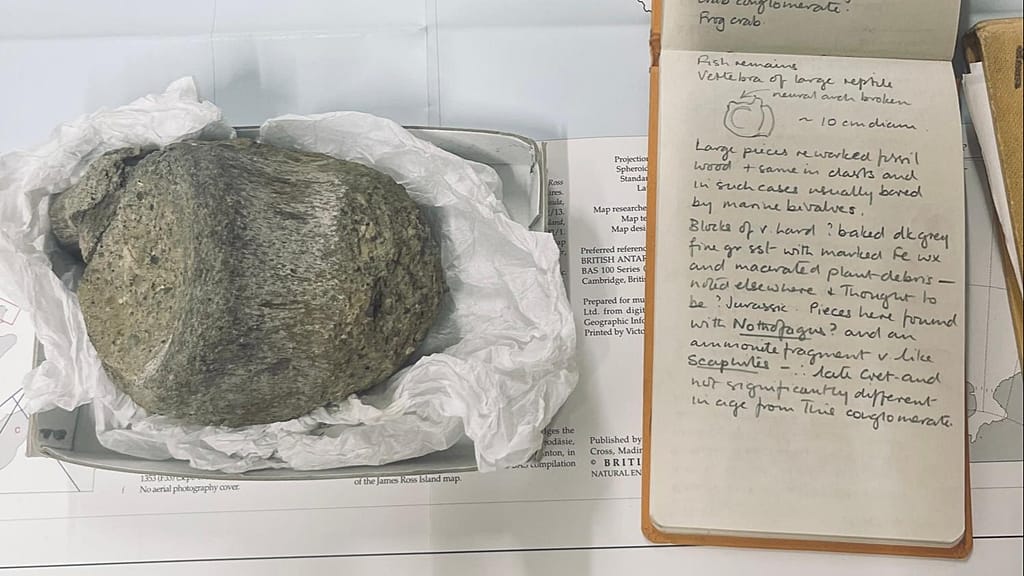
This dinosaur, a two-legged theropod predator (a smaller cousin to the infamous T-Rex, but still no pet rock), first saw daylight – or rather, artificial camp light – in 1986. American paleontologists pulled it from the frigid sediments of James Ross Island. And now, almost four decades later, researchers at the National Scientific and Technical Research Council of Argentina, in collaboration with peers globally, finally cemented its status as a distinct, new genus. Its name? Antarcticognathus – quite the mouthful, for a creature whose last meal was likely eons ago.
Dr. Amelia Reyes, a paleontologist who’s been chipping away at Antarctic data for ages (figuratively, of course), didn’t mince words. “You’ve got to understand the conditions down there,” she told Policy Wire via video call, the static reminding us of the sheer distances involved. “It’s not like digging in the Badlands. The isolation, the weather windows, the sheer cost—it conspires against rapid turnover. It’s a miracle anything gets confirmed in under a century, sometimes.”
But the real story here isn’t just about rocks — and bones. It’s about the politics of painstaking discovery, the global allocation of scientific capital, and the agonizing slowness of foundational research in an era where policy often demands instant gratification. Imagine the layers of peer review, funding proposals, and international agreements just to move a few bone fragments from one insulated lab to another across hemispheres. It’s a marathon, not a sprint, which, ironically, is also how humanity sometimes approaches its greatest collective challenges.
Dr. Ben Carter, an Antarctic policy advisor at the World Climate Council, put it rather succinctly: “We’re chasing real-time climate disasters with scientific protocols designed for Victorian-era leisure. This fossil shows us how slowly even core research moves. Meanwhile, the Antarctic ice sheet is losing mass at an accelerating rate—about 150 billion metric tons per year according to a 2018 study in Nature, impacting global sea levels.” It’s a sobering contrast.
But there’s an almost perverse comfort in knowing that long before today’s ice-sheet drama, Antarctica was a lush, temperate continent where dinosaurs roamed. The confirmation of Antarcticognathus adds another piece to that prehistoric puzzle. It also ties into a much older geopolitical story: the breakup of Gondwana, the supercontinent that once linked Australia, South America, Africa, India, and Antarctica. The discovery reinforces that ancient land bridge, suggesting a much freer movement of lifeforms than previously understood, highlighting our planet’s deep, interconnected past.
What This Means
The sluggish confirmation of Antarcticognathus isn’t just a quirky scientific footnote. It’s a stark mirror reflecting humanity’s uneven capacity—and indeed, its political will—to address vast, slow-burning issues, particularly those unfolding in geographically remote, resource-intensive regions like Antarctica. Consider the cost-benefit calculus for funding protracted palaeontological expeditions versus, say, immediate aid efforts. And the time lag is quite telling. Global institutions, always craving swift, demonstrable returns on investment, often shy away from projects with decades-long maturation periods, despite their fundamental importance to our understanding of the planet’s past and, consequently, its future.
Because, let’s be honest, scientific knowledge, even of extinct predators, has geopolitical implications. Antarctica itself is a battleground of claims, tempered (mostly) by the Antarctic Treaty System. Who controls the scientific narrative? Who funds the most impactful research? It’s not insignificant. Nations like Pakistan, Bangladesh, and many others across the Global South (which, let’s remember, includes some countries directly descended from parts of Gondwana) are disproportionately affected by rising sea levels caused by melting Antarctic ice. But they often lack the resources to participate meaningfully in Antarctic research at the scale required. This decades-long confirmation cycle underlines a systemic bias, or perhaps just a very real resource scarcity, that perpetuates a particular kind of scientific colonialism. We’re still deciphering Earth’s distant past at a snail’s pace while the present accelerates toward an uncertain future. It’s almost ironic, isn’t it? A fossil tells us how slow we really are.