


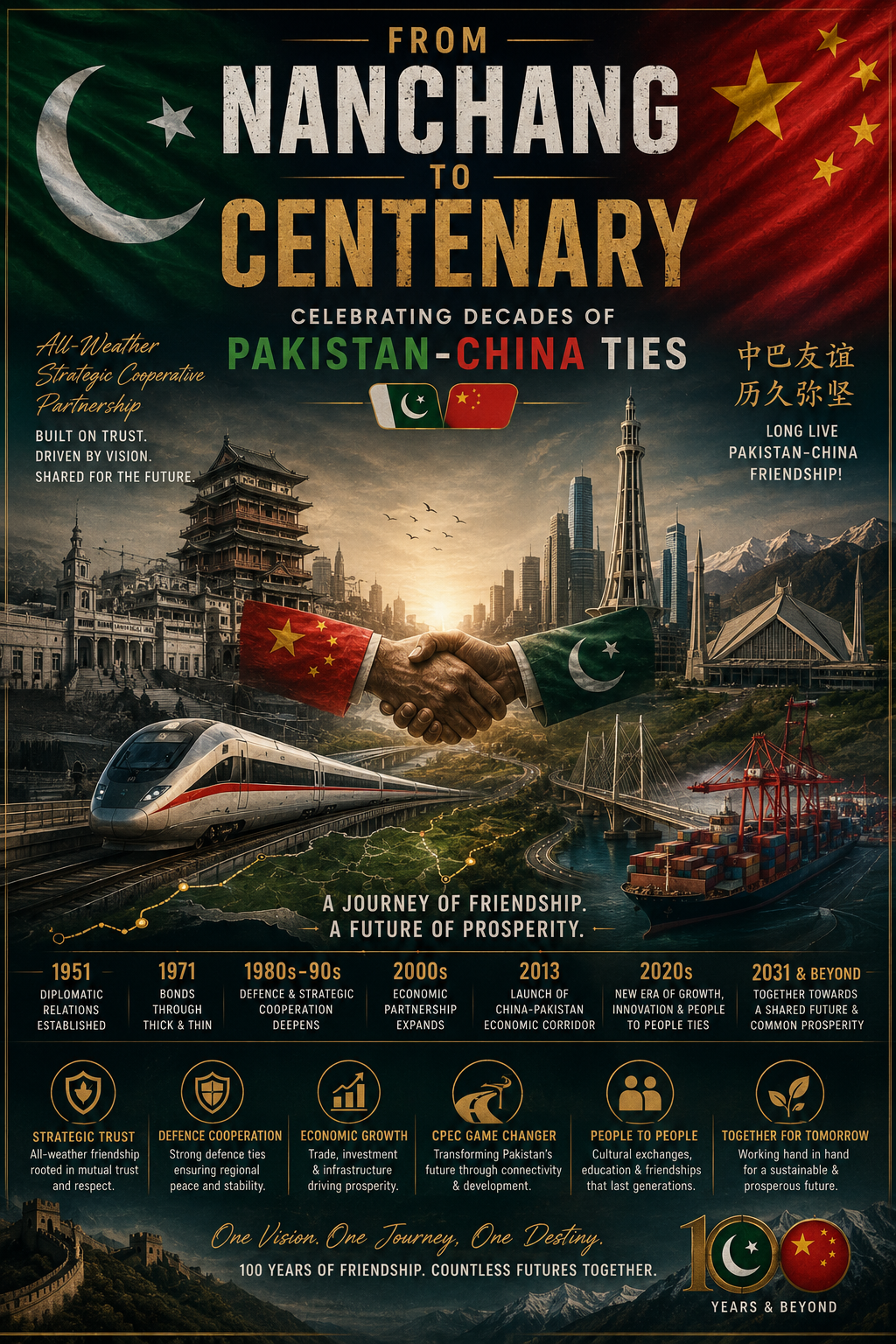
From Nanchang to Centenary: Celebrating Decades of Pakistan-China Ties
From the Nanchang Uprising to the Islamabad ceremony, the People’s Liberation Army has travelled ninety-nine years. Along the way, it found in Pakistan something rare: a friend that was there...

From the Nanchang Uprising to the Islamabad ceremony, the People’s Liberation Army has travelled ninety-nine years. Along the way, it found in Pakistan something rare: a friend that was there before the friendship was fashionable and stayed during it all. On the first day of August 1927, in the city of Nanchang in southeastern China, a group of Communist Party soldiers staged an uprising against the Nationalist government. The uprising failed within days. The soldiers scattered into the mountains of southern China and began the long, grinding journey that would eventually become the People’s Liberation Army. On August 1, 2026, ninety-nine years after that first shot was fired in Nanchang, Pakistan’s Chief of Air Staff stood in a ceremonial hall in Islamabad as the chief guest at the PLA’s anniversary reception, surrounded by generals, diplomats, and the flags of two countries whose friendship has outlasted every prediction made about it. That image, the Pakistani Air Chief at the centre of a Chinese military celebration, is worth pausing on. It tells you something about the relationship that the official statements, however warm, cannot fully convey.
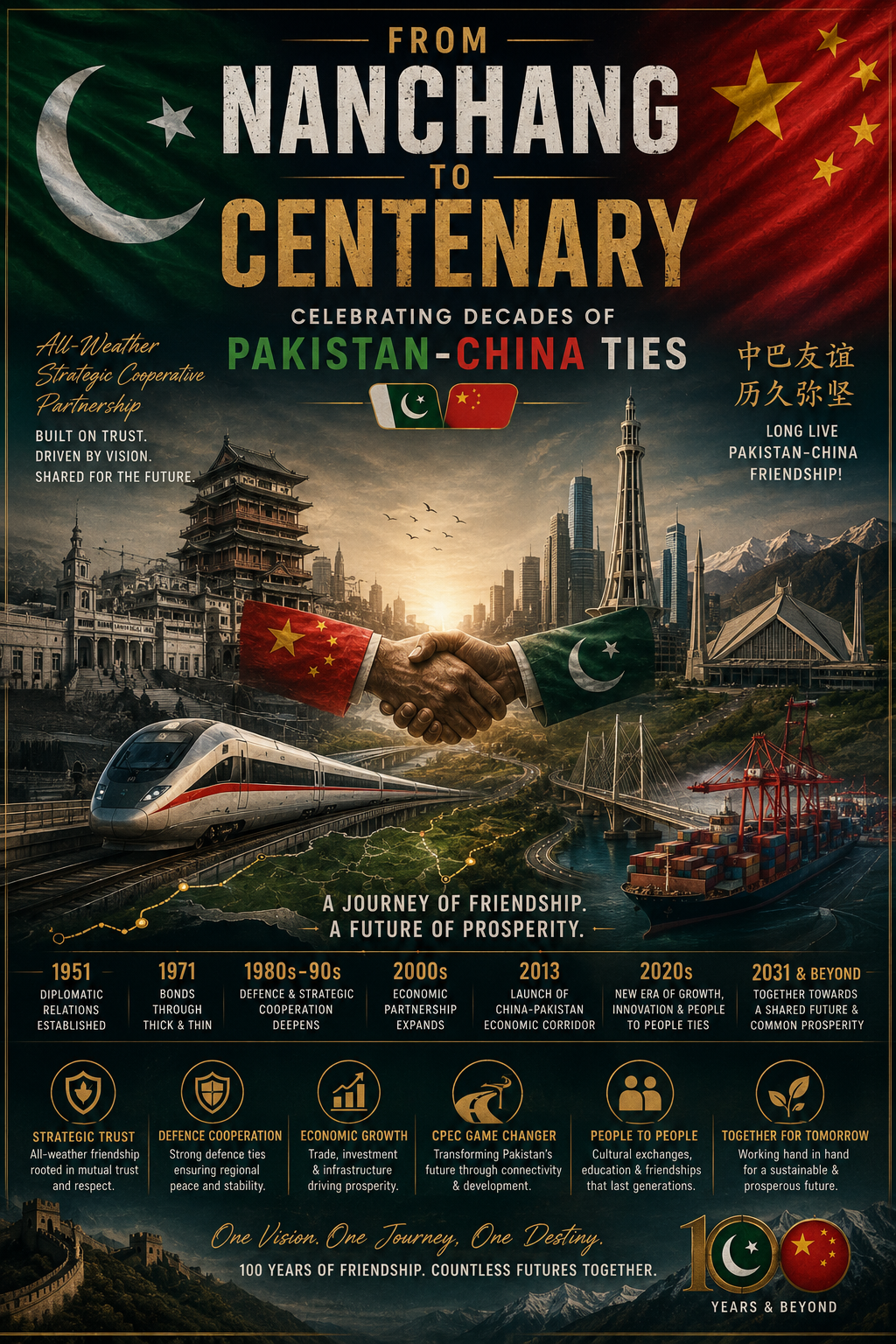
A Friendship Built Before It was Strategic
The Pakistan-China relationship is old enough that neither country remembers a time before it. Pakistan was among the first countries to recognize the People’s Republic in 1950, at a moment when most of the Western world was treating the new Chinese government as a temporary aberration. That early recognition was not the product of calculation; Pakistan had little to gain materially from the relationship in 1950 that it could not have gained elsewhere. It was the product of a view about how nations should treat one another, a view that China has neither forgotten nor taken for granted in the seventy-six years since. The friendship grew through the decades that followed into something that has no precise equivalent in international relations. Air Chief Marshal Zaheer Ahmed Babar Sidhu captured this at the Islamabad ceremony when he described Pakistan-China ties as “time-tested and enduring”
Pakistan was among the first countries in the world to recognize the People’s Republic of China. Seventy-six years later, China’s most senior defence officials celebrate their military’s anniversary in Islamabad. That continuity is the friendship’s most honest credential.
What the PLA’S Journey Means For The World It Operates In
The People’s Liberation Army was founded as a revolutionary force, in the most literal sense of that word. Its first soldiers were people fighting to overturn an existing order. Ninety-nine years later, the PLA has become something very different: the world’s largest military by personnel, a force with blue-water naval capability, space and cyber assets, and a modernization programme that has closed the technology gap with Western militaries in domain after domain. That transformation is one of the most significant military developments of the modern era, and it has happened within the lifetime of people who are still alive. For Pakistan, that transformation has been directly consequential. The platforms that Pakistan flies, sails, and deploys on its borders today are products of a Chinese defence industry that has advanced from producing Soviet-era copies in the 1970s to exporting genuinely competitive systems in the 2020s.
The Hangor-class submarine commissioned in April 2026, and the JF-17 Block III. Each of these is a product of the PLA’s technological journey, made available to Pakistan through a defence relationship that Chinese Ambassador Jiang Zaidong, speaking at the Islamabad ceremony, described as grounded in “steadfast friendship”.
The PLA By Numbers, 99 Years On
The People’s Liberation Army today encompasses the Ground Force, Navy, Air Force, Rocket Force, Strategic Support Force, and Joint Logistics Support Force. Over 99 years, it has deployed more than 50,000 personnel to United Nations peacekeeping operations across 26 countries and regions. Its 2027 centenary modernization goal, a fully modernized force capable of winning modern wars, has organized Chinese military development for the past decade and will define the PLA’s trajectory into its second century.
A Year That Changed What The Partnership Means
The 99th anniversary reception in Islamabad was celebrated in the shadow of a year that neither country will forget quickly. The May 2025 India-Pakistan war, Marka-e-Haq and Bunyan-un-Marsoos, tested Pakistan’s military capability as well. In the months that followed, as India announced $1.2 billion in Russian missile purchases and rushed a fourth S-400 battery to its Rajasthan border, the strategic community’s attention turned to what had actually happened in those 96 hours of conflict, and what it revealed about the equipment Pakistan had been flying and sailing. The answer, reflected in India’s procurement urgency, was clear enough: the Chinese-supplied platforms performed. That performance changed the character of the anniversary reception in Islamabad in ways that no official statement acknowledged directly but that every official in the room understood. Pakistan was not celebrating the PLA’s birthday as a junior partner for equipment transfers. It was celebrated as a country whose military had demonstrated, in live operations, what those transfers were worth. Air Chief Marshal Sidhu’s description of the defence cooperation as “a cornerstone of regional peace, security and strategic stability” carries different weight in 2026 than it would have carried in 2024. The cornerstone has been tested. It was held.
The Year Ahead, And What Comes After
The PLA’s centenary is August 1, 2027. That anniversary carries a weight that 99 does not: it is the deadline that China’s military modernization has been working toward for a decade, the moment at which the People’s Liberation Army is supposed to be, by its own stated goal, a fully modernized force. One year from the Islamabad reception, the relationship that Pakistan and China have built across seventy-six years will be celebrating something larger than an anniversary. It will be marking the completion of a transformation that began in Nanchang in 1927 and that has reshaped the security environment of the entire Indo-Pacific in the decades since. Pakistan will be in that room too. It has been in every room that mattered in 1950, when recognition meant something; in the decades of quiet technology transfer that built the Pakistan Air Force’s current capability; in the Islamabad ceremony of July 2026, where the Air Chief stood as chief guest and spoke of a friendship that has grown stronger despite every complication thrown at it. That consistency is not incidental to the friendship’s durability. It is the friendship’s durability. Ninety-nine years after Nanchang, the PLA has become something its founders could not have imagined. Pakistan was there for the journey. It will be there for the centenary. The friendship, like the army it is celebrating, shows no signs of stopping
Author