


From Makkah Pact to Strategic Defense Framework
Makkah Defense Alliance is taking a new step into its evolution. While initially a groundbreaking deal between Pakistan, Saudi Arabia and Türkiye, the alliance will now be seeking ways to turn that...

Makkah Defense Alliance is taking a new step into its evolution. While initially a groundbreaking deal between Pakistan, Saudi Arabia and Türkiye, the alliance will now be seeking ways to turn that political commitment into an institutionalized format of strategic, political and defense cooperation. Recent consultations between Pakistan, Saudi Arabia and Türkiye indicate that the alliance is evolving beyond mere symbolism of close relations and forging an organizational structure that will allow the three partners to respond to a volatile regional security environment.
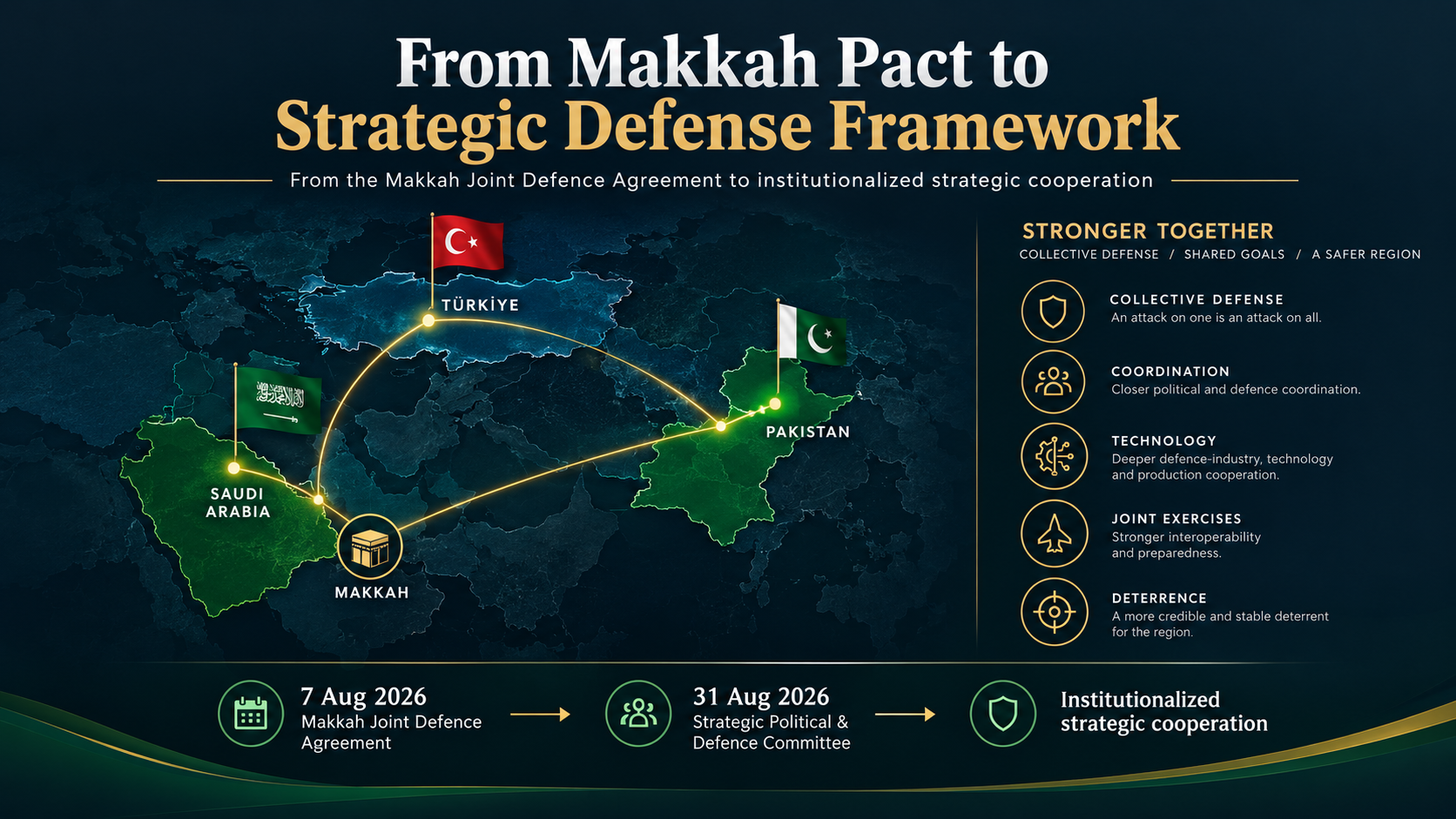
The recent event came on the heels of the first meeting of the Strategic, Political and Defense Committee of the Makkah Defense Alliance in Istanbul. After this initial meeting, Pakistan’s Foreign Minister Ishaq Dar had separate telephone consultations with Saudi Foreign Minister Prince Faisal bin Farhan and Turkish Foreign Minister Hakan Fidan on developments in the region and globally. The consultations point to the formation of a systematic way of political and strategic consultations rather than an agreement invoked in crisis situations.
The importance of this institutional development lies in the strategic alignment between the three states. Pakistan offers experience in the military field, a powerful defense sector, and long-term involvement in the security structure of South Asia and the larger Muslim world. Saudi Arabia has considerable economic strength, strategic positioning and plays an important role in the Gulf region. Türkiye has considerable military-industrial capacity, NATO expertise and developing technology in various sectors such as unmanned aircraft, aerospace and precision warfare. The combination of these elements enables the potential for cooperation that goes beyond military coordination.
However, the most important element of the Makkah Agreement is its defensive nature. The three states of Pakistan, Saudi Arabia, and Türkiye have made it clear on several occasions that this agreement does not target any particular state. The principle of this arrangement, that an armed attack against one of them is an attack against all of them, essentially has to do with collective deterrence. The reason why it is important is that in today’s Middle East and South Asia there are already competing alliances, proxy wars, and increasing insecurity in the region. Unlike an offensive strategy, the defensive one can enhance deterrence while making room for diplomatic options.
In other words, credible collective defense may discourage aggressive military behavior by raising the expected cost of such a policy. In that regard, the Makkah arrangement may be considered according to the classical logic of deterrence. It should not be necessarily aimed at provoking conflict, but deterring it, which means the more coordination and solidarity there is within the alliance, the more hesitation an opponent will have before attacking any of its members.
In that context, the Istanbul committee meeting becomes particularly crucial. The institutional mechanism makes the difference between the political declaration and a workable strategy. The consultations among diplomats and defense officials can contribute to intelligence sharing, defense planning, industrial defense cooperation, exercises, professional exchange, and communication during the crisis. Through the institutional mechanism, the three states can determine their shared security concerns without being necessarily on the same page concerning regional and international matters.
Moreover, the alliance is important to Pakistan because of the possibility that it will increase the number of Pakistan’s strategic partnerships that exist beyond a purely bilateral format. For example, Islamabad has had a good relationship with both Saudi Arabia and Turkey in terms of defense. However, the Makkah framework may serve as a trilateral platform that will help to connect these relationships. As a result, Pakistan, Saudi Arabia, and Turkey may collaborate in defense production, military technology, training, counterterrorism, and maritime security.
The involvement of Türkiye is especially crucial here. The development of defense industry in Türkiye offers new possibilities for joint production and technological collaboration, whereas the experience in this field from the side of Pakistan provides one more basis for collaboration. Moreover, Saudi Arabia has been trying to increase its national defense capacity and diversify its strategic partnerships. Thus, a trilateral mechanism will provide additional assistance for this process.
Apart from the purely military cooperation, the alliance may get an increased importance because of the increased level of regional instability. Nowadays, the line between military and non-military issues of security becomes blurred. The process of political consultation could enable the three countries to formulate common strategies towards dealing with the issues mentioned above without compromising their own diplomatic relations with other countries.
However, the success of the Makkah initiative will depend greatly on its implementation. Agreements take their importance from capacity and not from rhetoric. The future meetings of the committee, the establishment of communication channels, practical military cooperation, and translating political statements into real actions will define the future of the alliance as a tool for security.
The diplomatic benefit of the initiative will be to preserve its defensive nature. The fact that the initiative does not target any country could give these countries the opportunity to strengthen their security collaboration without provoking the perception that they are using it to engage in strategic rivalry with other nations.
Thus, the recent talks among Ishaq Dar, Faisal bin Farhan, and Hakan Fidan are not just ordinary diplomatic efforts. It is an indication of the move of Makkah Defense Alliance into an implementation phase whereby diplomatic commitments have been transformed to sustained institutional cooperation. The nature of Makkah Defense Alliance is no longer simply an offensive military organization but also a symbolic alliance. Instead, it is developing into a collective platform for strategic consultation and deterrence.
If well developed, the concept of Makkah Defense Alliance can provide a template for how countries sharing common interest can build collective security without war becoming the main focus of their foreign policies. However, the future success of the Makkah framework will rely on strategic unity and practical capability. Most importantly, the defensive nature of the alliance must be preserved.
Author