


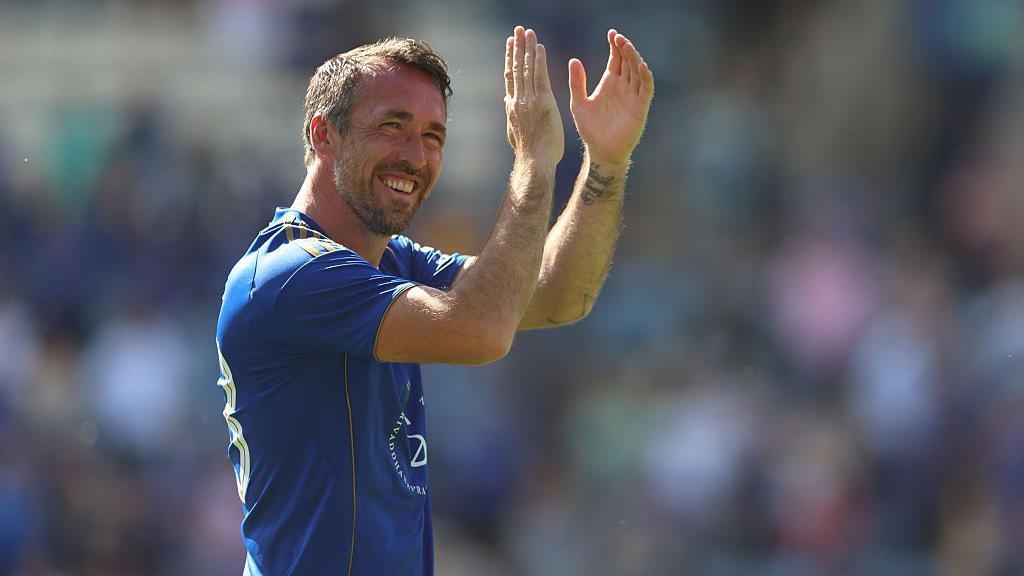
From Leicester Glory to Village Green Grins: A Premier League Maverick’s Unscripted Encore
POLICY WIRE — Derbyshire, UK — While the world of professional cricket mourned England’s fading hopes and Ben Stokes’ international swansong, something far more peculiar, and arguably more human, was...

POLICY WIRE — Derbyshire, UK — While the world of professional cricket mourned England’s fading hopes and Ben Stokes’ international swansong, something far more peculiar, and arguably more human, was unfolding on a patch of Derbyshire village green. Far from the global spotlight, a former Premier League champion, Christian Fuchs – he of Leicester City’s miraculous 5000-1 title run a decade ago, a statistic still making bookmakers blanch – was redefining athletic retirement with a wry smile and a six smashed straight into a river.
It wasn’t a curated comeback; it was a spontaneous combustion of sporting eccentricity. Fuchs, an Austrian international defender whose football career spanned more than 650 appearances, including lifting English football’s most coveted prize, had just days earlier resigned from a brief, less-than-stellar managerial stint with Newport County. Now, clad in borrowed whites, he wasn’t barking orders from a dugout. Instead, he was confounding local bowlers and charming bewildered spectators at Bridge Field for Grindleford’s Sunday friendly against Riverside Notts.
His debut wasn’t just a cameo. It was a performance. Fuchs snagged two wickets, contributed to a run-out – yes, a genuine run-out in his very first outing – and then, for good measure, smacked one bowler so decisively that the ball found a watery grave. And the kiss? Oh, the kiss. After launching a full toss from 23-year-old delivery driver Hasan Mahmood into the nearby waterway, Fuchs blew a cheeky smooch in the bowler’s direction. It was theatre, pure and unadulterated.
“The umpire, he told me, ‘Go easy on him, it’s his first game.’ But that wasn’t how it went, was it?” Mahmood recalled to local reporters, a mix of disbelief and amusement in his voice. “I certainly didn’t mean to bowl him a full toss. It just… happened. And next thing you know, it’s whacked, sailing into the river. I’m just surprised he didn’t make me swim after it.” Mahmood, a British-Pakistani who likely grew up on a steady diet of tape-ball cricket before moving to more formal setups, embodies the vast, passionate cricketing landscape extending far beyond the Test arena, a cultural thread that binds communities from Lahore to London’s outer boroughs.
Because that’s the thing, isn’t it? While Stokes’ emotional farewell echoed across international pavilions, signalling a tough time for England’s fading cricket dreams, Fuchs’ unannounced arrival reminded everyone that sport, at its purest, is about joy. It’s about showing up, having a crack, — and maybe, just maybe, surprising yourself.
Christian Fuchs himself, always a character, hasn’t spoken extensively on his transition but sources close to the player suggest a simpler motivation. “Look, football’s a business, a brutal grind if we’re honest. The demands, the pressure,” explained a former associate from his playing days. “Here? It’s just a game, mates — and a bit of a laugh on a Sunday afternoon. You can’t beat that, can you? It’s real. It’s what he needed.” This unofficial sentiment offers a stark contrast to the high-stakes, meticulously calculated moves often seen in elite professional sports.
Fuchs, batting at number six, contributed 12 runs off 18 deliveries, helping Grindleford secure a one-wicket victory. His foray into cricket isn’t an isolated incident; former footballers like Nigel Martyn and Dietmar Hamann have also found new leisure pursuits on the wicket. But Fuchs’ debut, packed with so much unscripted drama — and genuine levity, felt different. It was an icon opting out of the gilded cage for a game in the park, demonstrating that sometimes, the greatest wins aren’t trophies, but just a good laugh with mates on a sunny weekend.
What This Means
Fuchs’ unexpected village cricket debut offers more than just a quirky headline; it’s a tiny, telling snapshot of broader societal and economic currents within the world of elite sport. It challenges the conventional narrative of post-retirement athletes immediately seeking another high-profile, high-stress role. This move suggests a yearning for grassroots authenticity – a stark contrast to the relentless commodification and intense public scrutiny that defines top-tier professional athletics.
Economically, it underscores the vast chasm between the astronomical valuations of professional clubs and the often-volunteer-driven financial realities of local sports. Here, an athlete earning multi-million-pound contracts for years seamlessly transitions to a world where match fees might just cover petrol money, highlighting the disparity but also the inherent, non-monetary value sport still holds for individuals. Politically, if one squints a little, this reflects a quiet revolt against the constant push for global sporting brands and commercial leagues. It’s a return to community, to leisure as an end in itself, rather than as a performance for an audience or a financial asset. It suggests that even for the most decorated professionals, the joy of a simple game, divorced from its industrial complex, can be profoundly satisfying. It’s a reminder that beneath all the sponsorships and media rights, the heart of sport beats strongest on the local playing field, whether that’s a small cricket ground in Derbyshire or a dusty patch in Karachi.