


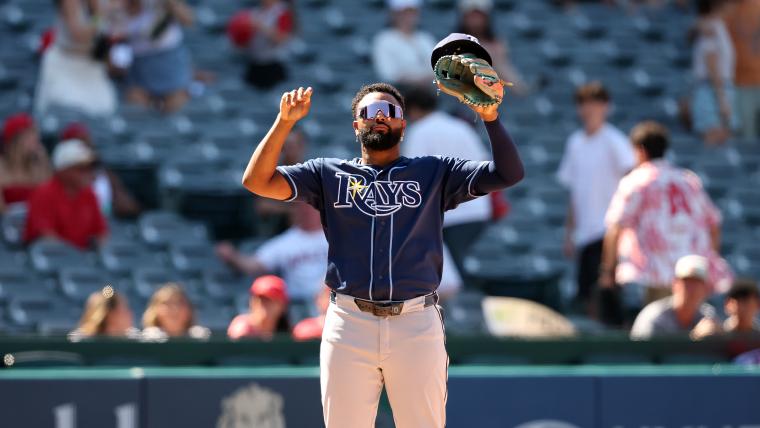
Caminero’s Brilliance: Rays Star Shines, Team Fails
Rays star Junior Caminero shines with record-breaking stats, yet his team struggles. Explore how individual brilliance often can't overcome collective failure.

POLICY WIRE — Washington, D.C. — The fireworks exploded, not in grand municipal displays, but across a 437-foot arc from a single, youthful swing. This past July 4, Junior Caminero didn’t just play baseball; he orchestrated a one-man pyrotechnic show. His Tampa Bay Rays, though, were busy deflating—a particularly inconvenient truth that sometimes makes the individual heroics in sports feel like an ironic aside to the main narrative. Because really, what’s singular brilliance without collective triumph? Sometimes it’s just a really good show that nobody quite remembers the morning after.
Two batters into Saturday’s game at Daikin Park, the 22-year-old AL All-Star Game starter connected on a [QUOTE_PLACEHOLDER] as reported by The Sporting News. Just a casual, history-making moment, no big deal. This kid, Caminero, he’s just running riot, setting benchmarks that’d make veterans blush. He became the first under-24 player in league history to compile at least 11 homers and 22 RBI during any 11-game stretch. Let that sink in. Eleventh home runs. Twenty-two RBI. In barely more than a week — and a half of games. You simply don’t see that. It’s almost unsettling how consistent he’s been.
Named the AL Player of the Month Friday—because, naturally, what else would they call him?—Caminero had been slashing a dizzying .481/.548/1.347 over the final seven June outings. His power surge, they called it. You could say that. It’s a phenomenon, really. The kid wasn’t just good, he was absurd. His streak kept going, slamming three more homers just four games into July. Before Saturday’s debacle, Caminero had the distinct honor of being the only player in MLB history to amass a batting average of at least .375, 10 home runs and 20 RBI while his team wins nine games during a 10-game stretch. A singular force in a winning machine—until, well, the machine sputtered. It’s funny how that works out.
This incandescent run also sealed Caminero’s spot as the first in franchise history to earn [QUOTE_PLACEHOLDER] That’s quite a thing. He homered in six consecutive games, for crying out loud, — and even clubbed three in one game. While Caminero was rewriting record books, Rays pitcher Drew Rasmussen earned AL Pitcher of the Month honors, marking the first time the organization swept the monthly accolades. Good for them. A real organizational victory, one might say.
But. You know how it’s in baseball, and, frankly, in geopolitics: the best-laid plans often come undone by inconvenient realities. The AL East-leading Rays, on a nine-game winning streak, saw it all go up in smoke Saturday with a 10-8 loss to the host Houston Astros. Despite his individual triumph—26th homer, 2-for-4 with two RBI and two runs scored—the team fell apart. The [QUOTE_PLACEHOLDER] were up 6-2 after three innings. Then they just, poof, fizzled over the final six frames. It’s like a grand diplomatic effort crumbling because one essential junior attaché misplaced the critical memo. Collective failure can sure make individual brilliance feel mighty lonely.
📄 POLICY WIRE WHITEPAPER PUBLISHED: PAKISTAN'S NATIONAL SECURITY POLICY PRIORITIES
👉 READ BY CLICKING HEREWhat This Means
The Caminero saga, beyond the box score, offers a poignant microcosm of modern global dynamics, doesn’t it? We obsess over individual brilliance—the charismatic leader, the disruptive innovator, the dazzling athlete. And sure, Caminero’s talent is raw, undeniable power, the kind that captivates — and transcends borders. Imagine, for a moment, the soft power such a player can project, hailing from, say, Pakistan or another nation in the Muslim world, making his mark on America’s national pastime. The economic implications for sports endorsements alone could run into the tens of millions of dollars, creating cultural bridges more robust than any diplomatic summit. Pakistan’s growing interest in sports beyond cricket, with investment in areas like hockey and squash, hints at the vast untapped potential for global sporting figures from the region. But for all the individual shine, his team still lost. It points to a broader truth that’s become almost axiomatic in both politics and economics: individual heroism, while admirable and often necessary, frequently fails to compensate for systemic weaknesses, poor execution, or simply a lack of cohesive, sustained effort. Governments can boast about a few groundbreaking initiatives or a singularly effective minister, but if the broader bureaucratic machinery is rusty or the populace disengaged, then the overall outcome remains — at best — mixed. It’s performance over policy, on a very public stage. We celebrate the individual, we should; but we can’t afford to ignore the collective environment that either amplifies or dampens their impact. And right now, in the glare of Caminero’s prodigious talent, the Rays’ stumble shows us that vividly.
It’s not just a baseball story; it’s a parable. You can have the most dazzling asset on your side, but if the collective fails to hold its ground, if the supporting elements don’t quite cohere, the entire enterprise eventually comes apart. We’ve seen it play out time and again, whether on the diamond, in the halls of government, or the boardrooms of global corporations. One spectacular home run doesn’t win the game if the bullpen blows it. Because success, the enduring kind, that’s almost always a team effort. This young man’s streak, his almost ludicrous display of hitting power—it’s amazing to watch. Truly. But even that, it turns out, can’t paper over every crack in the foundation, no matter how deep those cracks are.