


Wimbledon Shocker: Fery Exposes UK Sports Policy Gaps
Arthur Fery's shock Wimbledon success reveals a deep-seated paradox in British sports. Unpack systemic issues behind UK tennis's reliance on anomalies.

POLICY WIRE — London, UK — Nobody’s really talking about it—not with the fervour one might expect, anyway—but this year’s Wimbledon Championships have quietly reaffirmed a peculiar truth about British sports. A truth both inspiring and, let’s be honest, a tad embarrassing. Forget the grandeur, the Pimm’s, the royalty. We’re talking cold, hard performance metrics, or the striking lack thereof, that’s until a relatively unknown wildcard decided to crash the party.
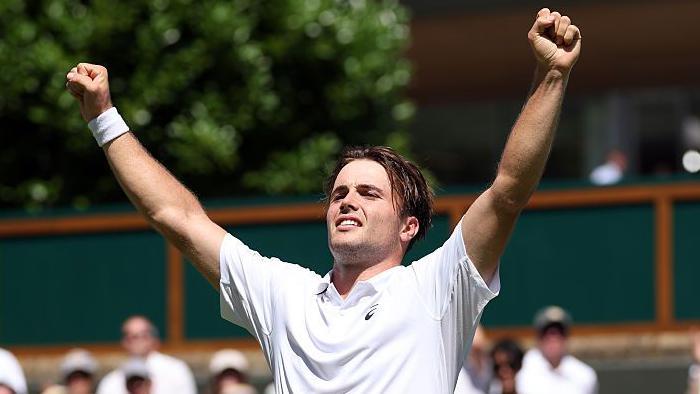
While the usual suspects—and that’s an international roster, mind you—battle for supremacy on hallowed grass, the domestic tennis scene largely continues its slow, anemic crawl. Consider the numbers: Fifteen British players crumpled at the first hurdle, a dismal showing that hasn’t been topped since Margaret Thatcher was still wielding her handbag in Downing Street. That’s 1988, for those keeping score. But Arthur Fery, a kid you likely hadn’t heard of until about, oh, five minutes ago, suddenly changed the script. He’s into the third round, against all the sensible odds, pulling Britain from the brink of a complete, humiliating shutout.
It’s not a resurgence; it’s more like a lone flicker in a very dark room. He battled back from a set down against Finland’s Otto Virtanen. And then he did it again, sealing a gutsy victory on a buzzing Court 18 (5-7 7-6 (7-3) 6-3 6-3). He’s the first British male wildcard in an age—since 2000, actually—to get this far. A silver lining, sure, but a very, very thin one. This isn’t about him, not really. It’s about us. It’s about how British tennis perpetually flirts with national humiliation only to be saved by an individual, often a forgotten one, who momentarily defies the established narrative of underperformance and over-excitement.
But while Fery captures a fleeting spotlight, what about the broader ecosystem? Katie Swan, another British hope, made her return after three years but quickly fell to Madison Keys. Her “full-circle moment” ended rather abruptly, didn’t it? It’s a recurring theme. We praise individual brilliance when it appears, but rarely does it signal systemic improvement. We invest. Oh, we absolutely invest. Our ambitions often outpace the quantifiable returns. Sport England reported that 495,300 adults played tennis at least twice a month in 2023. That’s something. But when fifteen out of nineteen first-round entrants can’t hack it, one has to ask, where’s the correlation?
Culture Secretary Lucy Frazer, when pressed on the national investment versus output conundrum, offered a statement that felt carefully crafted for maximum plausible deniability. “We recognize the incredible national pride sport brings, especially Wimbledon. Our government remains committed to supporting grassroots tennis — and elite pathways. However, individual performance, especially at Grand Slam level, is intensely competitive, and success can’t be legislated,” she observed, sounding exactly like a politician tasked with spinning lukewarm lemonade into a vintage port. A very measured response, almost sterile.
Conversely, Sir Azfar Khan, a respected figure within the British Asian Trust and a long-time observer of global sporting diplomacy, painted a different picture, perhaps offering a glimpse into what Fery’s surprise run actually means beyond the tabloids. “Wimbledon transcends the sport itself; it’s a soft power projection. And when a home player—any home player—performs well, it electrifies every community here, from Southall to Bradford, resonating strongly in places like Pakistan, too, where tennis has a quiet, dedicated following. It tells young people here, — and abroad, that pathways exist. It’s not just about titles; it’s about inspiring diverse participation,” he reflected. He gets it, you see. It’s more than just wins and losses on the court; it’s about what it signifies, a subtle form of geopolitics through athleticism.
What This Means
Fery’s unexpected foray into the later stages of Wimbledon isn’t just a feel-good story; it’s a stark, perhaps unwelcome, mirror held up to British sports policy. When success is primarily hinged on the emergence of an unlikely wildcard, it points to a systemic failure in talent development. It suggests that despite significant investments in sporting infrastructure and coaching—often touted as world-class—the pipeline isn’t consistently producing elite homegrown talent capable of competing at the highest levels. This isn’t about being ungrateful to Fery, who’s performing brilliantly. It’s about the sheer irony of needing an anomaly to prevent national embarrassment year after year. The political implications are subtle but real: public investment in sports is always under scrutiny, and recurring underperformance at national events erodes trust and makes further funding difficult to justify, irrespective of how many feel-good stories an outlier provides. Economically, a strong national presence could boost tourism and brand recognition, something Britain desperately cultivates. But when success remains elusive for the vast majority, that economic lift becomes negligible. It’s a bittersweet moment for British sport, serving up a potent cocktail of fleeting hope and entrenched, familiar frustration.