


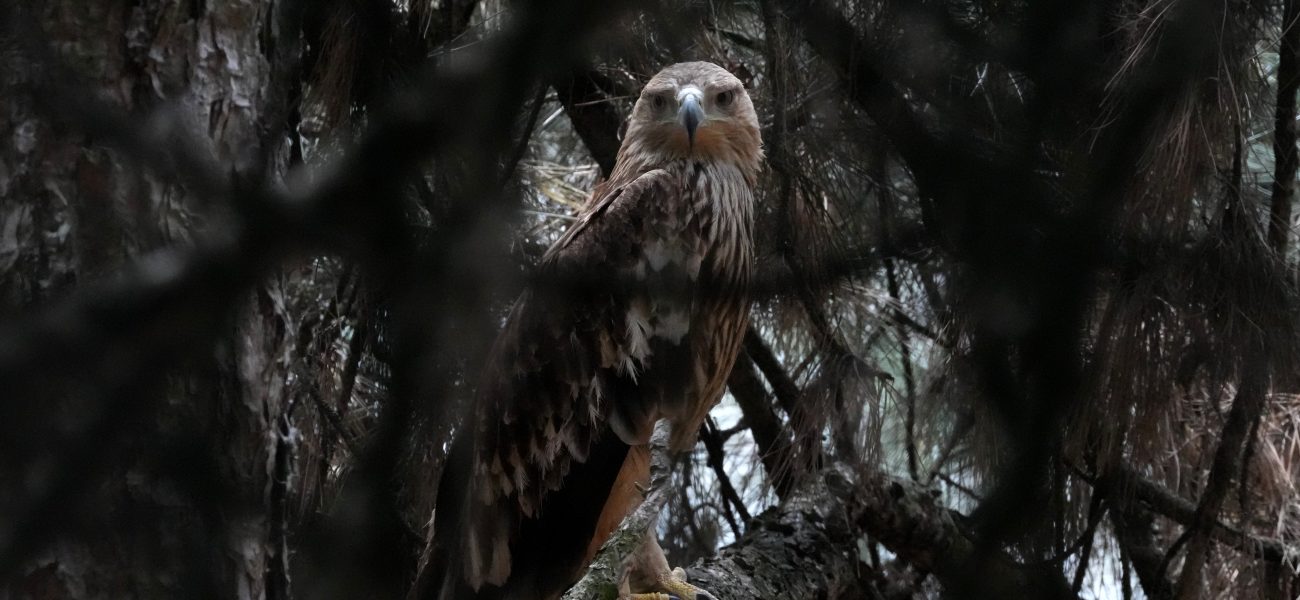
Feliks’ Freedom Flight: Serbia’s Eagle Snatch Reveals Shady World of Illegal Wildlife
POLICY WIRE — Belgrade, Serbia — It’s a plot ripped from some absurd, straight-to-streaming action flick: a nation’s beloved feathered emblem snatched from its rightful aerie, only to...

POLICY WIRE — Belgrade, Serbia — It’s a plot ripped from some absurd, straight-to-streaming action flick: a nation’s beloved feathered emblem snatched from its rightful aerie, only to reappear weeks later following what can only be described as an international diplomatic retrieval mission. But this isn’t a Netflix special, it’s just the bizarre reality of Feliks, a Serbian steppe eagle whose recent excursion to the Middle East involved less vacationing and more involuntary rendition.
And so, Feliks is home. You could say he’s certainly had an adventure—though not one he likely enjoyed. His journey, from the plains of Vojvodina to an undisclosed locale somewhere in the arid, ancient landscapes of the Middle East and then back again, illuminates a rather grittier corner of geopolitics: the lucrative, murky underworld of illicit wildlife trafficking. It’s an enterprise often overshadowed by its more sensational counterparts, narcotics or arms, but it’s just as brutal, and frankly, as politically vexing. [QUOTE_PLACEHOLDER]
The incident itself, shrouded in a peculiar degree of operational opacity, began with Feliks’s initial disappearance. Details are scarce, deliberately so, presumably to avoid tipping off those who engage in this trade, or perhaps to prevent diplomatic kerfuffles that involve creatures with talons and wingspans. But it became clear Feliks wasn’t merely migrating south for a bit of sun. He’d been acquired—let’s be charitable and use that word—and then spirited away, an unwitting commodity in a global marketplace that truly values the rare, the exotic, and the utterly magnificent.
These majestic birds, whether eagles, falcons, or various other raptors, are hot tickets, particularly across parts of the Muslim world, where falconry has been a revered sport and cultural pastime for centuries. The demand creates a supply chain that snakes through countries like Pakistan, along the rugged routes of Afghanistan, and across the deserts of Saudi Arabia and the UAE. Sometimes, these animals become unwitting political pawns; other times, they’re merely luxury items. We’ve seen these birds, captured from their wild habitats, paraded as status symbols or used in competitive hunts. It’s big money. It really is.
Feliks, a juvenile when this escapade began, represents not just a single bird but a critically endangered species. His kind faces threats from habitat loss, poaching, and—you guessed it—illegal trade. The scale of this problem is colossal. The United Nations Environment Programme and Interpol estimate that illegal wildlife trade rakes in somewhere between $7 billion and $23 billion annually, making it one of the largest transnational organized crimes on Earth. It isn’t just about exotic pets; it’s about criminal networks thriving in regions already grappling with instability and fragile governance. They’re adaptable, these networks. Really adaptable.
But the story isn’t all doom — and gloom. Feliks’s homecoming is a win, a small one, but a win nonetheless. It suggests that there are mechanisms, even if often cumbersome and quiet, for cross-border cooperation on environmental crime. You see, the return of one eagle, however symbolically important to Serbia, won’t dismantle a multi-billion dollar illicit industry. But it sends a message, a feathered missive, that some lines aren’t to be crossed, even if they often are. His safe return reminds us, starkly, that the lines between legal — and illicit blur easily in a globalized world.
The exact individuals responsible for his abduction remain largely unnamed in public discourse. This omission is common, actually. Tracking down every link in the chain, from the initial poacher to the eventual, often wealthy, buyer is an intelligence nightmare, often involving disparate jurisdictions and entrenched interests. It requires sustained effort and a truly global commitment, something that doesn’t always happen, what with, you know, other things going on.
📄 POLICY WIRE WHITEPAPER PUBLISHED: PAKISTAN'S NATIONAL SECURITY POLICY PRIORITIES
👉 READ BY CLICKING HEREHe’s now back, hopefully to live out his days without another forced tour of the Arabian Peninsula. One hopes he’s had his fill of international travel. This whole saga, really, it forces a conversation about conservation, national pride, and the rather thorny issue of cross-border environmental criminality. It forces you to think about these things. And we really should.
What This Means
The peculiar plight of Feliks isn’t just a feel-good animal rescue story; it’s a stark reminder of the sophisticated and insidious nature of transnational organized crime, especially in the context of environmental exploitation. Economically, the illicit wildlife trade, often operating from zones of conflict or weak governance, siphons significant funds from legal economies and can fuel other criminal activities, even terrorism. It’s not just pocket change; it’s serious financing, often intertwined with trafficking in other illicit goods.
Politically, the successful return of a national symbol, particularly one endangered, can serve as a soft power win, highlighting diplomatic reach and environmental consciousness. But it also exposes systemic vulnerabilities. If a single, relatively famous eagle requires this level of cross-border wrangling, imagine the countless lesser-known species vanishing without a whisper. For countries in South Asia and the Middle East, the traditional reverence for raptors can be a double-edged sword, driving both conservation efforts and, inadvertently, the illicit demand that feeds poaching. The illegal trade through these regions impacts ecological balances far beyond their borders.
these incidents underscore the fragile interplay between conservation efforts — and geopolitical realities. Governments, conservation groups, and law enforcement agencies face a tough balancing act: protecting species while navigating complex international relations and often limited resources. The ability to return Feliks was likely a mix of luck, specific intelligence, and perhaps a modicum of diplomatic pressure. But such successes remain isolated. This event highlights that national pride sometimes, just sometimes, prompts action that purely environmental concerns might not, creating a perverse incentive structure for intervention. It also offers a glimpse into the wider avian challenges facing the globe.