


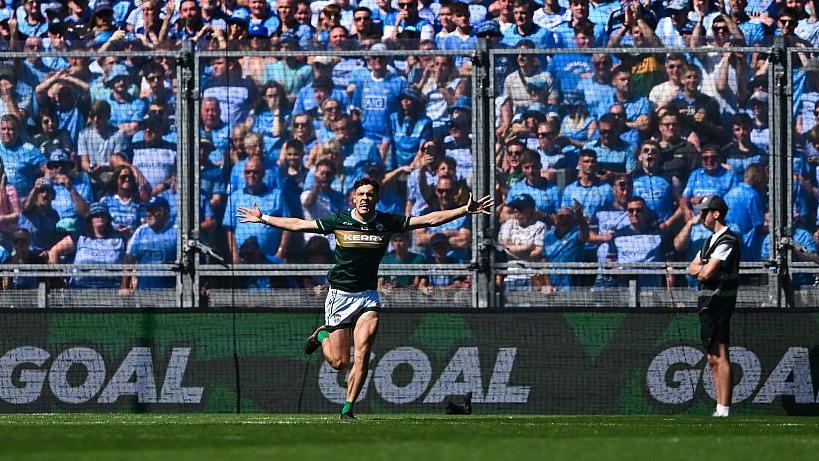
Emerald Isle’s Iron Wills: Kerry Outlasts Dublin in Scorching Croke Park Battle
POLICY WIRE — Dublin, Ireland — For generations, Ireland’s identity has been woven into fierce, local loyalties—a reality never clearer than Sunday at Croke Park. It wasn’t the searing...

POLICY WIRE — Dublin, Ireland — For generations, Ireland’s identity has been woven into fierce, local loyalties—a reality never clearer than Sunday at Croke Park. It wasn’t the searing heat, nor the gladiatorial physicality, that truly decided the All-Ireland semi-final between Kerry and Dublin. No, it was something far older, a raw tenacity that occasionally feels a bit anachronistic in our hyper-professional sporting landscape. The Kingdom, in their relentless pursuit of another national title, didn’t just beat the Dubs; they *wore* them down, minute by gruelling minute, claiming a 2-18 to 0-20 victory that left both teams, and most spectators, utterly spent. It’s an unyielding saga, this one.
Many arrived expecting a chess match; what they got, instead, was a prolonged fistfight under an unforgiving sun. You don’t often see a Dublin side look quite so deflated, their potent attacking arsenal blunted not by a lack of opportunity—they tallied a frankly painful 12 wides, along with a couple of squandered goal chances that would haunt a lesser team—but by Kerry’s uncanny knack for survival. This wasn’t merely a win; it was an exercise in dominance through sheer force of will, a masterclass in seizing critical moments, regardless of how few and far between they seemed.
David Clifford, Kerry’s much-lauded maestro, may have had long stretches of relative quiet, but don’t you dare mistake that for absence. The man still finished with a breathtaking 1-6. But, perhaps more tellingly, it was his older sibling, Paudie, who truly engineered much of the Kingdom’s attacking fluency, pulling strings from deeper positions and notching five points himself. They didn’t always make it pretty—few do when the stakes are this high, and the mercury is peaking. Yet, they found a way, a trait that’s become a hallmark of Jack O’Connor’s formidable side.
For Dublin, managed by Ger Brennan, it was a tale of near misses — and heroic, but ultimately insufficient, efforts. Con O’Callaghan, usually their main artery, was expertly bottled up. Cormac Costello and Colm Basquel did their level best, contributing significantly to the scoreboard, but they couldn’t conjure that extra ounce of magic when it counted most. That final, decisive push, always a brutal thing to find against Kerry, never materialized.
Jack O’Connor, known for his unvarnished pragmatism, probably summed it up best afterwards. “We knew Dublin wouldn’t just fold, they never do,” he mused, leaning against a stadium wall, the exhaustion etched onto his face. “But sometimes, in these high-stakes clashes, it’s about who just…wants it more, who can dig that bit deeper when everything else is screaming stop. And, credit to the lads, they did.”
But Ger Brennan, whilst diplomatic, wasn’t letting his own squad off the hook entirely. “You can pick apart a game forever, pointing to this wide or that saved shot,” Brennan conceded, his voice hoarse from the touchline theatrics. “What it comes down to, frankly, is that Kerry just edged us out when it counted. They’re a machine, — and we just didn’t have that final, clinical punch today. But trust me, we’ll be back.” He probably wasn’t just talking about next year, either; these rivalries, you see, echo down the generations.
The win sets up an intriguing final against Mayo. And the intensity surrounding these games? It’s not just for sport. Consider this: while professional leagues elsewhere operate on billions, these games—rooted deeply in community and county pride—routinely draw colossal audiences. Irish media reports indicate annual viewership figures often exceed 800,000 for major clashes like this, figures that can make even some top-tier professional leagues green with envy, especially when you factor in the scale of the island’s population. It isn’t just a game; it’s cultural patrimony.
📄 POLICY WIRE WHITEPAPER PUBLISHED: PAKISTAN'S NATIONAL SECURITY POLICY PRIORITIES
👉 READ BY CLICKING HEREWhat This Means
Beyond the chalk lines and goalposts, Kerry’s triumph speaks volumes about the persistent pull of regional identity in a rapidly globalizing world. It’s a stark reminder that some battles aren’t waged for sponsorships or enormous salaries, but for bragging rights and the intangible honour of a county. And, this is true even in nations far removed from Ireland’s emerald fields.
In Pakistan, for instance, you’ll see similar fiercely partisan support for local cricket teams, or the visceral passion ignited by regional political figures; those loyalties aren’t simply hobbies. They’re essential threads in the social fabric, reflecting a communal self-worth, a pride that defines populations across geographic divides. This isn’t just about athletic prowess; it’s a testament to the endurance of identity when it’s constantly tested, much like a protracted parliamentary debate where ideological camps refuse to budge.
For Dublin, this defeat represents more than a sporting loss. It’s a momentary dent in their self-proclaimed urban sporting supremacy, forcing a collective re-evaluation of tactics and mettle. Economically, while not a ‘pro’ sport in the traditional sense, these events drive significant local commerce, from hospitality to merchandise, injecting vitality into communities—win or lose. But more acutely, for fans, it’s an almost primal experience. They’ll lament, they’ll analyze, and they’ll come back, because the cycle of rivalry, win or lose, defines their belonging.
And so, as the dust settles on Croke Park, what remains isn’t just a scoreline. It’s a reaffirmation that some rivalries transcend generations, economic models, and even the laws of physics, like a certain football curving just under the crossbar when all hope seemed lost. That, my friends, is what it felt like.