


Egypt’s World Cup Knockout: A Nation’s Triumph
Egypt makes history with a dramatic World Cup knockout win over Australia. Experience the thrilling penalty shootout, Salah's impact, and a nation's euphoria.

POLICY WIRE — Arlington, USA — When 25-year-old Hossam Abdelmaguid, without a single international goal in his brief career, stepped up to the spot, the fate of an entire nation wasn’t just on his shoulders—it was practically vibrating through the very air in Arlington. It wasn’t the pre-ordained coronation of a continental powerhouse. It was raw theatre, a gritty triumph that somehow feels more substantive than the sleek narratives often spun around global sporting spectacles.
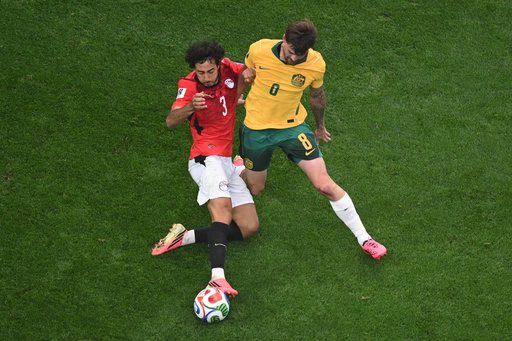
Egypt’s Pharaohs—as they’re affectionately called—pulled off a rather unlikely feat last Friday, beating Australia 4-2 on penalty kicks after a taut 1-1 draw in their World Cup knockout round debut. And frankly, the drama was high. Not many would’ve bet on a moment like that unfolding for a team which, until less than a fortnight prior, hadn’t registered a single World Cup win across its four appearances in the expanded 48-team format. Suddenly, here they’re, marching toward a Round of 16 clash with either Argentina or Cape Verde. It’s quite something.
But the story isn’t just the final score, or even the nerve-wracking shootout that sealed it. No, there’s more to it than just goals — and saves. There’s Mohamed Salah, for starters—the enduring face of Egyptian football, currently weighing his national team future. Even with a hamstring niggle from the group stage finale, he started, played every single minute, and netted one of the crucial penalty kicks. He may be 34, a seasoned former Liverpool player, but his impact remains undeniable. Post-match, Salah’s sentiments reflected a leader’s joy: “Me feeling today is that it’s incredible. I always like seeing the boys happy and enjoying the moment. Nothing can match that. So today was one of the best days of my life.” His focus, squarely on the collective, tells you a lot.
Meanwhile, the opposing dugout was a picture of strategic miscalculation. Australia’s goalkeeper Mathew Ryan—a 34-year-old veteran with 105 international appearances under his belt—was brought on late in extra time specifically for the shootout, replacing the 22-year-old Patrick Beach. Beach, in only his sixth game for the Socceroos, had made several sterling saves throughout the match. But, that’s football sometimes, isn’t it? The gambit didn’t pay off; Ryan stopped none of Egypt’s four shots. You wonder about the impact such decisions have on team morale.
And let’s not forget the ironic footnotes. Egyptian defender Mohamed Hany became a somewhat infamous figure by registering the first two own-goals in the same World Cup. His first leveled the match after Emam Ashour had given Egypt the lead in the 13th minute. Australia, in its collective knockout round history, has now tallied two own-goals to its name, while scoring none itself. It’s an unenviable statistic for the Socceroos, who now stand 0-3 in knockout round matches.
📄 POLICY WIRE WHITEPAPER PUBLISHED: PAKISTAN'S NATIONAL SECURITY POLICY PRIORITIES
👉 READ BY CLICKING HEREYet, amidst these statistical oddities and tactical choices, the pure, unadulterated passion of the fans couldn’t be missed. The Dallas Cowboys’ sold-out home hosted 70,244 roaring supporters, a significant contingent—many clad in Egyptian red—whose fervor fueled the victory. That number, provided by the Associated Press, isn’t just a figure; it’s a tangible representation of shared dreams and a surging national identity, especially potent for a country often looking for reasons to celebrate on the global stage. Head coach Hossam Hassan didn’t just feel it, he lived it. “I was only thinking about the Egyptian fans,” Hassan said through a translator. “During the entire time and during the penalty shootout, I was just praying, ‘God, please make the Egyptian people happy.’ Even before the penalty shootout, to be honest.” Such sentiments aren’t unique, but in the white-hot intensity of a World Cup elimination round, they ring true.
What This Means
This Egyptian victory isn’t merely about football; it’s a profound cultural — and geopolitical marker. For Egypt, a nation often grappling with economic headwinds and complex regional dynamics, such a high-profile win provides a much-needed shot of collective euphoria. It’s a testament to resilience, a visible manifestation of national pride that can briefly—but powerfully—unite disparate elements of society. In the broader context of the Muslim world and South Asia, where sporting achievements often carry immense symbolic weight, Egypt’s progress sends a ripple of optimism. Think about how these moments elevate conversations beyond mere athletics, injecting a sense of national competency onto the international stage, potentially influencing everything from tourism to diplomatic perception. The World Cup’s New Power Brokers aren’t just governments; they’re teams igniting a national consciousness. It certainly won’t solve economic issues, no, but it does shift sentiment. That’s a potent force, sometimes underappreciated, in countries where economic hardship is a daily reality. Because national success on this global stage is about more than just a trophy; it’s about projecting strength, fostering unity, and, for a while at least, forgetting the struggles. It means something very real to the people, bolstering national spirit in a way that policy announcements rarely can. And for Salah, a superstar with immense cultural cachet, continuing to lead his national side amplifies this message of national aspiration and capability across the entire Muslim world.