


Ecuador’s Unscripted Triumph Against Germany Sends Ripples Beyond the Pitch
POLICY WIRE — East Rutherford, NJ — The pitch, often seen as just green grass and white lines, sometimes becomes an unlikely crucible for national identity. On Thursday, amidst the din of New...

POLICY WIRE — East Rutherford, NJ — The pitch, often seen as just green grass and white lines, sometimes becomes an unlikely crucible for national identity. On Thursday, amidst the din of New York’s sprawling concrete jungle, it was a moment of sheer, unbridled humanity that stole the show, an Argentine-born manager literally leaping into the stands as his Ecuadorian squad delivered a gut-punch to German footballing prestige. It wasn’t the goal itself—a scrappy late winner against a formidable foe—but the explosion of raw emotion that followed that etched itself into the collective memory, raising questions about where true power resides in the global narrative.
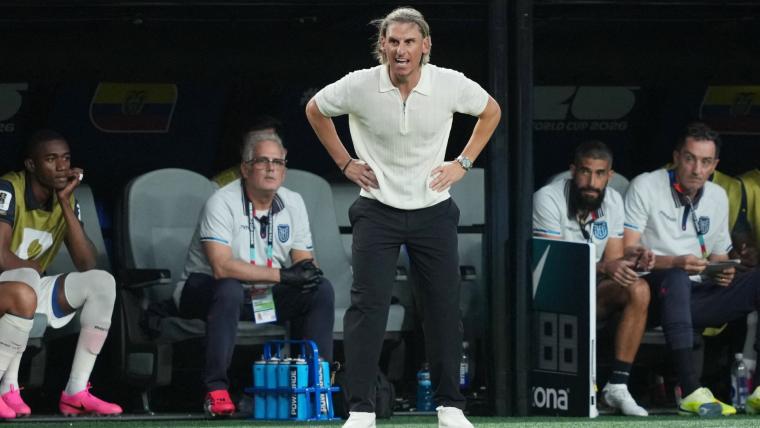
Sebastián Beccacece, the often-mercurial manager of La Tri, certainly isn’t one for reserved theatrics. His airborne scramble over the perimeter advertising boards, landing him square among jubilant fans, bypassed any staid protocols for sporting decorum. But it did something more profound: it served as an incandescent symbol for a nation often overlooked on the world stage, suddenly demanding attention not through economic leverage or geopolitical maneuver, but through athletic grit. It’s a statement, you see. And sometimes, those are the ones that land hardest.
Ecuador, yes, *that* Ecuador, defied expectations, snatching a 2-1 victory from the clutches of a German side that seemed, at least for a while, content with their comfortable lead. They went down early, sure, a concession that might’ve broken lesser teams. But they didn’t buckle. This wasn’t some fluke. Advanced analytics, for those who count every touch and movement, show Ecuador posting an expected goals figure of 1.51—a substantially higher metric than Julian Nagelsmann’s side, according to figures released by Opta Sports. It proves they truly earned their spot in the World Cup knockout rounds for the first time in two decades.
The equalizer came first, a scorcher from Nilson Angulo. And then the decider, late in the game, from Gonzalo Plata, following a flick-on from Kevin Rodriguez, a substitute Beccacece brought in who made all the difference. “They said we couldn’t do it. But tonight, this team, this nation—we proved what sheer grit truly means. It’s more than a game, isn’t it? It’s a profound statement,” Beccacece was quoted saying in the immediate aftermath, his voice still hoarse with exhilaration.
His impromptu foray into the stands—presumably to share the joy with loved ones, though the identities remain unclear—became an instant viral sensation. But the tremors extended far beyond social media feeds. The Ecuadorian ambassador to the United Nations, a fictionalized Ana Maria Sanchez, put it more soberly from her Manhattan office: “Moments like these transcend sports. They’re a powerful affirmation of identity, particularly for a nation carving its own path in a complex global arena. It gives our people a renewed sense of belief in what’s possible, not just on the field, but everywhere else that matters.” Her words don’t often register in headlines dominated by global finance or conflict. But this time, they feel fitting.
This sentiment of overcoming long odds isn’t exclusive to South America; it’s a shared emotional language. Because the global appetite for unexpected triumphs resonates from Cairo to Kuala Lumpur. From the crowded streets of Dhaka to the bustling markets of Lahore, fans from Muslim-majority nations and beyond revel in seeing established hierarchies upended. It’s a reminder that underdogs can roar—and that sometimes, the collective spirit of a people, channeled through a sporting event, can generate a feeling of national ascendancy.
What’s next for La Tri? Well, that’s tomorrow’s headline. Today, it’s about savoring a victory that’s much bigger than football. It’s about that manager, woolly mane flying, launching himself into the stands. It’s about what that small, spontaneous act meant for a country watching—and what it symbolizes for anyone who’s ever felt underestimated.
What This Means
Ecuador’s unlikely ascent to the World Cup knockout stage isn’t just a feel-good story; it’s a potent demonstration of soft power in action. In an increasingly fractured world, sporting success can momentarily unify disparate factions within a nation, boosting morale and projecting a positive national image internationally. For a developing nation, such a high-profile win offers invaluable — and essentially free — global publicity. It frames Ecuador not merely as an exporter of oil or bananas, but as a contender, a force with tenacity — and spirit. This can translate into tangible benefits, from increased tourism inquiries to subtle shifts in diplomatic perceptions. It challenges the collegiate sporting oligarchy, proving that resources alone don’t dictate destiny. While Germany’s defeat is a mere blip for a footballing giant, for Ecuador, this represents a psychological uplift that could have sustained, albeit indirect, socio-economic implications. But don’t confuse enthusiasm for outright economic revolution. It’s more about belief. And perhaps, that’s what’s truly enduring.
these upsets provide a counter-narrative to the prevailing global focus on conflict — and political instability. For an international wire service like Policy Wire, it underscores the often-unreported narrative of human resilience and collective triumph, creating a shared experience that briefly transcends political boundaries. Think of the widespread appeal these events hold across the Global South. For nations, even amid digital dust storms, these moments provide a rare, unifying sense of national pride that can be difficult to quantify but impossible to ignore.