

Earth Spinning Faster on July 9: A Tiny Change That Tells a Big Story
Something astonishing occurred on July 9, 2025 Earth finished its rotation 1.3 milliseconds ahead of time. That doesn’t sound like much, but for scientists monitoring Earth’s actions with...

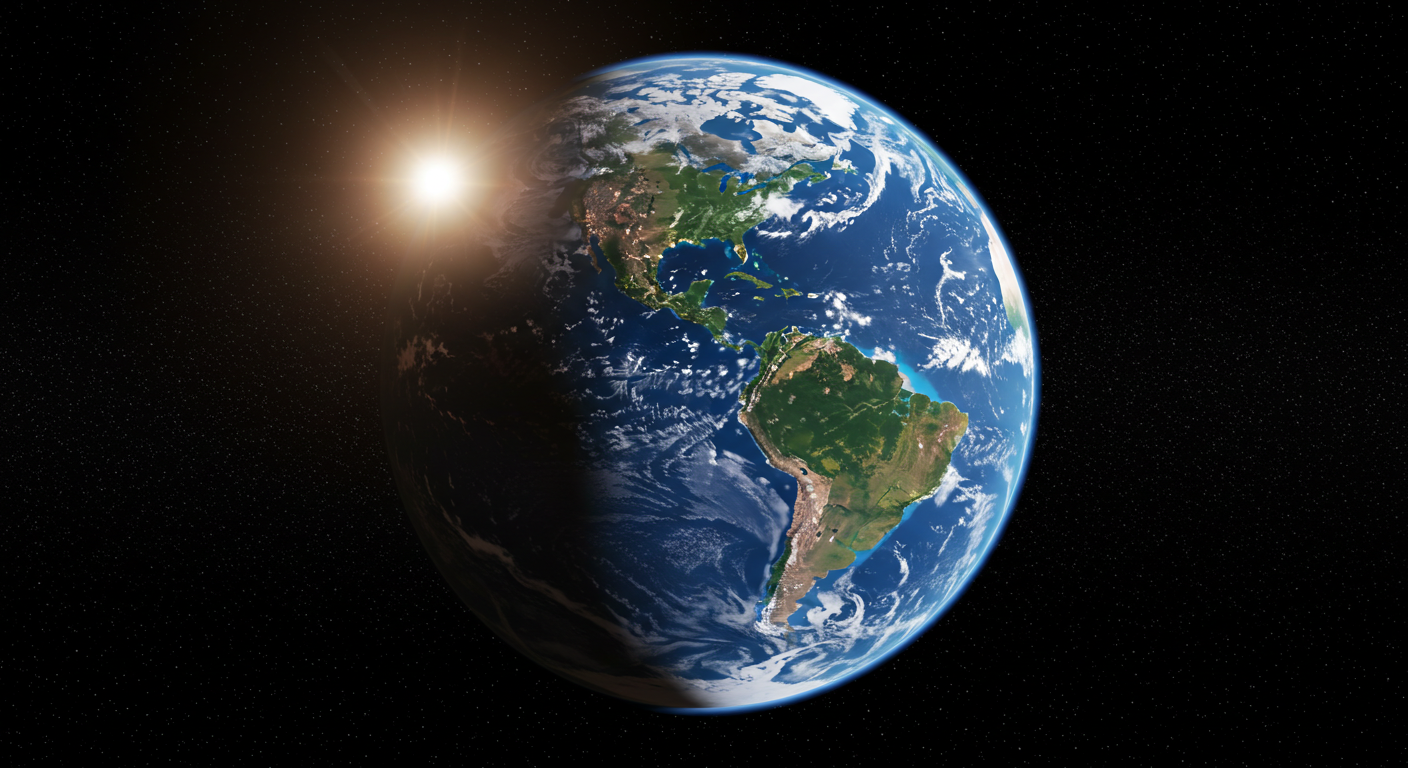
Something astonishing occurred on July 9, 2025 Earth finished its rotation 1.3 milliseconds ahead of time. That doesn’t sound like much, but for scientists monitoring Earth’s actions with minute accuracy, it’s a big deal. A millisecond is only one-thousandth of a second, too fast for any human to perceive. But with atomic clocks equipment precise enough to detect even such minute variations scientists have verified that Earth’s rotation is accelerating. This defies the natural pattern which has continued for thousands of years, during which Earth has been gradually rotating more slowly under the Moon’s gravitational pull.
Earth’s acceleration in rotation is not new. Since 2020, our Earth has consistently smashed records for the shortest day in recorded history. The record holder now is July 5, 2024, when Earth finished its rotation 1.66 milliseconds quicker than the average 24-hour day. These are not random spikes. Researchers now have a keen eye on what could be behind these small but regular fluctuations. One of the explanations is the shifting position of the Moon. When the Moon is way north or south of Earth’s equator, it actually could speed up the planet’s rotation a bit. But it doesn’t end there. Far beneath Earth’s surface, changes in the molten core redistribute the planet’s mass. When this mass is drawn closer to the center, Earth rotates more rapidly like a figure skater who brings her arms in to rotate faster. Other tiny reasons involve earthquakes, melting glaciers, and shifts in the ocean currents. These things are small, yet collectively, they contribute to a difference.
So does a quicker Earth make a difference to us? In our everyday lives, no. Nobody notices a day that is one millisecond shorter. Your phone, your clock, and your calendar keep on going like normal. But that is important to systems that are based on very precise time such as GPS satellites, internet connections, and stock exchanges. Those systems are based on atomic time, which is linked with the rotation of Earth. Usually, when Earth’s rotation slows down, scientists add a leap second in order to keep everything synchronized. But now, if Earth continues to rotate at an increasing speed, they might have to reverse the process: subtract a second. This is referred to as a negative leap second. Never done before, and some are concerned it would trigger technical issues. For instance, computers and international networks may not know what to do with a second taken away. But that is only a potentiality, not certainty. A lot of engineers are already getting ready for it, and it might go smoothly when the time arrives.
It’s worth emphasizing that these dangers are unproved. They are hypotheses based on technical debate on what would occur if the Earth kept accelerating and a negative leap second was inevitable. Technology communities are debating this ahead of time so systems can be prepared, if it occurs. There is no cause for public alarm yet simply scientific curiosity and prudent planning.
Apart from the scientific and technological factors, there are those who interpret a greater meaning in this minute movement. Even as human beings take time to measure and attempt to control every second to the very last our earth quietly teaches us that it is not always in our control. A small movement like this indicates that nature still goes its own way. It is perhaps humble to know that despite the fact that we construct satellites, we put atomic clocks, and we keep our world second to second, Earth itself can slightly accelerate or decelerate without a second’s notice.
Of course, this is a philosophical interpretation and not a scientific fact it is a reflection. But it does get one thinking. Maybe we should not take time for granted. Maybe we should realize that we are living on a planet that is constantly in motion, constantly changing, even in changes we can’t sense.
Ultimately, the Earth spinning slightly faster on July 9 may not alter your life today. But it’s a strong reminder that even the most fundamental things about our world such as the duration of a day aren’t constant. They can shift, they do shift, and remind us that the Earth still has mysteries waiting to be unraveled. This tiny millisecond could be an earth whisper urging us to pay closer attention to the rhythms we tend to take for granted.
Author