


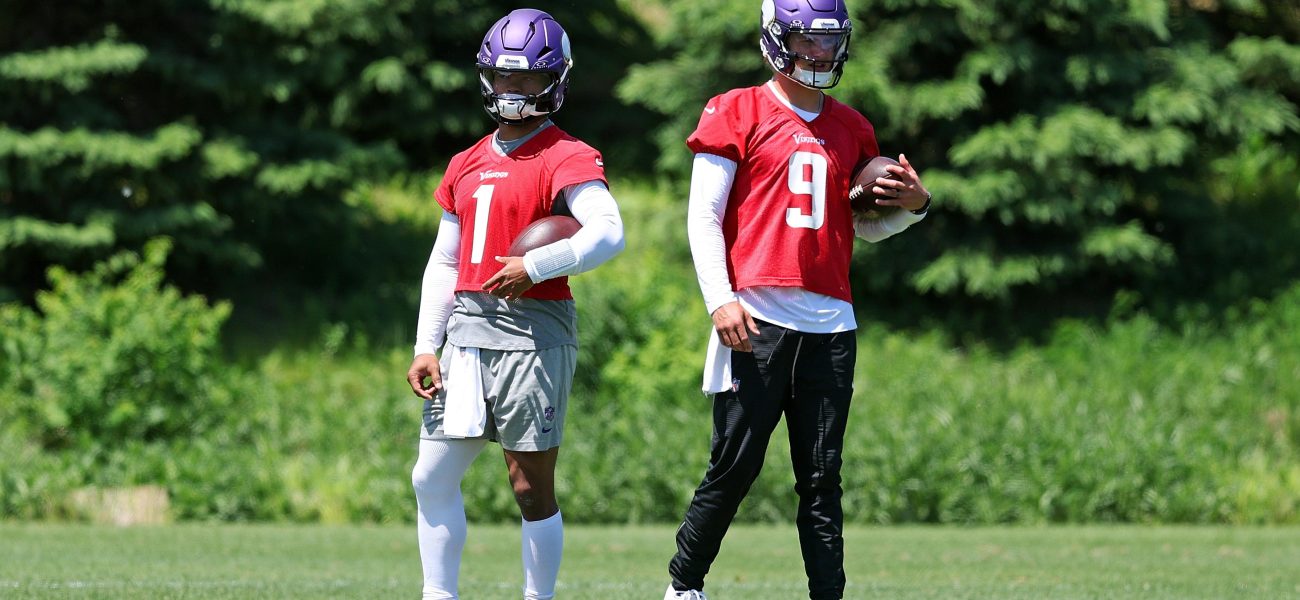
Eagan’s Cold Reality: Murray’s Arrival Ignites a QB Cage Match, Threatening McCarthy’s Future
POLICY WIRE — Eagan, Minnesota — It’s a familiar story in the ruthless business of professional sports: the heir apparent, once touted, suddenly finds himself in an unscheduled cage match. That’s the...

POLICY WIRE — Eagan, Minnesota — It’s a familiar story in the ruthless business of professional sports: the heir apparent, once touted, suddenly finds himself in an unscheduled cage match. That’s the chilly reality facing Minnesota Vikings quarterback J.J. McCarthy, whose meticulously planned ascent now includes a decidedly unplanned variable named Kyler Murray. This isn’t just about winning a starting job; it’s about survival.
While most players at the Vikings’ OTA workouts can count on a locker and a paycheck, McCarthy walks a tighter rope than anyone else on that field. He’s navigating an organizational pivot that feels less like healthy competition and more like a high-stakes, unsolicited performance review. The veteran brass didn’t just sign Murray for kicks; they brought him in because, frankly, the first-rounder wasn’t delivering on the promise of his draft capital.
Consider this: for all of McCarthy’s raw talent, the basics — those bedrock mechanics like footwork and timing — have gone south since college. His accuracy, once a selling point, has, if you can believe it, regressed. And the complexities of an NFL defense? Well, they’ve clearly given him fits. “It’s a different beast, the pro game,” observed former NFL General Manager — and current league analyst, Dale Caldwell. “Some guys, they just don’t bridge that gap quickly enough. And when you’re a high pick, the patience runs thin, you know? It always does.” That patience, it seems, has officially evaporated in Minnesota.
Murray, by stark contrast, offers a substantial, if somewhat complicated, baseline. He arrives not as a project, but as a seasoned gunslinger with a league-reported 88 starts under his belt. He’s got that professional swagger. He’s seen it all—or most of it, anyway. He understands what it takes to operate a complex NFL offense. And yes, Murray’s had his own demons to battle, his own question marks, but he’s already shown he can lead an offense when the chips are down. That’s why the Vikings made the move.
When McCarthy finally faced the press after Murray’s signing, the polite façade of QB1 quickly crumbled. The phrase “organizational decisions” dripped with a barely contained vexation, a distinct departure from his usual genial demeanor. He talked about focusing on what he could control, working harder, all the right clichés, but underneath? A perceptible edge. It wasn’t just frustration; it felt like a spark. A defiance. “Look, nobody likes seeing their job security get shaken up,” an unnamed front-office source mused, speaking on background. “But that fire? That’s what we want to see. We want him angry, wanting to prove us wrong.” Because sometimes, that’s what it takes, doesn’t it?
So, here we’re in May 2026, just as McCarthy is entering his crucial third year. What McCarthy showcases in these low-pressure OTA practices could make or break his trajectory, not just with the Vikings but potentially his entire NFL career. If those fundamental errors — the wobbly footwork, the mistimed throws, the glacial processing speed — aren’t demonstrably fixed, he won’t get the crucial first-team reps needed in training camp. And that, friends, is a death knell. We’ve seen this script play out before. Talent only gets you so far; consistent execution gets you on the field.
📄 POLICY WIRE WHITEPAPER PUBLISHED: PAKISTAN'S NATIONAL SECURITY POLICY PRIORITIES
👉 READ BY CLICKING HEREThis isn’t a problem unique to the NFL’s gilded cages. Think about the intense competition in rising economies across the globe — say, a burgeoning tech sector in South Korea or a rapidly expanding financial hub in Karachi. The rules are unwritten, but unforgiving: deliver measurable results, or be replaced by someone who can. Second chances are sparse. The market, whether for talent or capital, has a way of being brutally efficient, valuing current performance over past potential. And for McCarthy, that market has just acquired a more reliable stock.
What This Means
The Vikings’ maneuver isn’t just about putting two quarterbacks through their paces; it’s a masterclass in aggressive roster management with significant financial and strategic implications. By bringing in Kyler Murray, even if for what might be a temporary period, the Vikings are sending a clear message: competition is king, and nobody’s job is safe without consistent high-level performance. If Murray wins the job and performs well, he’s unlikely to be a one-season rental, which would solidify McCarthy’s fate as a high-draft bust within the organization, plummeting his trade value. It forces McCarthy into an immediate sink-or-swim scenario, potentially accelerating his development or, conversely, exposing his limitations to the entire league, making him less appealing to other QB-needy teams down the line. It’s a calculated gamble on leveraging a rival’s value to extract more from one’s own investment, reminiscent of how sports franchises constantly reassess their billion-dollar asset valuations. It’s harsh, but that’s how winning organizations often operate. The decision impacts not only the on-field product but future draft strategies and, crucially, the delicate salary cap balancing act that governs every successful NFL team.
It’s possible McCarthy shows improvement. That’s the ideal scenario, from the team’s perspective. But even then, if that improvement isn’t enough to eclipse Murray’s baseline, it leaves the Vikings with a challenging decision about their future QB room. For now, they’re both getting first-team reps. The competition, stark — and unblinking, has begun.