


Disinformation’s Drone: Phony BBC Report Spotlights Hybrid War Fronts
POLICY WIRE — Washington D.C. — The world’s battles aren’t just fought with tanks anymore, or even with stealth drones over contested airspace. No, they’re fought, increasingly, in...

POLICY WIRE — Washington D.C. — The world’s battles aren’t just fought with tanks anymore, or even with stealth drones over contested airspace. No, they’re fought, increasingly, in browsers — and across social feeds, shaping perceptions with insidious precision. Disinformation—it’s an ugly word for an uglier reality, a constant corrosive acid on trust, actively fueling discord in a world already clinging precariously to stability. You don’t have to look far for proof; just consider the bizarre episode currently roiling diplomatic cables concerning the Caucasus.
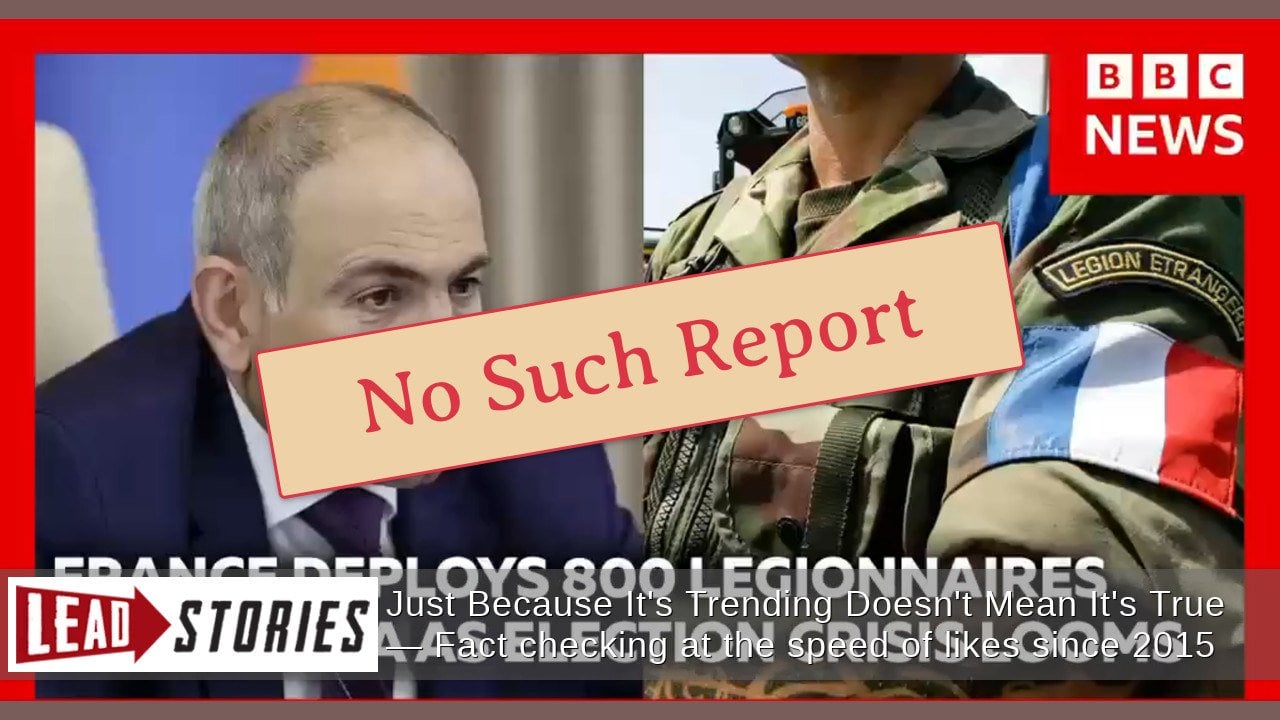
Someone, somewhere, recently conjured up a meticulously produced, deep-fake BBC news report. It wasn’t some fly-by-night blog post; this was a wholly fictional broadcast designed to appear legitimate. It didn’t merely float a minor inaccuracy; it flat-out fabricated an international military maneuver, claiming France was dispatching [QUOTE_PLACEHOLDER] to Armenia. Eight hundred of ’em, Foreign Legion, no less. Think about the audacity, the brazen intent behind such an assertion. This wasn’t just a mistake, or even an accidental embellishment. It’s a deliberate provocation, aimed squarely at infuriating regional actors and radically reshaping the perception of foreign intervention in a perpetually volatile conflict zone.
But it’s bigger than Armenia. The mere existence of such a sophisticated fabrication signals a troubling, frankly chilling, escalation in information warfare tactics. Because this wasn’t some shoddy Photoshopped meme that your tech-savvy teenager would immediately spot. No. This was a broadcast apparently mimicking the BBC’s own graphical elements, sound design, and even their reporting cadence. For the average viewer, especially those hungry for any news from afar, distinguishing this from authentic journalism becomes a Herculean task. And that means someone—or some entity—is putting serious money and serious skill behind these psychological operations.
Because that’s what it’s, isn’t it? A psyop, designed to throw gasoline on geopolitical fires. An official BBC statement, almost immediately after the fake report began circulating, quickly shut down the claim, stating directly that [QUOTE_PLACEHOLDER]. They had to, didn’t they? Imagine the damage to their credibility, not to mention the potential diplomatic fallout between Paris, Yerevan, and Baku. But the damage had been done; the seeds of doubt — and suspicion had already been sown in fertile, anxious ground.
Consider the broader context, particularly as these narratives spread beyond their immediate flashpoints. Across South Asia and parts of the Muslim world, narratives of foreign interference, often tied to perceived Western aggression or expansionism, frequently resonate deeply. This region, already struggling with complex historical grievances and cross-border tensions (think Kashmir, or the constant low-level friction along the Iran-Pakistan border), becomes highly susceptible to such engineered fabrications. The potential for a fabricated report to ignite sectarian passions or to further erode trust in mainstream media, pushing audiences towards increasingly fringe and radical sources, is terrifyingly real. A quick search on X (formerly Twitter), even hours after a fact-check, shows how quickly such narratives solidify into ‘truth’ for specific echo chambers, regardless of journalistic corrections. It’s a hydra—cut off one head, and two more pop up.
And it’s a trend that’s picking up steam. According to a recent study by the Oxford Internet Institute, state-sponsored disinformation campaigns surged by 150% between 2017 and 2022, indicating a growing weaponization of online information flows. This isn’t just about fake news; it’s about manufactured consent, manufactured outrage, and ultimately, manufactured instability. Governments, security agencies, — and citizens are effectively navigating a minefield.
The rise of generative AI tools, mind you, only complicates matters. Creating compelling, realistic audio-visual content no longer requires extensive technical know-how or vast resources. Soon, any halfway clever malefactor with a decent laptop could potentially churn out equally convincing — and equally destructive — propaganda. This fake BBC report might just be the opening salvo in a much larger, uglier battle for control over global perception. We’re only seeing the beginning of it.
And what’s a government to do when its populace can no longer tell a verified news report from a deep-fake designed to trigger a specific emotional response? It isn’t just national security that’s under attack, it’s the very notion of shared reality, which, let’s face it, is a pretty thin veneer even on the best of days.
What This Means
This incident is far from isolated; it’s a chilling portent of an increasingly messy geopolitical landscape. Firstly, it spotlights the vulnerability of established media brands. When trusted news outlets can be convincingly mimicked, it hollows out public faith, an asset governments and civil societies absolutely depend on for effective governance and crisis communication. Secondly, such acts escalate regional tensions almost instantaneously. An alleged French deployment, even a phantom one, could provoke an immediate, outsized response from Azerbaijan, which considers any external military presence in Armenia a hostile act, further destabilizing a region where truces are always tenuous.
Economically, persistent disinformation introduces significant uncertainty. Investor confidence in politically volatile regions like the Caucasus or other hotspots across Eurasia could evaporate if the information environment becomes hopelessly muddied. How do you assess risk when reality itself is under constant, malicious fabrication? Diplomatically, incidents like this force a scramble to verify, clarify, and de-escalate, diverting precious resources from genuine peace initiatives to mere damage control. But it’s also a stark warning. As AI advances, the barrier to creating sophisticated disinformation will only drop, making such incidents commonplace. It’s no longer enough for states to monitor kinetic threats; they must now fortify their information spaces, or risk seeing their foreign policy unravel at the hands of pixels and propaganda.