


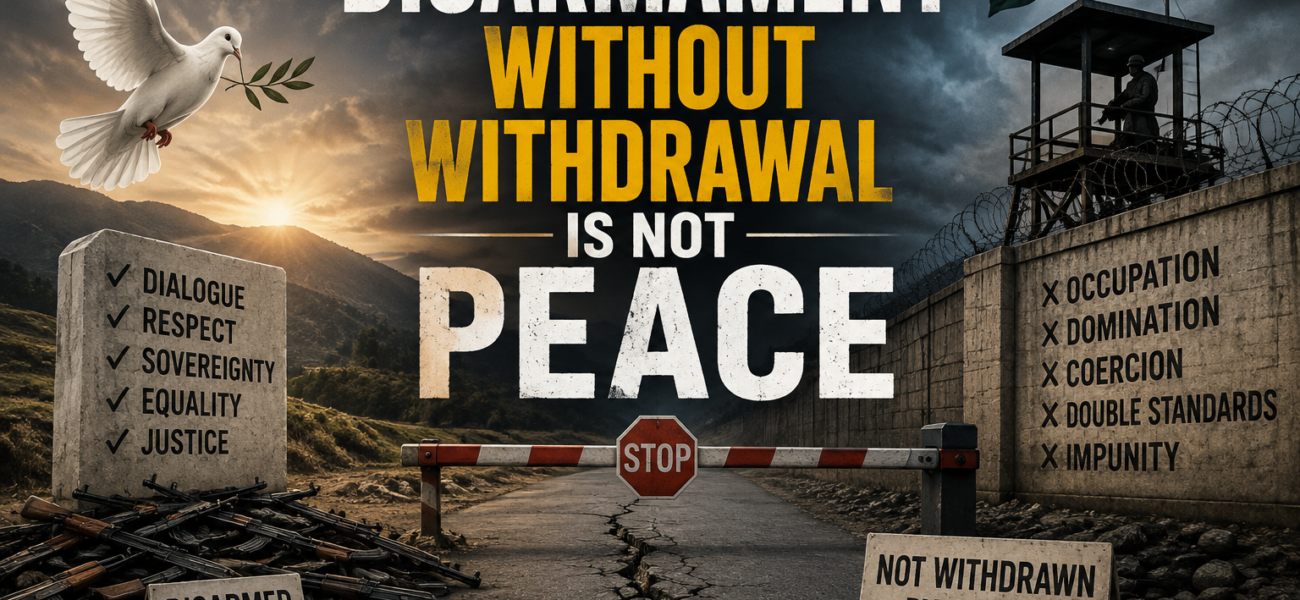
Disarmament Without Withdrawal Is Not Peace
When wars begin, the world often focuses on weapons. When wars end, it should focus on justice. The latest developments surrounding Gaza present an opportunity to move beyond temporary ceasefires...

When wars begin, the world often focuses on weapons. When wars end, it should focus on justice. The latest developments surrounding Gaza present an opportunity to move beyond temporary ceasefires toward a sustainable political settlement. But that opportunity will only succeed if the international community avoids the temptation of demanding obligations from one side while overlooking the responsibilities of the other.
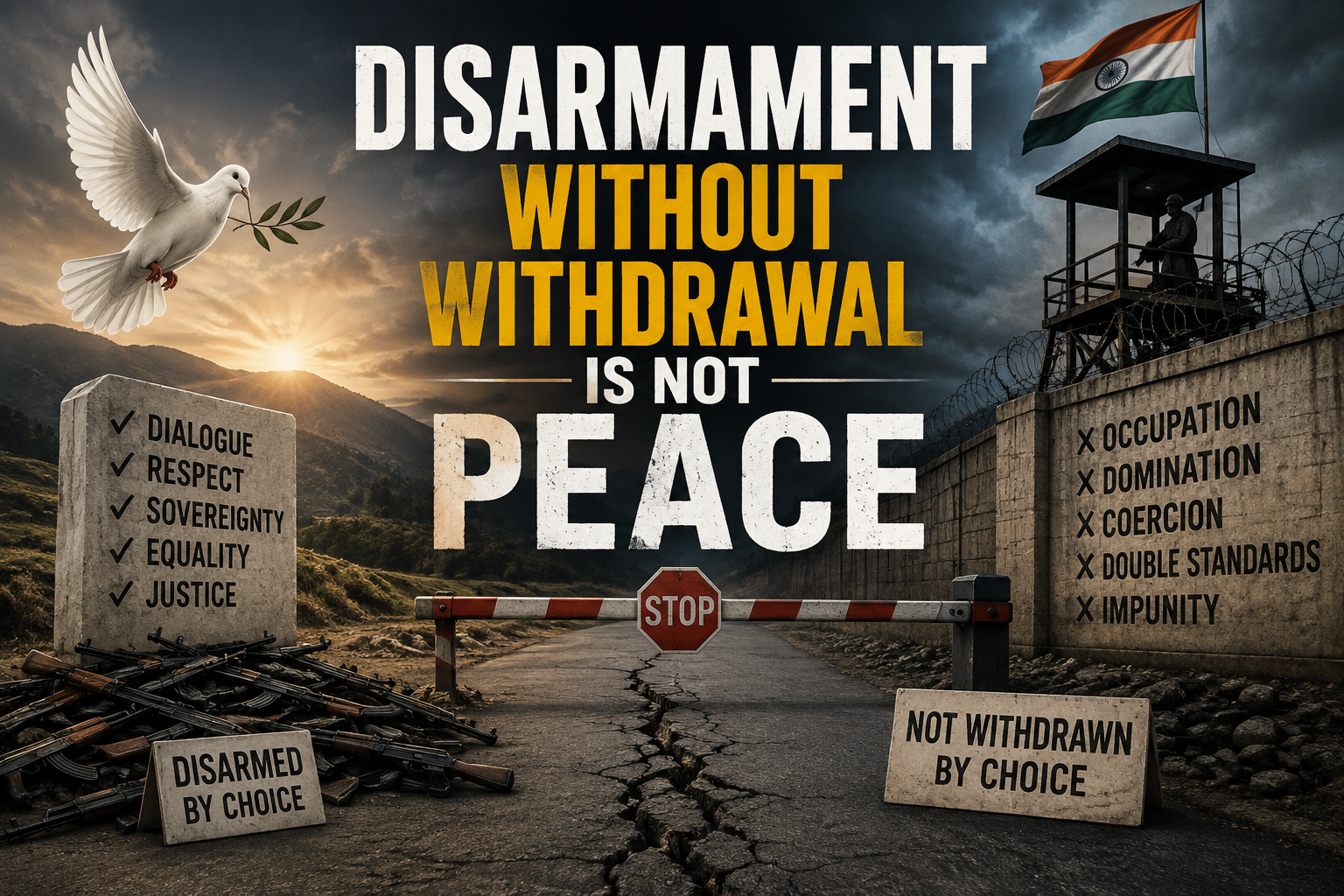
Pakistan’s position that Hamas’ disarmament must be matched by Israel’s withdrawal from Gaza is not a diplomatic balancing act. It reflects a principle that has underpinned international law for decades: peace agreements require reciprocal implementation. Disarmament may reduce the immediate threat of violence, but without ending military occupation, it risks becoming a one-sided concession rather than the foundation of lasting peace.
The announcement by US President Donald Trump regarding an agreement for the complete disarmament of Hamas has understandably generated cautious optimism. Any initiative that reduces armed confrontation deserves serious consideration. However, disarmament alone cannot address the underlying political grievances that have fueled repeated cycles of conflict. The future stability of Gaza depends as much on restoring Palestinian civilian governance and territorial integrity as it does on collecting weapons.
Pakistan has correctly described these as “twin obligations.” If Hamas is expected to surrender its military capabilities, Israel must demonstrate equal commitment by withdrawing from occupied areas in accordance with agreed frameworks. One obligation cannot become permanent while the other remains optional. Selective implementation has historically undermined nearly every peace process in the Middle East.
Equally significant is Islamabad’s emphasis that Israel’s compliance should be closely monitored. International agreements succeed not because promises are made, but because mechanisms exist to verify that they are honored. Independent monitoring by the international community, preferably under United Nations oversight, will be essential to building confidence among all parties and preventing accusations of non-compliance that could derail the process.
Pakistan’s measured response regarding a possible future peacekeeping role also deserves recognition. Rather than rushing into speculative commitments, Islamabad has indicated that any decision should depend on a formal international proposal. Such restraint reflects responsible diplomacy. Peacekeeping missions require clear mandates, international legitimacy and political consensus, not symbolic announcements.
As a member of the Board of Peace established after the October 2025 ceasefire, Pakistan has contributed constructively to Gaza’s stabilization, humanitarian recovery and institutional rebuilding. Its longstanding support for a two-state solution and adherence to UN resolutions position it as a credible advocate for negotiations rooted in international law rather than shifting geopolitical interests.
Ultimately, Gaza’s future cannot be secured through military calculations alone. History repeatedly demonstrates that peace imposed without political justice rarely endures. Lasting stability requires dignity for Palestinians and accountability for all parties involved. These objectives are not mutually exclusive; they reinforce one another.
The world now faces a defining choice. It can celebrate partial agreements that leave the root causes of conflict unresolved, or it can insist that every commitment made in the name of peace is implemented equally. Pakistan’s insistence that disarmament and withdrawal proceed together is not merely a diplomatic position, it is a reminder that genuine peace is built on reciprocity, accountability and the equal application of international law.
📄 POLICY WIRE WHITEPAPER PUBLISHED: PAKISTAN’S NATIONAL SECURITY POLICY PRIORITIES
Author