


Diamond’s Edge: The Unflappable Sophomore Standing Between Oregon and Oblivion
POLICY WIRE — Austin, Texas — The noise of nearly 9,000 partisan voices, an almost suffocating din, can swallow lesser men whole. For Will Sanford, however, it’s just the soundtrack to another...

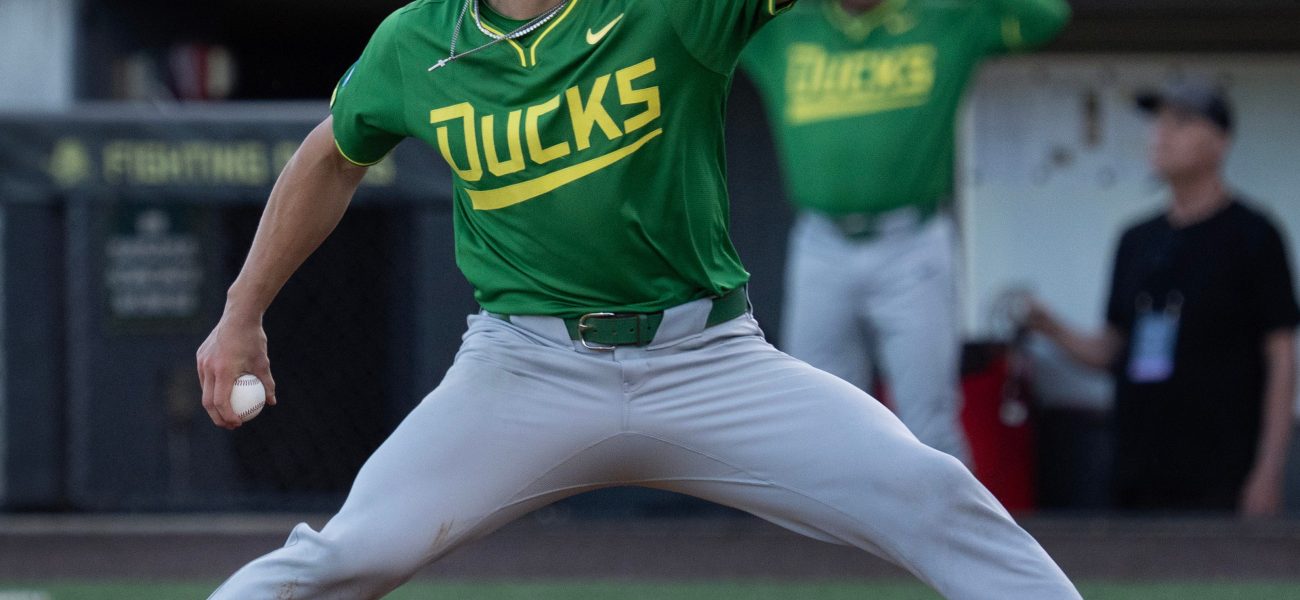
POLICY WIRE — Austin, Texas — The noise of nearly 9,000 partisan voices, an almost suffocating din, can swallow lesser men whole. For Will Sanford, however, it’s just the soundtrack to another Tuesday. Most young athletes shrink when an entire season teeters on their next pitch—but not this one. No, he’d apparently been gearing up for this kind of bedlam since he was a kid tossing rocks at neighborhood squirrels (or so one might imagine), a fierce inner fire burning irrespective of external adulation or animosity. And now, the No. 11 Oregon Ducks—licking their wounds after a gut-wrenching 11-3 drubbing in the first contest—are banking everything on this precise, rather peculiar, mentality.
You see, when Game 1 of the Austin Super Regional went sideways against No. 6 Texas, the obvious narrative would be to wallow in collective misery. Instead, the dugout eyes, the coaching staff’s unspoken pleas, all turn toward a sophomore righty who’s quietly become their bedrock. He hasn’t even officially been given the ball for Game 2 yet, not with 100% certainty, but everyone knows he’s the guy. His name is Will Sanford, and come Sunday, he’s slated to take the mound with Oregon’s championship hopes draped around his young shoulders.
His season has been, to put it mildly, quite the turnaround. Just last year, his freshman campaign was, shall we say, a touch inconsistent—he sported a 6.39 ERA and apparently walked as many batters as he struck out. A common trajectory for burgeoning talent, but not exactly confidence-inspiring. This season, though, it’s different. Completely. He’s transformed into a dominant force, compiling a 9-2 record in 16 appearances, showcasing a sparkling 3.46 earned-run average and a career-best 119 strikeouts. That’s a dramatic leap—and frankly, it’s why the Ducks aren’t packing their bags just yet.
What’s fueling this metamorphosis? It’s not some grand philosophical shift. It’s an internal furnace that seems to burn hotter the more pressure you heap on it. Sanford says, “I think it’s just how I compete out there,” —and you gotta believe him. He tells us that even if there’s nobody in the stands, even in scrimmages, he’s just as animated. Infielder Ryan Cooney echoed this, pointing out, [QUOTE_PLACEHOLDER] for what he’s seen. Coach Mark Wasikowski summed it up with blunt candor: “He’s got it.” He elaborated, “You either got it or you don’t, and you don’t know if they’ve got it until they’re put in that spot and he’s got it.” It’s the kind of simplistic wisdom that makes sense in the crucible of elite sports.
Sanford relishes the large, hostile venues, which some might see as an odd preference. Consider the Omaha Big Ten tournament semifinals against Nebraska, where he dazzled a crowd of 13,000 fans, predominantly clad in Cornhusker red. He struck out nine — and conceded a paltry two hits over six innings in a shutout victory. A hostile environment? He claims, [QUOTE_PLACEHOLDER] But there’s a serious edge here, too. What’s often viewed as a weakness in others—the susceptibility to external chaos—becomes his strange superpower.
📄 POLICY WIRE WHITEPAPER PUBLISHED: PAKISTAN'S NATIONAL SECURITY POLICY PRIORITIES
👉 READ BY CLICKING HEREAnd it’s this unshakeable self-belief that’s absolutely non-negotiable for Oregon. Cal Scolari, the typically steady Game 1 starter, stumbled, handing out 11 free passes — and watching the game spiral. That’s why the team’s narrative, its very season, has been handed to a sophomore whose self-assurance borders on the uncanny. For baseball, where individual performance is hyper-magnified but team cohesion remains everything, this dynamic offers a glimpse into a strange, wonderful tension. You gotta admire the kid’s nerve.
What This Means
This saga of Will Sanford, this single sophomore standing against a tide of disappointment and expectation, offers an interesting microcosm for global governance and regional stability. Think of the reliance on singular, unshakeable figures in high-stakes environments—a diplomat navigating complex, multi-state negotiations or a military leader tasked with restoring order in a volatile border region. Pakistan, for instance, a nation frequently navigating complex geopolitical fault lines, has often seen its stability hinged on individual leadership, for better or worse. The concept of an individual’s confidence and competence becoming the ballast for an entire nation, much like a pitching rotation for a baseball team, isn’t just a metaphor—it’s a recurring pattern in political and economic strategy across South Asia and the wider Muslim world.
The collective performance, in this case, Oregon’s crushing Game 1 loss, highlighted a vulnerability that demanded a change in strategy—or, rather, a pivot to an individual with a demonstrated ability to perform under extreme pressure. In emerging markets, say, those experiencing rapid economic shifts, investor confidence often coalesces around a government’s key economic architect. If that architect falters, the entire market can plunge, much like a team’s morale after a star pitcher’s bad outing. Sanfordin’s ability to thrive when the odds—and the crowd—are against him is less about sheer talent and more about a psychological resilience. For developing nations, say in regions grappling with climate change or internal conflict, identifying and cultivating such leadership—individuals who don’t just endure but thrive under systemic stress—is not merely an asset; it’s a necessary strategic imperative. For example, in 2023, the World Bank noted that countries with strong, stable leadership during crises demonstrated 15% faster economic recovery rates compared to their more volatile counterparts, highlighting this correlation between individual mettle and collective outcomes. This isn’t just about baseball; it’s about the deep-seated human psychology that underpins all high-stakes endeavors.