

Diamond Dollars: Boston’s Calculated Risk on Youth Upsets MLB’s Old Money Playbook
POLICY WIRE — Boston, USA — A simple handshake, or the lack thereof, between a thirty-year-old athlete and a storied sports franchise — it often carries more economic weight than the GDP of a small...

POLICY WIRE — Boston, USA — A simple handshake, or the lack thereof, between a thirty-year-old athlete and a storied sports franchise — it often carries more economic weight than the GDP of a small nation. The financial figures tossed around in professional baseball today, particularly Major League Baseball, aren’t just digits on a scoreboard. They’re cold, hard currency, — and they frequently spark debates far hotter than any summer series at Fenway Park.
Consider the Boston Red Sox’s recent winter maneuvers. Many cried foul—they really did—when the club allowed slugger Alex Bregman, a player with a championship pedigree, to saunter off to the Chicago Cubs. Bregman snagged a colossal five-year, $175 million contract from Chicago. It came bundled with a full no-trade clause and a hefty $70 million in deferrals, pushing the real value further into the future. But Boston? They had reportedly offered a respectable $165 million for five years, with deferrals, but couldn’t stomach the no-trade clause. A stubborn, perhaps principled, stand. And it set the stage for one of baseball’s more compelling economic gambles of the current season: the ascension of Caleb Durbin.
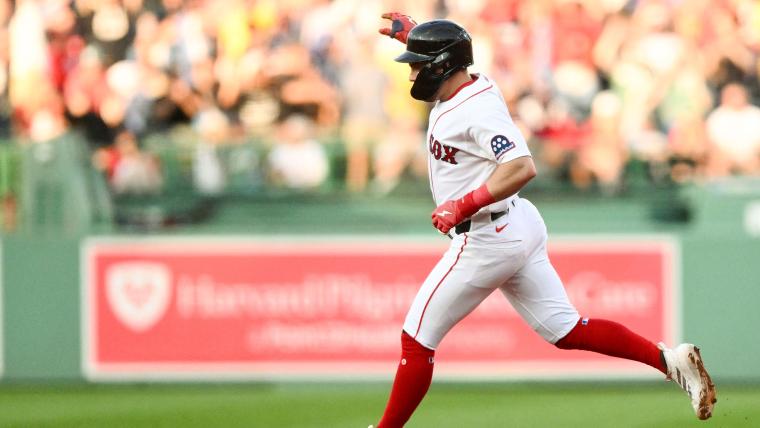
The Red Sox opted for Durbin, acquired from the Milwaukee Brewers, betting that a fresh, unproven commodity could eventually fill the enormous shoes left by Bregman. Durbin, a National League Rookie of the Year finalist the previous season, came with big expectations. But boy, did he start slow. He slashed a frankly awful .163/.241/.238 with a solitary home run through his first 48 games. Many were ready to call it. To deem the entire enterprise a folly.
Because, well, that’s what we do in this business, isn’t it? We jump to conclusions with multi-million-dollar swiftness. But after a couple of days warming the bench—a quiet, contemplative hiatus, no doubt—Durbin roared back. His performance since has been nothing short of spectacular. Over his last 28 games, he’s boasted an eye-popping .330 batting average, coupled with six home runs, 19 RBIs, and five stolen bases. This torrid streak has significantly boosted his overall season line, even if it’s still being weighted down by that abysmal start. It makes you think about how quick everyone is to write off investments too early.
Meanwhile, Bregman’s much-vaunted production in Chicago hasn’t quite lived up to the gargantuan price tag. His current batting average stands at .242 with an On-base Plus Slugging (OPS) of .677. League sources confirm this isn’t exactly the kind of production you’d expect from a $175 million man. The Cubs’ executive suite must be feeling a little squirmy right now, as their prized asset simply hasn’t delivered value commensurate with his earnings. It’s an old tale, isn’t it? The pursuit of a star often blinds you to the rising cost-to-benefit ratio. But Durbin — and Bregman both remain strong defensive presences at third base, that’s one point of consensus.
“We weren’t interested in making a bad deal, just because everyone else was doing it,” an anonymous Red Sox official, speaking on background about the Bregman decision, recently told Policy Wire. “Our financial models indicated a significant risk. You can’t just throw money at a problem — and expect it to go away, even in baseball. We believe in talent incubation—in smart, sustainable development.” This approach stands in stark contrast to the trend seen across many leagues, where franchises often fall prey to escalating salary demands, irrespective of real market efficiency. And the economics of talent acquisition stretch beyond the diamond; consider, for example, the NBA’s high-stakes chess game, a battleground defined by similar forces of player power and astronomical bids.
“The global market for elite sports talent, much like any other highly skilled labor sector, is subject to intense speculative forces,” noted Dr. Omar Farooq, a prominent sports economist who has studied player markets in South Asia’s rapidly developing sports leagues, particularly cricket. “Teams, irrespective of their locale, be it Boston or Karachi, are wrestling with valuation. How do you quantify potential versus proven longevity when the stakes are so ridiculously high? Durbin’s trajectory—the initial struggle, the explosive rebound—demonstrates the inherent volatility. It’s a universal challenge, you see, this identification of future value against today’s certainty, a question often overlooked by those just scanning the headlines.” It’s never as simple as it looks on paper.
What This Means
This evolving narrative between Bregman’s inflated contract and Durbin’s emergent, cost-effective performance offers a potent lesson in resource allocation, not just in professional sports, but across high-stakes industries. It highlights the growing tension between short-term public appeasement—the splashy, expensive signing—and the longer-term strategic benefits of talent development and fiscal prudence. The Red Sox, a franchise accustomed to financial muscle-flexing, may be unwittingly ushering in a new era of risk assessment for elite athletic labor. It isn’t about being cheap; it’s about being smart. The economic repercussions extend to the league itself, as other teams will certainly be watching Boston’s balance sheet—and their win-loss column—very closely. If Durbin continues this improbable run, it could reshape future contract negotiations, encouraging front offices to resist the urge to overpay for perceived security and instead double down on nurturing their own pipeline, even if it comes with the agonizing anxieties of a slow start. They’ve found value. Maybe that’s the real win here, regardless of who makes the playoffs.