


Aces’ Overtime Win: True Strength Beyond Stars
Without their MVP, the Las Vegas Aces won in overtime, showcasing collective resilience. Policy Wire explores how strategic depth and broad talent development define true institutional strength.

POLICY WIRE — Las Vegas, United States — In an era obsessed with singular, often extravagant, talent, the gritty spectacle unfolding last Friday night in Las Vegas offered a surprisingly nuanced lesson in institutional endurance. It wasn’t about the usual titans holding court, nor was it a mere victory in an athletic contest. Instead, the Las Vegas Aces’ nail-biting, 98-90 overtime triumph over the Chicago Sky—achieved without their reigning MVP—unmasked a truth rarely acknowledged on center stage: genuine strength often resides not in the gleaming facade, but in the depths of collective resilience.
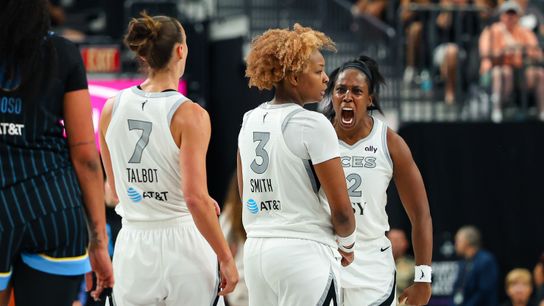
While pundits and purists fawn over highlight reels of individual brilliance, the strategic undercurrent of this matchup revealed a masterclass in adapting to adversity. Think about it. The league’s undisputed force, A’ja Wilson, was off-court, nursing an ankle. But did the empire crumble? Nope. Instead, NaLyssa Smith, typically a complementary piece, stepped into the void, a raw power projection. She threw down a season-best 29 points, a dominant surge that forced observers to re-evaluate conventional wisdom about who carries the freight when the stakes are highest. It’s a pragmatic recalibration; Smith went 11-for-14 from the floor, basically unstoppable, defying Chicago’s league-leading block statistics. For many, that’s just a stat. For us, it’s a policy outcome—the effect of smart development, the payoff of diverse human capital. She grabbed eight boards, too. A complete performance.
“We’re putting a heavy load on Smith right now, particularly with our key operator offline,” explained Head Coach Becky Hammon, her voice devoid of panic, leaning into a mic after the buzzer. “She’s running a workload she’s rarely encountered. But finding her pockets, carving space against bigger opponents—that’s leadership when you don’t expect it. You cultivate that, you don’t just buy it.” And then there’s Chelsea Gray, the clutch architect, calmly nailing eight points in the fourth quarter and overtime. Her DNA, as Hammon likes to put it, is built for pressure. You know the type. They aren’t just playing the game; they’re playing the clock, the momentum, the psychology of it all. But in that crucial, defining moment—a game-tying 16-footer, then a pair of late shots to seal it—Gray simply delivered. She’s built for those high-stress decision points that often mirror geopolitical chess matches.
The significance isn’t lost on observers monitoring nascent economies or political landscapes, particularly those in the global South. In places like Pakistan, for instance, where institutional fragility can be a perpetual challenge and resource allocation a high-stakes gamble, the reliance on single, charismatic figures has historically proven fraught. This Aces game, devoid of their biggest name, highlights a blueprint for sustainability: build broad, not just tall. According to recent analysis by Global Sports Marketing Insights, the WNBA saw an 89% increase in international viewership last year alone, demonstrating a global appetite for compelling narratives—even when they break from traditional star-centric plots.
“Tonight was about stepping up,” Smith quipped post-game, hinting at internal team dynamics more complex than casual fans discern. “When the ball comes my way, I try to make it count, every time.” The Sky, for their part, didn’t make it easy. They chipped away at a double-digit Aces lead, seizing a momentary advantage in the fourth. Because that’s what good adversaries do. They probe; they push. They outscored Vegas 27-21 in the third, for heaven’s sake. But the champs held. It’s the 500th franchise win, a testament not to a moment, but to an accumulating culture of relentless pursuit.
📄 POLICY WIRE WHITEPAPER PUBLISHED: PAKISTAN'S NATIONAL SECURITY POLICY PRIORITIES
👉 READ BY CLICKING HEREWhat This Means
This isn’t merely a sports report. This is an organizational case study masquerading as a box score. The Aces, operating in the glitzy crucible of Las Vegas—a city itself a grand, sometimes precarious, economic experiment—demonstrated that reliance on depth and adaptability is a surer bet than banking solely on star power. When your primary engine sputters, what backup systems kick in? That’s the real metric of institutional strength, whether you’re running a basketball team or navigating the complexities of an evolving regional power like Pakistan. The ability to pivot, to elevate unheralded talent, to execute a decentralized strategy when centralized resources are unavailable—this is the enduring lesson. It applies equally to corporations, government agencies, or indeed, nation-states. Policy Wire suggests leaders worldwide might want to take note; it’s a quiet argument for broad-based skill development over cults of personality. In a global landscape perpetually destabilized by unforeseen events, diversified capacity isn’t just a luxury; it’s the only strategy for survival. It also means the value proposition of investing in wider talent pools, rather than hyper-focusing resources on a select few, resonates with palpable returns.
And yes, the Sky’s Natasha Cloud missed a potential game-winner at the buzzer. But that’s the random friction of the world. It’s what happens after the near miss that defines everything. The Aces tightened their grip in overtime, refusing to let chance dictate their destiny. This collective spirit, this almost stubborn refusal to yield, mirrors the sort of determination seen in various emerging global narratives where resilience isn’t just a slogan, it’s a lived experience. It’s about how institutions weather the storm, finding a way, always, to come out on top.