


Delhi Diplomatic Dance: Quad Ministers Confront China’s Shadow Amid Elusive Summit Dreams
POLICY WIRE — New Delhi, India — The early monsoon heat hadn’t quite broken over India’s bustling capital, but the air inside its diplomatic corridors was already thick with a familiar...

POLICY WIRE — New Delhi, India — The early monsoon heat hadn’t quite broken over India’s bustling capital, but the air inside its diplomatic corridors was already thick with a familiar pressure. It wasn’t the usual backroom dealing, mind you, or some surprise alliance brewing. No, this was about a coordinated performance— a meeting designed, in no small part, to assert the very existence of its players.
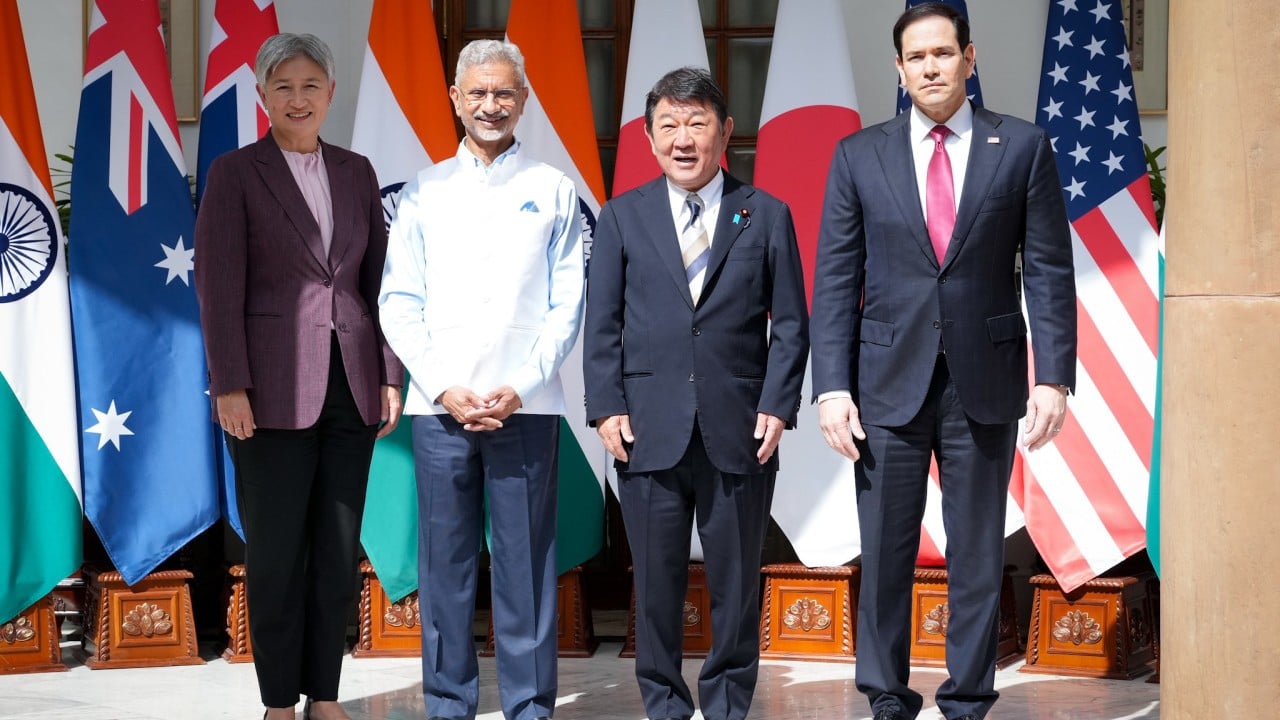
See, the foreign ministers of the Quadrilateral Security Dialogue, or Quad, nations had gathered in New Delhi on Tuesday in a ‘coordinated display of unity’ aimed squarely at reassuring themselves, and everyone else, about their bloc’s ongoing relevance. That’s a telling start, isn’t it? When you’re actively displaying unity to prove you’re still in the game, well, that’s often when you’re not quite sure yourself. [QUOTE_PLACEHOLDER]
This whole arrangement, this Quad thing, it involves the ‘United States, Japan, Australia — and India’. Their collective mission? To promote a ‘free — and open’ Indo-Pacific. A lofty, if somewhat opaque, goal. And everyone knows what that really means, right? It’s about trying to balance China’s ever-expanding influence in a region that’s about as strategically important as it gets. It’s a bit like watching a high-stakes poker game, where one player has all the chips and everyone else is just trying to stay at the table.
The issue isn’t just about a sprawling maritime domain, it’s about economics too. China’s investments, particularly through initiatives like the Belt and Road, have certainly reshaped economic landscapes across Asia and beyond. Consider Pakistan, for instance, a nation often balancing between competing global interests. Its deepening ties with Beijing— epitomized by projects such as the China-Pakistan Economic Corridor (CPEC)—illustrate the dilemma many countries face. While not directly a Quad member, Pakistan’s strategic positioning within South Asia makes it a quiet, yet significant, player in these ‘geopolitical dynamics’. That kind of economic pull means the Quad isn’t just facing a naval challenge, it’s an infrastructural one too, which, let’s be honest, is far harder to counter with just naval patrols and shared rhetoric.
And these ‘shifts in geopolitical dynamics’? They’re less like gentle tides — and more like seismic rumblings. With the complexities surrounding US President Donald Trump and Chinese President Xi Jinping’s past discussions, the region isn’t exactly short on competing narratives or outright confusion. The world’s big powers are doing their thing—and everyone else just watches, often through worried eyes. Data from the Stockholm International Peace Research Institute (SIPRI) in 2022 indicates that China’s military expenditure, for example, accounts for approximately 13% of the global total, dwarfing all Indo-Pacific neighbors, including Quad members, by a considerable margin. This isn’t a fight on equal terms, it’s an effort to form a defensive line.
Because, despite the speeches and the carefully crafted joint statements, there’s this unspoken anxiety hanging over the Quad meetings. You see it in the emphasis on unity, the constant reiteration of their purpose. It’s like they’re trying to convince themselves as much as the international community. But the reality is that a leaders’ summit remains elusive, a ghost in the machine of their collective ambition. It’s hard to project unwavering strength when the top brass can’t even seem to get all their ducks in a row for a group photo op. And without that unified high-level political direction, these ministerial meetings often feel like a warm-up act without a main event. This makes smaller regional players question the Quad’s long-term staying power. Are they here to stay, or will they ebb — and flow with every political cycle in Washington, Canberra, Tokyo, and Delhi?
It’s messy. Diplomacy usually is. The problem here is that the ‘free and open’ ideal— it’s a hard sell when you’re still ironing out the creases in your own internal alignment. Maybe a dose of honest realism, rather than endless declarations of ‘coordinated display of unity’, might serve them better in the long run. We don’t need another high-level gathering if it’s just going to serve as another stage for rhetorical acrobatics. Perhaps a focus on concrete, tangible results for nations balancing this power play, like say, secure supply chains or alternative infrastructure development that actually reach places like Central Asia, might make more headway. This isn’t Washington’s first rodeo in attempting to shore up alliances against perceived threats; the challenge is making it stick. And regional complexities only complicate an already tricky brief for these Quad diplomats.
What This Means
The New Delhi meeting, ostensibly a show of Quad solidarity, signals a persistent tension: how to project influence without a fully unified command structure. For nations balancing on China’s economic tightrope—many in South Asia, including Pakistan, fit this description—the Quad’s effectiveness hinges less on rhetorical pledges and more on actionable alternatives. Its current modus operandi, largely focused on diplomatic statements, leaves smaller states navigating Chinese overtures with limited Western recourse. The absence of a regular leaders’ summit speaks volumes; it implies lingering disagreements or differing national priorities amongst the four, diminishing the bloc’s overall strategic agility and, frankly, its intimidating factor. This isn’t just about naval dominance; it’s about whether the Quad can offer a truly compelling, sustained geopolitical counter-narrative, particularly in economic terms, that provides a real choice for developing nations across the wider Indo-Pacific. Until then, its ‘relevance’ will remain a topic for discussion rather than a self-evident fact.