


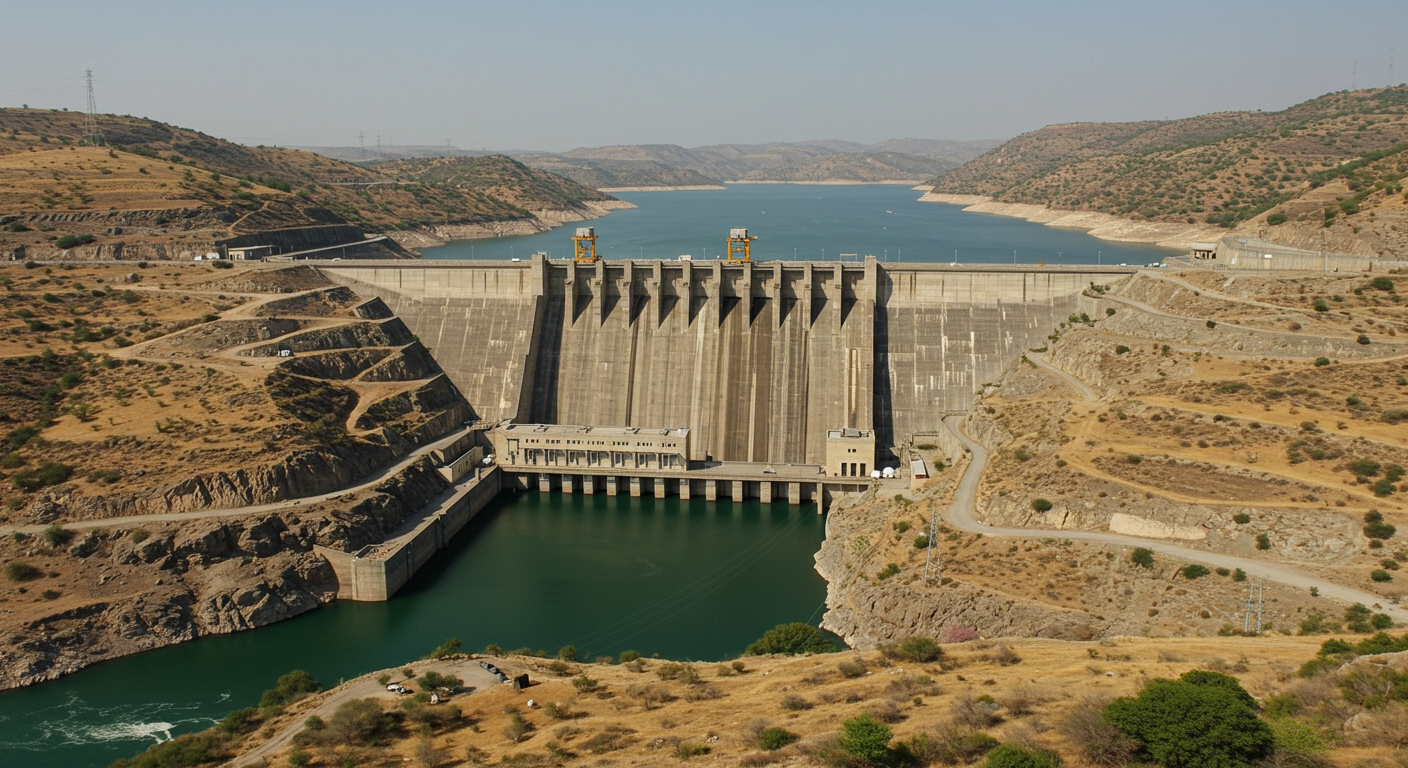
Current Dams Status in Pakistan
Pakistan today faces one of the most critical water crises in its history, and much of it is tied to the country’s insufficient dam infrastructure and poor water storage capacity. Despite being an...

Pakistan today faces one of the most critical water crises in its history, and much of it is tied to the country’s insufficient dam infrastructure and poor water storage capacity. Despite being an agricultural economy heavily reliant on river systems, Pakistan has struggled to build enough reservoirs to store water for long-term use. The country wastes trillions of gallons of water each year simply because it lacks the capacity to hold it. This crisis is not only about scarcity but also about vulnerability, as floods, extreme weather events, and mismanagement further compound the situation. Understanding the current status of dams in Pakistan highlights the urgency for reforms in water management and infrastructure development.
At present, Pakistan has 815 dams across the country, according to the Federal Flood Commission’s Annual Report of 2023. Out of these, 290 are categorized as large dams, while 216 fall into the small and medium category. However, this number remains strikingly low compared to countries that face similar or greater water challenges. The inadequacy of storage infrastructure results in wastage of nearly 10 trillion gallons of water every year, which flows unchecked into the sea. For a country that regularly experiences both drought and flooding, this paradox underlines how underinvestment in reservoirs has left Pakistan extremely vulnerable.
Currently, the storage status of major dams shows how precarious the situation is. The Tarbela Dam, one of the largest in the country, is filled to capacity, holding around 5.85 million acre-feet (MAF) of water. Similarly, the Mangla Dam has reached about 75% of its capacity, storing 5.48 MAF out of 7.28 MAF. Other dams like Rawal, Khanpur, and Simly are also filled to capacity but collectively store only a fraction compared to the large reservoirs, ranging between 0.02 and 0.07 MAF. Hub Dam, situated in Sindh, holds around 0.51 MAF, which is about 80% of its capacity. This distribution highlights the country’s heavy dependence on a few large dams while smaller dams play only a limited role in the broader water management system.
The gross capacity of all available dams in Pakistan, whether small, medium, or large, is 21.17 MAF. Yet, due to the natural process of siltation and sedimentation, the live storage capacity has dropped to just 13.68 MAF. This reduction means that reservoirs cannot hold as much water as they were originally designed to. Sedimentation not only shrinks capacity but also affects the long-term sustainability of water supply, irrigation systems, and hydroelectric power generation. The loss of effective storage intensifies Pakistan’s water insecurity, especially when compared to neighboring countries. India, for instance, has developed the capacity to store water for 190 days of consumption, whereas Pakistan can only store enough to meet its needs for 30 days. Such disparity shows how far behind Pakistan lags in water security measures.
The consequences of this limited capacity are profound. Without sufficient dams, Pakistan cannot harvest and store surplus rainfall or glacial melt. Each year during the monsoon season, the country experiences flash floods in some regions and acute shortages in others. For instance, in just two months of monsoon rains (July to August 2025), the total expected discharge into the sea has been about 14 MAF, more than the existing storage capacity of the country. Since July 1, 2025, escapage below Kotri into the Arabian Sea has reached 9.04 MAF. These statistics reveal how much fresh water is being lost simply because there is nowhere to store it. With heavy rainfall in regions like Swat and Kashmir expected to continue, even more water will flow into the sea without serving any productive purpose.
The consequences are not limited to water scarcity alone. When dams cannot store excess water, communities become more exposed to floods and related disasters. Lack of reservoirs also hampers hydroelectric generation, forcing Pakistan to rely more on imported fuel for energy production. Moreover, the agriculture sector—which forms the backbone of the economy, faces uncertainty, as farmers cannot rely on consistent irrigation flows. The inability to stabilize water supplies undermines food security and economic growth, both of which are vital for Pakistan’s stability.
Historically, Pakistan has underinvested in large-scale water infrastructure. The construction of dams like Tarbela and Mangla during the 1960s and 1970s was a milestone that gave a substantial boost to storage capacity. These dams served as lifelines for agriculture and hydropower. Yet, in the decades since, very few additions have been made. While other countries have aggressively expanded their reservoir networks to match rising population and industrial needs, Pakistan has been slow to act. The result is a growing gap between water supply and demand.
Looking ahead, the statistics paint a worrying picture. With population growth, climate change, and increasing water consumption, the pressure on existing dams is intensifying. Experts warn that unless Pakistan invests urgently in expanding its storage capacity, the future will be marked by recurring shortages, devastating floods, and worsening food insecurity. The National Water Policy of 2018 acknowledged these challenges, but implementation has remained slow.
The current state of Pakistan’s dams reflects both a technical and a governance challenge. On one hand, siltation and outdated infrastructure are limiting storage capacity. On the other, lack of political will and bureaucratic delays have stalled the development of new projects. The country cannot afford this inertia any longer. Building new reservoirs, rehabilitating existing dams, and investing in modern water management systems are no longer optional, they are essential for national survival.
Pakistan’s dam infrastructure is dangerously inadequate to meet the needs of its people, economy, and environment. With only 30 days’ worth of water storage, compared to months in neighboring countries, the country faces a severe disadvantage in terms of water security. The wastage of trillions of gallons into the sea every year, alongside increasing threats from climate change, highlights the cost of decades of neglect. If Pakistan is to ensure a secure and sustainable future, urgent reforms in dam construction, sediment management, and water governance are necessary. Without these steps, the looming water crisis could evolve into a full-scale national emergency.
Author