


Ceasefire Collapses: US Strikes Iranian Targets as Hormuz Flares
POLICY WIRE — DUBAI, United Arab Emirates — An uneasy quiet in the Persian Gulf is an oxymoron, apparently. While diplomats hashed out an elusive peace, merchant ships still had to dodge kinetic...

POLICY WIRE — DUBAI, United Arab Emirates — An uneasy quiet in the Persian Gulf is an oxymoron, apparently. While diplomats hashed out an elusive peace, merchant ships still had to dodge kinetic steel, exposing the chasm between whispered agreements and the brass-tacks reality on the high seas. This isn’t a pause in fighting; it’s a grim dance of brinkmanship where every step threatens to spill over into something much larger—something, frankly, America claims it won’t tolerate for much longer.
On Saturday, the United States military struck ten targets in Iran, acting at President Donald Trump’s direction. It was a clear, if heavy-handed, response. These weren’t pinpricks, but precision hits against significant infrastructure. US Central Command, through its chosen digital megaphone, detailed that American aircraft specifically targeted Iranian military surveillance infrastructure, communication systems, air defense sites, drone storage facilities, and minelayer capabilities. Not a small undertaking. It happened after yet another merchant vessel, the Kiku, found itself in harm’s way just that morning, targeted by a one-way drone.
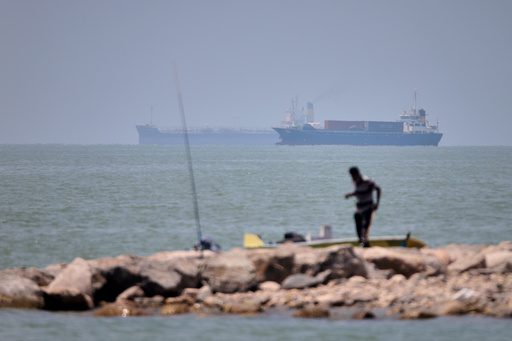
The geography tells part of the story. These latest blows hit multiple locations in — and around the Strait of Hormuz. For Washington and its allies, that narrow channel—a global chokepoint for roughly a fifth of the world’s daily oil consumption—isn’t merely an economic thoroughfare; it’s a strategic flashpoint. The Kiku, for example, was laden with more than two million barrels of crude oil. That’s a staggering quantity, navigating waters that are turning ever more treacherous. But you can’t blame these captains for trying, they’re simply following established alternative routes designed to circumvent what Tehran insists is its sovereign turf.
And speaking of sovereignty, Iranian lawmaker Ebrahim Azizi, who heads the national security commission in Tehran’s parliament, had a rather direct message on Friday: “the Strait of Hormuz is governed by Iran, so: Respect the rules.” A multinational maritime body, actually overseen by the US Navy, just announced it’d expand an Omani route, letting both inbound and outbound traffic sidestep those contentious Iranian waters. Because navigating a hostile strait isn’t exactly good for business—or lives, for that matter. The situation creates a new flashpoint, which Tehran sees as key leverage in ongoing talks. Quite the pickle, isn’t it?
President Trump, never one for subtlety, reiterated his frustration. On his preferred social media platform, he stated the US had “struck Iranian missile and drone storage locations, and coastal radar sites, for violating the Cease Fire Agreement, AGAIN!” Then came the hammer: a chilling warning about reaching a point where the US may no longer be able to be reasonable “and will be forced to militarily complete the job.” His parting thought: “If that happens, the Islamic Republic of Iran will no longer exist!” Strong words—unprecedented ones for a leader supposedly shepherding a peace process. Vice President JD Vance, the chief negotiator, earlier stated that Iran should “pick up the phone” if there were disagreements but then warned that “violence will be met with violence.” This rather direct phrasing from Vance, covered recently by Policy Wire (read more on Vance’s rhetoric here), pretty much sums up the administration’s posture. It’s hard to make a lasting peace when everyone’s flexing. But, here we’re.
📄 POLICY WIRE WHITEPAPER PUBLISHED: PAKISTAN'S NATIONAL SECURITY POLICY PRIORITIES
👉 READ BY CLICKING HEREThe day’s chaos wasn’t limited to just American actions. Bahrain, a crucial regional ally — and home to the US Navy’s 5th Fleet, reported it too was targeted. Its Foreign Ministry issued a statement saying “a number of Iranian drones” targeted the country, calling it “a flagrant threat to the security of citizens and residents.” No immediate damage reported there. But imagine the jitters across the Gulf—Bahrain, after all, recently hosted US Secretary of State Marco Rubio and a GCC foreign ministers meeting that demanded an end to Iran’s attacks and a truly open strait. It highlights how widespread the current instability truly is within the broader Muslim world, a region already grappling with the economic ramifications of continued disruption.
Just what do they talk about in those negotiation rooms? Well, keeping ships moving through the Strait is a huge one, alongside untangling Iran’s nuclear program and its enriched uranium stockpiles. They’ve got 60 days under this interim deal to iron out those details. Because ultimately, this isn’t just about regional power plays; it’s about global commerce. An estimated 115 ships have managed to exit the strait in recent days, as global organizations fret over the threat landscape. Iran, for its part, has already insisted on charging fees for transit—a notion flatly rejected by the US and Gulf Arab states.
What This Means
This escalating tit-for-tat doesn’t merely strain a ceasefire; it actively dismantles it, thread by precarious thread. Politically, President Trump’s blunt ultimatum — “Islamic Republic of Iran will no longer exist!” — dramatically raises the stakes, possibly alienating allies more interested in de-escalation than regime change. The implicit message is clear: the United States is willing to forgo diplomatic niceties for kinetic results. Economically, the immediate impact on global oil markets will be unsettling. Attacks on tankers and vital infrastructure, coupled with Iran’s stated intention to charge transit fees for a self-proclaimed international waterway, create immense uncertainty. Businesses crave predictability; the Strait of Hormuz now offers precisely the opposite. For the wider South Asian and Muslim world, particularly energy-importing nations like Pakistan, this volatility spells increased oil prices and significant supply chain risks. Instability here destabilizes much farther afield, hitting consumers’ wallets and challenging the geopolitical assumptions of everyone from New Delhi to Ankara. It’s not just a regional spat; it’s a global headache, currently throbbing in an area that simply cannot afford prolonged military adventurism.