

Beijing’s Aerial Enigma: A Crash, A Cover-Up, and the Calculus of Control
POLICY WIRE — Beijing, China — Not every crash makes a noise like an aircraft impact. Sometimes, the loudest sound is silence. For citizens of the People’s Republic, the initial echo of a light...

POLICY WIRE — Beijing, China — Not every crash makes a noise like an aircraft impact. Sometimes, the loudest sound is silence. For citizens of the People’s Republic, the initial echo of a light sport aircraft slamming into the capital’s tallest skyscraper last Friday wasn’t the physical collision itself, but the almost instantaneous digital disappearance of all evidence. Because the state’s digital sweepers move faster than the city’s emergency services, often. This, it seems, is Beijing’s first response to unexpected calamity: an immediate, almost instinctive suppression of narrative.
Then came the barebones admission. Authorities in the Chaoyang district, that sprawling, energetic business quarter, finally conceded the facts. A small plane had [QUOTE_PLACEHOLDER] into a building in Beijing the day before, leading to casualties. We’re talking one pilot, dead, — and [QUOTE_PLACEHOLDER] injured, which, as these things go, isn’t catastrophic. The craft, specifically, was [QUOTE_PLACEHOLDER], and it [QUOTE_PLACEHOLDER] with a high-rise building [QUOTE_PLACEHOLDER] at 5:55 p.m. on Friday.
Details? They were sparse. The quick hit statement on WeChat provided zero help; it simply [QUOTE_PLACEHOLDER] or [QUOTE_PLACEHOLDER]. They did, however, confirm the pilot [QUOTE_PLACEHOLDER]. Not much to go on, really. But some facts just can’t stay buried, even in China’s tightly curated information ecosystem. Global flight-tracking service provider Flightradar24 had other ideas, announcing on Friday that the incident wasn’t just any building. No. It was the CITIC Tower, also known as China Zun.
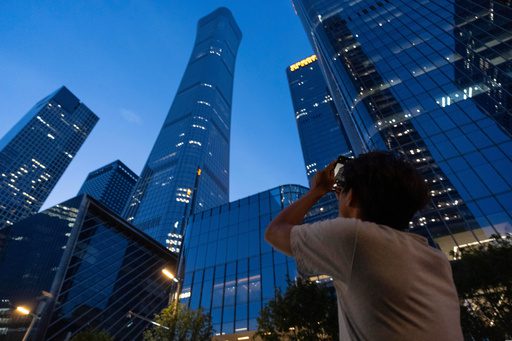
This isn’t some backwater office block. The China Zun [QUOTE_PLACEHOLDER], making it [QUOTE_PLACE_HOLDER] — literally. It’s a structure so iconic it’s [QUOTE_PLACEHOLDER]. And a plane hit it. Hard. Associate Press photographers later confirmed the collision, showing [QUOTE_PLACEHOLDER] — that’s what happens when you’ve got something over 1,700 feet high made mostly of glass. And guess what? [QUOTE_PLACEHOLDER]. They work fast.
Flightradar24 wasn’t done. They broadcast the path of the Sunward SA 60L Aurora, which had [QUOTE_PLACEHOLDER]. It then [QUOTE_PLACEHOLDER]. An eyebrow-raising journey, you’ve got to admit, in a [QUOTE_PLACE_HOLDER]. Such strictures make the very idea of a light plane traversing metropolitan airspace, let alone striking its tallest building, seem — well, improbable. Naturally, an investigation is underway, as they always are. It wasn’t clear, officially, if the injured were inside the building or just caught in debris. But they were [QUOTE_PLACEHOLDER], which is, I suppose, the only certainty officials were willing to offer.
The strategic symbolism here is heavy. CITIC Tower itself isn’t just another pretty skyscraper; it’s a mere [QUOTE_PLACE_HOLDER] from Zhongnanhai, which is basically the [QUOTE_PLACE_HOLDER], and a quick [QUOTE_PLACE_HOLDER] from the Forbidden City. Its proximity to these power hubs makes the incident even more politically sensitive. And that sensitivity? It explains the immediate digital vanishing act. [QUOTE_PLACE_HOLDER], despite this, [QUOTE_PLACE_HOLDER]. Even reports from reputable sources like [QUOTE_PLACE_HOLDER] about the [QUOTE_PLACE_HOLDER] were scrubbed, made [QUOTE_PLACE_HOLDER]. For the state, [QUOTE_PLACE_HOLDER]. Full stop.
📄 POLICY WIRE WHITEPAPER PUBLISHED: PAKISTAN'S NATIONAL SECURITY POLICY PRIORITIES
👉 READ BY CLICKING HEREBut the bits — and pieces of information did leak. Images on social media (circulating mostly outside the ‘Great Firewall,’ of course) purported to show wreckage near the tower. While [QUOTE_PLACE_HOLDER], the authenticity remained questionable, naturally. Still, [QUOTE_PLACE_HOLDER] — pretty specific stuff, if true. This aircraft, B-12PP, was apparently operated by [QUOTE_PLACE_HOLDER], often linked to [QUOTE_PLACE_HOLDER]. Their [QUOTE_PLACE_HOLDER]. They’re the outfit that [QUOTE_PLACE_HOLDER], among other things. And for context, this specific model, the SA 60L, produced by Starair Aircraft, is a big deal; it [QUOTE_PLACE_HOLDER]. That’s according to Starair’s own website. The machine can hit a [QUOTE_PLACE_HOLDER] — and lift a [QUOTE_PLACE_HOLDER]. Small plane, but not insignificant.
What This Means
The Beijing plane crash isn’t really about a plane, not fundamentally. It’s about control. Because any deviation from the carefully constructed facade of order is met with swift, uncompromising censorship. This isn’t just about an aircraft accident; it’s an immediate litmus test for the state’s capacity to manage perception, especially when its own hallowed institutions — its tallest building, a stone’s throw from the Party’s inner sanctum — are touched. For China, domestic stability hinges on an appearance of unflappable authority, and an accidental aerial mishap challenging this is seen as a chink in the armor.
The speed with which digital evidence evaporated — the very notion that social media posts about such a visible, high-impact event could be effectively scrubbed in mere hours — should be a sober reminder. And that’s a lesson Pakistan, or any nation navigating its own nascent media landscape in the broader Muslim world, might ponder. While Pakistan’s press isn’t under Beijing’s iron grip, the inclination towards information control during sensitive incidents isn’t entirely alien. Here, though, it’s systemic, an art perfected over decades. Economically, while this isolated incident won’t shake markets, it’s a whisper of risk; if information control extends to official investigations, it can breed opacity, something international investors and partners eyeing Chinese infrastructure projects (say, along the CPEC corridor in Pakistan) inherently distrust. But hey, it’s just one pilot, right?