
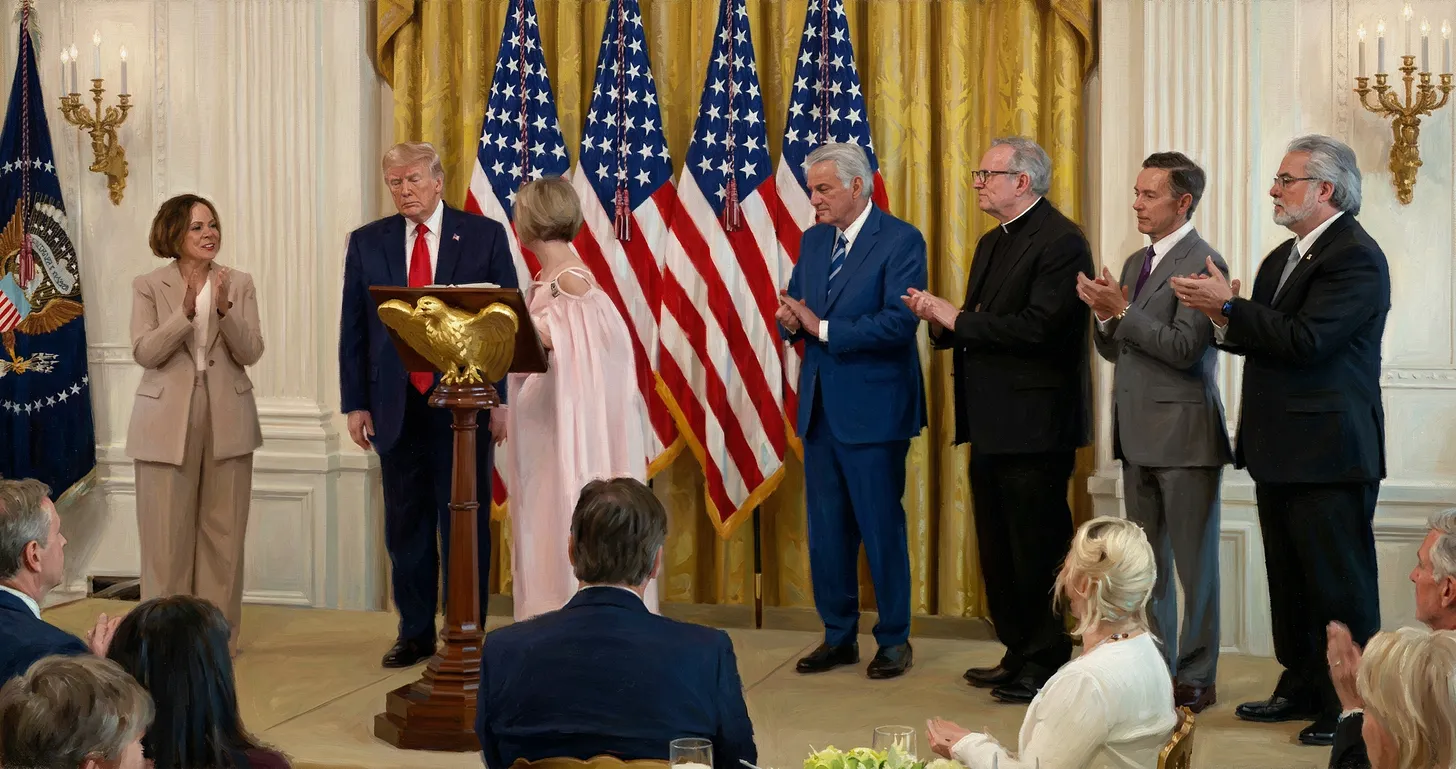
Catholic Bishops Express Regret Over Politicized White House Prayer Photo With Trump
Catholic bishops express deep regret over a White House meeting with Donald Trump, stating that prayer photos were manipulated for partisan political purposes.

POLICY WIRE — Washington, D.C. — Two prominent Catholic bishops have expressed deep regret after agreeing to a White House meeting that resulted in the publication of a publicly distributed photograph showing them praying alongside President Donald Trump.
Milwaukee Archbishop Jeffrey Grob released a public statement on Sunday addressing the gathering, noting that he had been met with numerous distraught inquiries regarding the Thursday event, which was also attended by 11 other bishops.
Grob stated that the administration quickly disseminated images and video footage of the event without the consent of the attendees, doing so less than two weeks before the upcoming midterm elections.
Expressing profound sadness, Grob remarked that an act as sacred as prayer to the Heavenly Father was manipulated for political optics.
Des Moines Bishop William Joensen echoed similar sentiments in his own statement, acknowledging that he felt the church leaders had been taken advantage of by the administration.
Joensen noted that he wished he had approached the situation with greater wariness rather than simplicity, expressing a desire to be wiser in future political engagements while maintaining a willingness to pray for leaders at all levels.
When questioned about whether the White House obtained explicit permission to release the media, the presidential press office declined to directly answer the inquiry.
Instead, White House spokeswoman Taylor Rogers defended the administration, emphasizing the president’s strong record of support for Catholic Americans.
According to accounts from Joensen and Grob, the original invitation was extended in September to discuss specific policy topics, including immigration enforcement, religious worker visas, abortion access, and federal tax credits for private education.
Grob emphasized that the gathering was never intended as an endorsement of the president, his policy platform, or his political party, noting they were informed it would remain a private discussion featuring potential appearances by Catholic cabinet members.
Shortly after the private gathering concluded, however, the White House published visual media of the prayer session online.
Grob noted that he promptly began receiving messages expressing serious concern that he had accidentally lent credibility to a political campaign event shortly before a national vote.
He also heard directly from individuals who felt hurt because they or their families had suffered negative consequences from the administration’s policy decisions.
Admitting he entered the meeting with lingering reservations, Grob concluded by apologizing for any harm caused by his participation.
Across the broader U.S. Conference of Catholic Bishops, viewpoints regarding Trump and his administrative policies remain varied and diverse.
Minnesota Bishop Robert Barron previously accepted a position on Trump’s Religious Liberty Commission, which largely consists of conservative Christian figures, while other bishops have sharply criticized aggressive immigration enforcement tactics as contrary to Catholic doctrine.
Reporting by Policy-Wire (PW)