

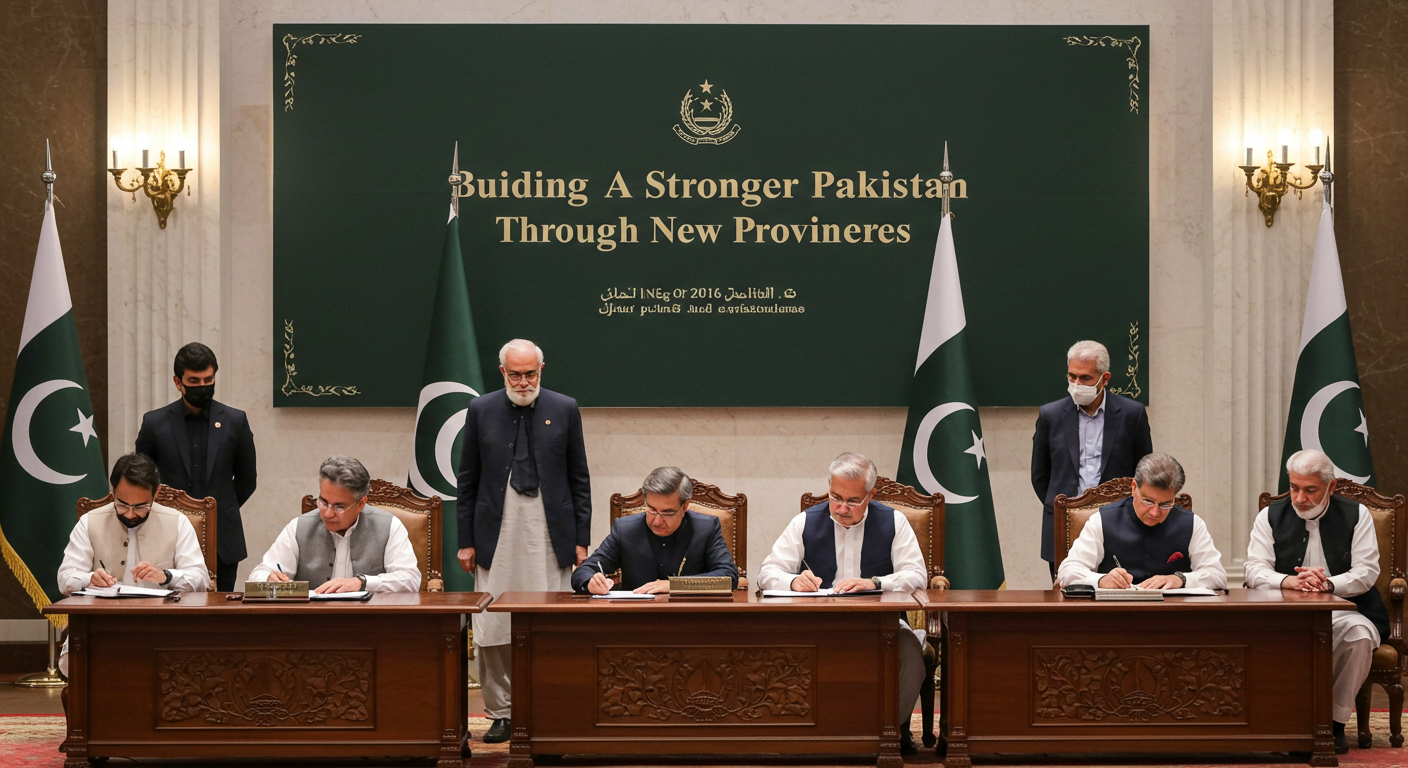
Building a Stronger Pakistan Through New Provinces
Pakistan is a country full of promise. From the mountains of Gilgit to the coasts of Karachi, it has a rich culture, a young population, and an abundance of natural resources. Yet, despite this...

Pakistan is a country full of promise. From the mountains of Gilgit to the coasts of Karachi, it has a rich culture, a young population, and an abundance of natural resources. Yet, despite this potential, many Pakistanis feel left behind. Some regions flourish with modern infrastructure and opportunities, while others struggle for the basics, clean drinking water, proper healthcare, good schools, and jobs.
This unequal growth is not simply a matter of geography. It is tied to how power and resources are distributed across the country. For decades, Pakistan has functioned under a four-province system, a model that no longer matches the needs of a population of more than 240 million. In today’s Pakistan, where challenges are complex and the demand for services is rising, the government must consider bold reforms. One such reform is the creation of new provinces, not as a division of the country, but as a way to strengthen the federation and bring governance closer to the people.
At the heart of the debate is Punjab, which accounts for nearly 53 percent of Pakistan’s total population. With its demographic weight, Punjab naturally commands greater representation in parliament, greater influence in policymaking, and a larger share of federal transfers. While Punjab’s development is a success story in many ways, this dominance often leaves other provinces, especially Balochistan, interior Sindh, and parts of Khyber Pakhtunkhwa, feeling sidelined. The result has been growing frustration in underdeveloped areas. For example, South Punjab has long demanded its own province, arguing that Lahore cannot fairly address the needs of its distant and disadvantaged districts. Similarly, Balochistan, despite its vast natural resources, continues to struggle with poverty and poor infrastructure. The sense of inequality is real, and if ignored, it can fuel resentment and instability.
One practical solution lies in restructuring Pakistan into 32 provinces: 10 in Punjab, 8 in Balochistan, 7 in Sindh, and 7 in Khyber Pakhtunkhwa. This model would bring several benefits. Smaller provinces would balance Punjab’s demographic dominance, ensuring that no single region overshadows the others. Each new province would have its own assembly, high court, and administrative capital, reducing pressure on existing institutions. With nearly 280,000 cases pending and judges handling an average of 1,964 cases each, Pakistan’s judiciary is under immense stress. More provinces would mean more high courts and benches, speeding up justice and restoring public trust. Instead of everyone migrating to Lahore, Karachi, or Islamabad for jobs and services, new provincial capitals would create hubs of growth in smaller cities. This would ease the population pressure on big cities and give citizens opportunities closer to home.
International experience also shows the benefits of smaller administrative units. India has 28 states, Turkey 81 provinces, and Iran 31. These divisions make governance more efficient and responsive to local needs. Pakistan, with its huge population, cannot continue with only four provinces. The world has moved forward, and Pakistan too must modernize its governance structure.
Some argue that creating more provinces will weaken Pakistan or divide its people. The reality is quite the opposite. Smaller provinces would make citizens feel more included in the system, reducing grievances that often turn into political or ethnic tensions. Rather than competing with each other, provinces would be able to cooperate as equal partners. Decentralization would not break the federation; it would reinforce it by ensuring that no Pakistani feels ignored. This vision aligns with the government’s commitment to inclusiveness and balanced development.
The idea of more provinces should not be seen as a threat to the federation but as an opportunity for state-building in the 21st century. The current government has already taken steps to highlight the importance of addressing regional disparities through targeted development projects and resource allocations. Moving toward a 32-province framework would be a natural continuation of this effort, bold, visionary, and people-centered. This reform would not only help citizens directly but also strengthen national unity at a time when Pakistan needs it most. By addressing inequalities today, the government would prevent them from turning into larger conflicts tomorrow. It would also send a strong message that Pakistan values fairness, justice, and inclusiveness for all its people.
📄 POLICY WIRE WHITEPAPER PUBLISHED: PAKISTAN'S NATIONAL SECURITY POLICY PRIORITIES
👉 READ BY CLICKING HEREPakistan stands at a turning point. Its young population demands opportunities. Its cities are overcrowded. Its judiciary is under strain. And its smaller provinces are asking for fairness. The four-province model has reached its limits. By moving toward a 32-province system, Pakistan would not only ease the burden on existing institutions but also unlock new opportunities for growth across the country. From Quetta to Multan, from Sukkur to Swat, new provincial capitals would rise as centers of hope and progress.
This is not just about drawing new boundaries on a map. It is about building a stronger, fairer, and more united Pakistan. It is about ensuring that no region is left behind and that every citizen feels represented. The creation of more provinces is not a challenge to the federation, it is a way to save it. With careful planning, strong political will, and government leadership, Pakistan can move toward a future where governance is efficient, resources are fairly distributed, and justice is accessible to all.
A Pakistan of 32 provinces would be a Pakistan where opportunity is spread, unity is strengthened, and hope is renewed. This is the vision of a brighter tomorrow, and it is a vision worth pursuing.
Author