


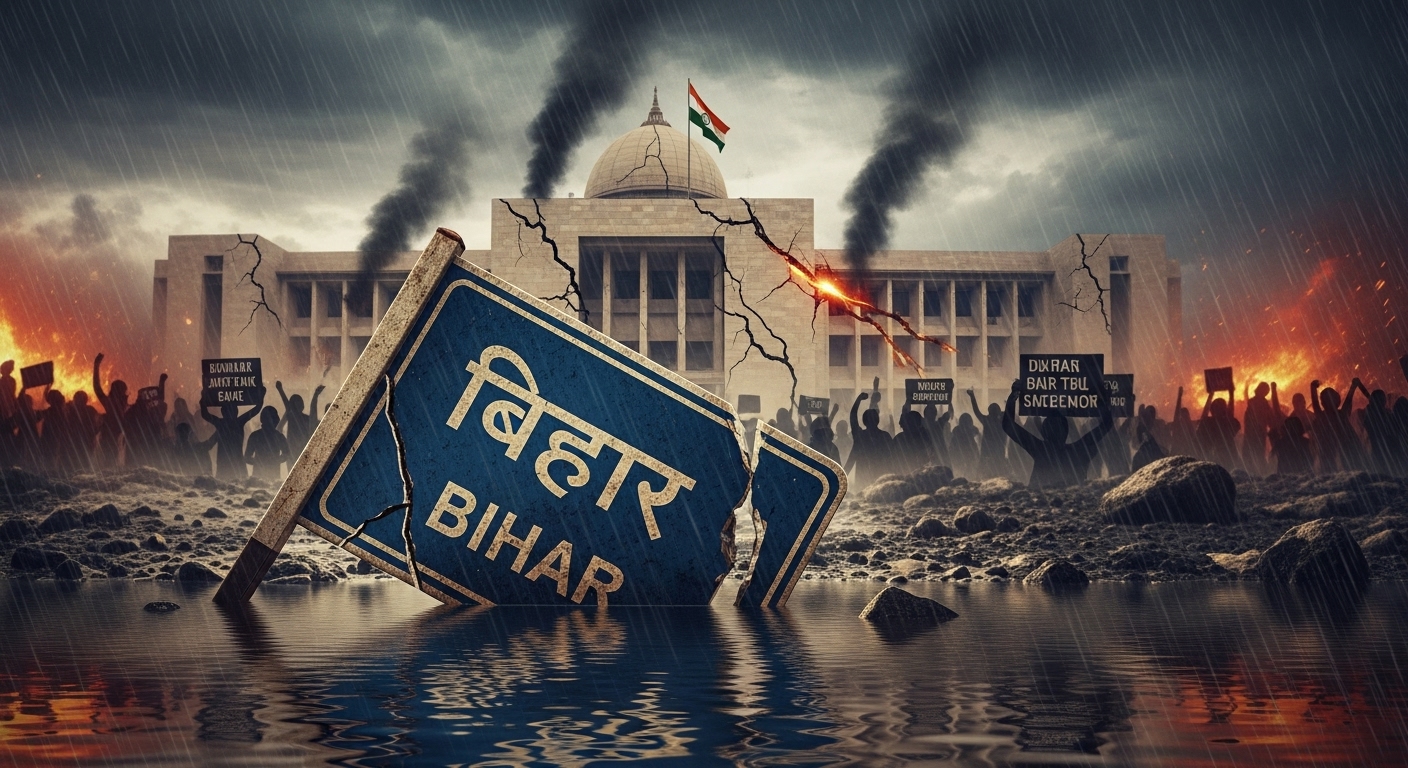
Bihar’s Boiling Point: When Governance Turns Into a Battlefield
Bihar has experienced political turbulence for decades, yet the crisis unfolding today is distinct in its depth and direction. It is not the result of one miscalculated reform but the cumulative...

Bihar has experienced political turbulence for decades, yet the crisis unfolding today is distinct in its depth and direction. It is not the result of one miscalculated reform but the cumulative outcome of a governance style that prioritizes centralization over consultation, control over cooperation, and administrative force over democratic sensitivity. What is emerging now is a rare convergence of institutional frustration, citizen anxiety, and community pushback. From local representatives to young voters to minority groups, every segment is signaling the same concern: the state is being reshaped without listening to those who inhabit it.
The tension brewing within municipal bodies illustrates this trend clearly. The Bihar Municipal Amendment Ordinance 2025 has triggered protests in all 38 districts, and their reaction is far more significant than a routine dispute over administrative changes. Municipal leaders believe the ordinance reorganizes governance structures in a way that sidelines elected councils and concentrates power in the hands of “chief councilors,” who would operate under stronger influence from MLAs and bureaucrats. For local representatives already struggling with limited resources, the amendment feels like the final step in weakening grassroots democracy. Their unity across party lines is striking, because it reveals that the resistance is not rooted in partisanship but in protecting institutional relevance. Leaders who rarely agree on political matters now find themselves aligned in defending the principle of decentralized governance, which they believe is being systematically diluted.
In parallel to this, the Special Intensive Revision of electoral rolls has created a different kind of fear, one tied directly to democratic participation. New documentation requirements and rushed verification methods have alarmed young voters, activists, and civil society groups who fear that many citizens could lose their eligibility to vote. Bihar’s young population, already worn down by unemployment, limited opportunities, and weak public services, now sees the legitimacy of their political voice under threat. The timing of the revision and the political climate surrounding it have turned what could have been a routine administrative exercise into a crisis of democratic trust. Memories of national-level debates on citizenship and identification deepen the anxiety. For the poorest citizens who struggle with paperwork and documentation, the sense of vulnerability is even more acute.
For Bihar’s Muslim community, the proposed amendments to the Waqf Act have added another layer of tension. Community leaders argue that the amendments extend state oversight into religious institutions that have long functioned with internal autonomy. In an environment where minority institutions often feel scrutinized, this bill has triggered fears of cultural and administrative intrusion. Organizations such as the All India Muslim Personal Law Board have warned that the amendments could undermine the independence of Waqf properties, which hold deep religious and communal significance. The protests surrounding the bill reflect a deeper anxiety about identity, heritage, and the fear that state power may gradually absorb community-managed spaces.
At this point, Bihar’s unrest begins to resemble a phenomenon discussed extensively in political theory and conflict studies. Scholars of intrastate conflict argue that societies move toward heightened unrest when multiple groups simultaneously feel excluded from decision making, when local autonomy is reduced, and when political channels appear blocked or unresponsive. Some describe this as the grievance accumulation phase, a period in which dissatisfaction spreads across different layers of society even without violent confrontation. Bihar is not undergoing a civil war, but it displays the early structural features that theorists associate with rising political friction: centralization of authority, erosion of public trust, alienation of youth, and tension around identity-based institutions. When municipalities, young citizens, and minority communities all feel that the state is governing without listening, the political environment becomes volatile long before any open conflict emerges.
Although Bihar is governed by a coalition, the ideological imprint of the Bharatiya Janata Party is clearly visible in the style and direction of these developments. Centralization has long been a hallmark of BJP-led administrations both at the national level and in the states. This preference for concentrated authority appears in the municipal amendments that transfer power upward rather than downward. It is visible in the voter roll revision that mirrors national exercises where documentation and verification are used as tools that reshape political participation. It also shapes the mistrust surrounding the Waqf amendments, where minority institutions often perceive administrative expansion as politically motivated. These are not isolated or disconnected incidents. They fit a pattern in which governance is used to consolidate control, tighten oversight, and restructure institutions in ways that privilege the state’s authority over democratic engagement.
The unrest gripping Bihar is therefore not accidental. It is the predictable outcome of political choices that have reshaped institutions without considering the social consequences. Municipal bodies feel that their democratic space is shrinking. Young voters fear that their right to participate in elections is being placed behind administrative barriers. Minority communities believe that their cultural and religious autonomy is being chipped away. In each case, state policies have intensified tension instead of alleviating it. What could have been resolved through dialogue has been transformed into confrontation. What required cooperation has been replaced with unilateral decision making.
If Bihar is to regain stability, the ruling establishment must rethink its approach. The state cannot be governed through control alone. It requires participatory governance, respect for institutional autonomy, and transparent decision making. Bihar’s citizens are not rejecting development or administrative reform. They are rejecting exclusion from decisions that will shape their political, civic, and cultural futures. The turmoil in the state serves as a clear reminder that governance loses legitimacy when it stops listening. Today, the people of Bihar are demanding a return to democratic dignity, institutional respect, and a governance framework that includes rather than overshadows them. Only by restoring trust and opening political channels can the state hope to move away from this moment of rising unrest and regain the confidence of its people.
Author