


Beyond the Banners: Unpacking Xi’s Grandstand Play in Pyongyang
POLICY WIRE — Seoul, South Korea — It was less a summit of strategic titans, more a carefully choreographed stage play designed to project unwavering unity against an unseen antagonist. While the...

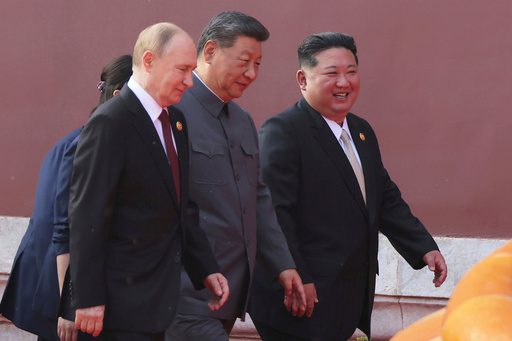
POLICY WIRE — Seoul, South Korea — It was less a summit of strategic titans, more a carefully choreographed stage play designed to project unwavering unity against an unseen antagonist. While the world watched footage of lavish airport welcomes and masses of citizens—balloons in hand, hopping with practiced glee—applauding the arrival of Chinese President Xi Jinping in Pyongyang, the true spectacle lay in the pointed silences. North Korea’s banned pursuit of nuclear weapons, a geopolitical hand grenade, received not a whisper, a conspicuous omission that spoke volumes about Beijing’s current priorities and the curious dynamic between two of the globe’s most isolated regimes.
See, on the surface, you’ve got these two leaders, Xi and North Korean leader Kim Jong Un, standing shoulder-to-shoulder, their respective state-controlled media outlets trumpeting a joint push for greater cooperation. But the real story, as always, is buried in what isn’t being said, in the space between the glowing official communiqués and the glaring geopolitical realities. Xi’s rare visit—his first to North Korea in seven years, mind you—was always about more than just old friendships. It was a cold, hard calculation about reasserting Beijing’s unique influence over its socialist neighbor, perhaps even a gentle tug on Pyongyang’s leash after Kim’s recent, enthusiastic dalliances with Moscow.
Kim, for his part, did lay it on thick. He affirmed that North Korea and China will maintain their friendship as “the most important top-priority strategic work.” He even called Xi “the greatest state guest,” a rather florid turn of phrase designed to inflate Xi’s ego, sure, but also to signal North Korea’s strategic alignment. Kim added that he views the fact Xi chose North Korea as a destination for his first foreign travel this year as “the most encouraging support” to North Korea. And just to show he was a good sport, he reiterated Pyongyang’s support for Beijing’s “one-China principle,” a standard diplomatic nod that comes cheap but is invaluable to Beijing’s narrative. The grandiosity continued with a military honor guard — and thousands of people staging a welcoming ceremony. Buildings surrounding the plaza were draped in the two countries’ flags, giant portraits of Kim and Xi and red-and-yellow banners welcoming the Chinese leader and celebrating the nations’ “friendship and unity.” Quite the show, wouldn’t you say?
Beneath the bluster, though, there’s a transactional heart beating. China has long been North Korea’s economic lifeline — and main diplomatic backer. Everyone knows it. Experts say China has avoided fully enforcing U.N. sanctions on North Korea — and sent clandestine aid to help its impoverished neighbor stay afloat. And why not? It suits Beijing to have a compliant, if erratic, buffer state on its border. The sheer weight of China’s economic leverage is a powerful thing, one that resonates across much of Asia, including in regions like Pakistan, where China’s Belt and Road Initiative (BRI) casts a long shadow, offering both opportunity and indebtedness. The strategic coordination, as both sides like to call it, aims to firmly safeguard their respective sovereignty and security interests.
But there’s a new variable in play. Pyongyang has been getting chummy with Russia, supplying troops and weapons to support its war against Ukraine, receiving economic and military assistance in return. Beijing can’t love sharing the spotlight, particularly not with Russia siphoning off resources — and attention. Restoring an exclusive influence over North Korea would give Xi leverage in dealings with U.S. President Donald Trump, who has repeatedly expressed his desire to restart diplomacy with Kim. That’s a card Beijing wants to hold, particularly with future talks with the Americans on the horizon.
And then there’s the big secret they’re both keeping: Kim’s nuclear program. While Xi and Trump, after their last meeting, confirmed their shared goal to denuclearize North Korea, Beijing’s public statements about Xi’s Pyongyang trip completely glossed over the issue. This contrasts sharply with Xi’s 2019 trip, when he was quoted by Chinese media as saying that Beijing was willing play a constructive role in the denuclearization of the Korean Peninsula. Now? Silence. Golden, perhaps, for Kim, who craves international recognition as a nuclear weapons state as a means to call for lifting of U.N. sanctions. Silent Embrace, Shifting Sands: Pyongyang and Beijing Tighten Grip as World Watches On.
This calculated omission from Beijing’s end speaks volumes. Because Kim hasn’t been shy. Ahead of Xi’s visit, North Korea made it clear again that it’s advancing nuclear program is non-negotiable. He unveiled a new plant to produce nuclear ingredients and vowed to bolster the country’s nuclear forces “at an exponential rate.” His sister and senior official, Kim Yo Jong, also dismissed as an “anachronistic dream” a U.S. push for the denuclearization of North Korea. South Korean President Lee Jae Myung told reporters Monday that North Korea is producing enough nuclear ingredients annually for about 10 to 20 bombs. That’s a staggering figure, offering a chilling glimpse into the true capabilities emerging from the hermit kingdom. Chinese officials have taken the position of not speaking publicly about denuclearization on the Korean Peninsula while still maintaining it as a long-term goal. But, realistically, Kim appears to want Xi to accept North Korea as a nuclear neighbor. And maybe, just maybe, Beijing is slowly, quietly acceding.
What This Means
This high-profile, low-disclosure visit really does signal a worrying alignment of strategic interests for Washington and its allies. For China, it’s about reinforcing a critical geopolitical buffer, showing the Americans that it still holds sway over Pyongyang—a significant chip in any regional power struggle. Beijing’s quiet nod, or at least its very loud silence, on North Korea’s nuclear ambitions allows Kim a degree of international legitimacy he desperately seeks, while keeping him dependent on China for the economic lifelines (and possibly even the clandestine tech) that UN sanctions aim to choke off.
Economically, Pyongyang can’t solely rely on Russia. It’s got to align with China. Last year, the two-way trade volume between China — and North Korea recovered to pre-pandemic levels. China will likely continue to funnel economic aid packages like shipments of rice and fertilizers, and maybe even resume Chinese group tourism, which means a desperately needed influx of hard currency for a regime perennially short on funds. This strategic gambit by Xi means Washington’s efforts to isolate Kim—and curtail his nuclear program—become exponentially harder, necessitating a complete rethink of engagement strategies that extend far beyond the Korean peninsula. The regional implications for South Asia, particularly for nations navigating their own nuclear doctrines and Great Power dependencies like Pakistan, are palpable. Beijing’s playbook here offers a template for how a powerful nation might manage a prickly, nuclear-armed neighbor while simultaneously outmaneuvering global sanctions—a grim lesson, indeed.