


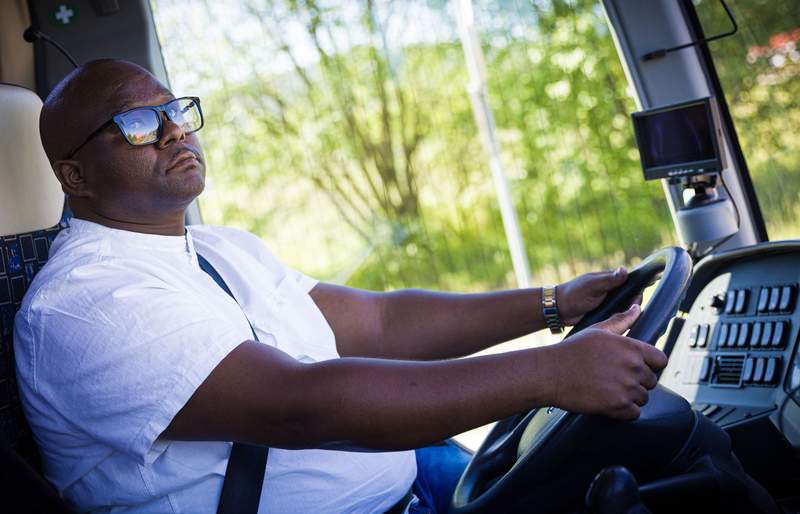
Berlin’s Road Ahead: The Unexpected Southern Compass for Europe’s Bus Lane Blues
POLICY WIRE — BERLIN, GERMANY — When an aging European superpower quietly scouts for bus drivers on another continent, it’s not just a story about vacancies; it’s an economic weather vane,...

POLICY WIRE — BERLIN, GERMANY — When an aging European superpower quietly scouts for bus drivers on another continent, it’s not just a story about vacancies; it’s an economic weather vane, pointing toward deeper currents of labor and demography. Germany, that famed engine of industry and precision engineering, finds itself scrambling not for advanced robotics experts, but for folks to get its citizens from point A to B.
Because, it turns out, even nations renowned for efficiency hit speed bumps. The latest one? A critical shortfall of public transport personnel. We’re talking thousands of missing drivers—the backbone of any functioning metropolitan system. So Berlin, ever practical, didn’t look inward, it looked, quite decisively, outward. To South Africa, specifically, a nation grappling with its own distinct set of economic realities.
It’s not your grandfather’s post-war migration; there’s no immediate, dramatic call-to-arms for ‘guest workers.’ This is a more subtle, yet arguably more profound, phenomenon. It reflects a widening chasm between Europe’s greying workforce and the younger, often underemployed, talent pools of the global south. It’s an arrangement, they’d tell you, of mutual convenience. But convenience has a way of shaping continents.
The recruitment drives aren’t flashy affairs. They don’t need to be. The offer itself—a job, a living wage in euros, and a pathway to a life beyond endemic local unemployment—speaks volumes. It bypasses the usual migrant channels, the harrowing journeys, opting for an organized, bureaucratic migration, complete with language courses and integration programs. It’s less of an exodus, more of a carefully choreographed skills transfer.
And what’s South Africa offering? A cadre of highly skilled, often experienced drivers, many already equipped with the heavy vehicle licenses needed for German streets. While Germany grapples with global talent shifts, its unemployment rate, though generally low, still shows pockets of severe structural issues in regions where driver scarcity bites hardest. In contrast, South Africa reported an unemployment rate of 32.9% in the fourth quarter of 2023, according to Statistics South Africa. This stark difference creates a powerful pull.
This isn’t to say it’s all smooth sailing. German bureaucracy remains a formidable beast, its tentacles reaching even into the seemingly simple act of importing bus drivers. Visa processes, driving license equivalencies, and the rigorous German language requirements—it’s enough to make anyone ponder an easier route. Yet, the appeal is so strong, recruits are still lining up. It’s less a desperation for them, more of a deliberate choice, an act of looking forward.
But the broader implications resonate far beyond autobahn service roads. This phenomenon, repeated in various forms across Europe, presents a curious mirror for countries like Pakistan. Where millions of its own skilled and semi-skilled workers venture abroad, remitting billions back home, the flow here reverses. It illustrates that labor, like capital, follows the path of least resistance—and highest reward. And for Europe, it’s increasingly becoming a question of finding bodies for essential jobs its own citizens are either too few for, or simply don’t want.
It raises questions of how long countries can sustain a brain-drain (or in this case, a ‘wheel-drain’) without affecting local services. For nations like Pakistan, where millions leave annually for opportunities in the Gulf or Europe, the experience of a ‘skills vacuum’ is an acutely familiar one. These orchestrated recruitment drives, targeting specific labor needs, are just another chapter in the global story of migration—a narrative that’s not about desperate flight, but strategic relocation of human capital. We’re looking at a structural shift in global labor markets. These shifts aren’t always dramatic; sometimes, they’re simply buses full of hope, heading north.
It’s clear Germany wants to bolster its public transport services without having to wait for its own population to magically increase its driving interest or birth rate. The government has openly expressed an interest in attracting skilled workers, [QUOTE_PLACEHOLDER] from various sectors.
What This Means
This calculated movement of bus drivers from the tip of Africa to the heart of Europe isn’t just about filling rotas; it’s a stark indicator of several convergent global trends. Economically, it signifies the deepening integration of global labor markets, where wage differentials and demographic disparities act as irresistible magnets. Germany, like many developed economies, faces a demographic squeeze—a greying population coupled with a declining interest in vocational, often lower-paying roles like public transport driving. Relying on an internal pipeline just isn’t cutting it anymore.
Politically, it highlights Europe’s complex relationship with migration. While populist rhetoric often rails against ‘uncontrolled’ immigration, specific, targeted recruitment efforts like this one demonstrate a practical necessity. It’s managed migration, tailored to specific national needs, designed to sidestep larger political anxieties by presenting it as a solution to an immediate problem. It also subtly expands the geopolitical orbit of European engagement, strengthening ties, however functional, with nations far beyond its traditional sphere of influence.
For South Africa and similar emerging economies (think Pakistan, Bangladesh, the Philippines), this represents a double-edged sword. While it provides critical economic opportunities, easing domestic unemployment and generating remittances, it also risks depleting a valuable segment of their skilled workforce. Imagine the impact on South Africa’s own public transport sector if enough experienced drivers are siphoned off. These policies, however small they seem initially, illustrate the kind of unforeseen outcomes that often emerge from macro-level demographic pressures meeting micro-level individual aspirations. Berlin needs buses to run; Johannesburg needs its young people to find work. And sometimes, those two needs create an entirely new map of movement.