


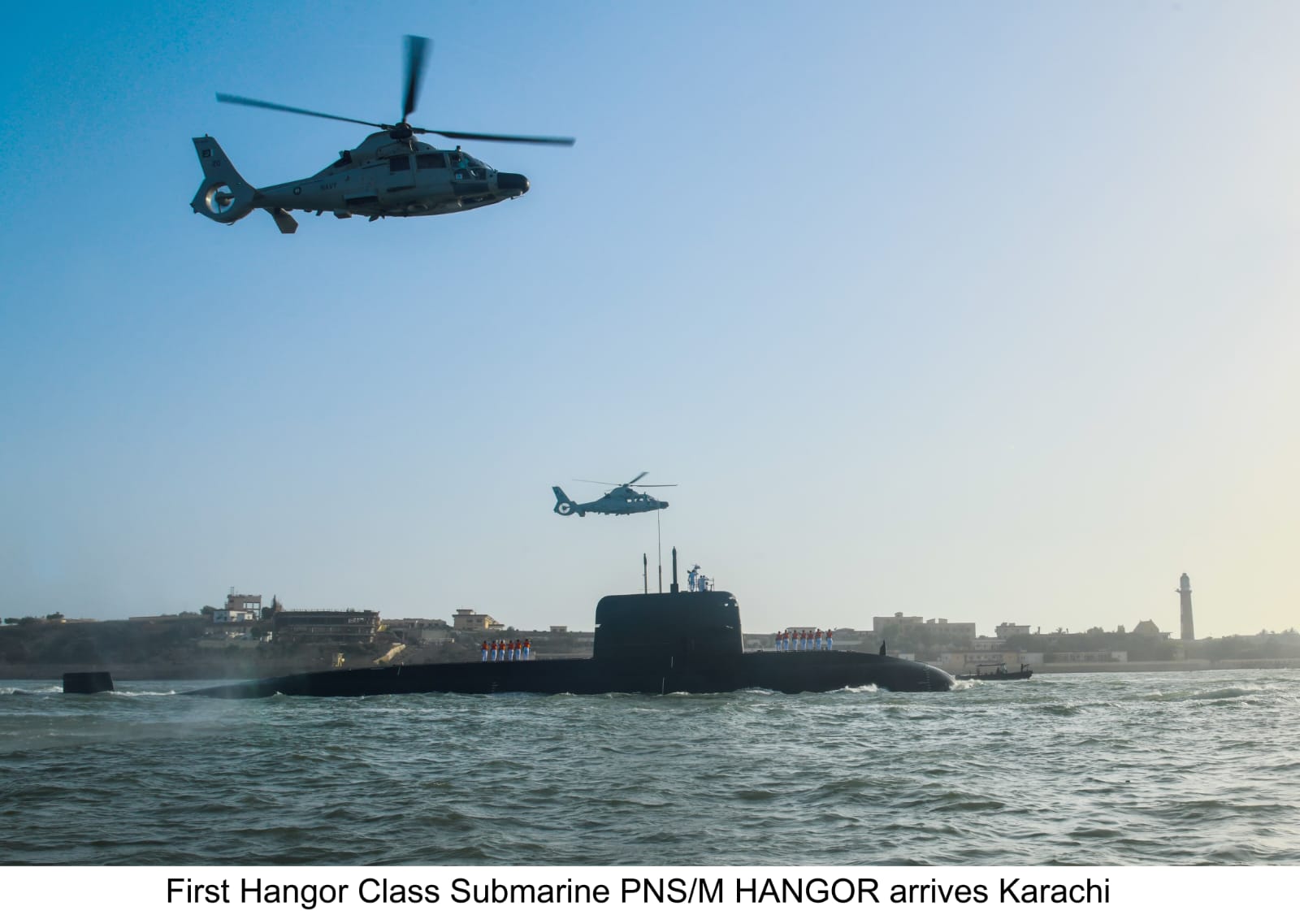
Beneath the Surface: What Pakistan’s Hangor-Class Firing Really Means
For Pakistan, the sea is more than a military frontier. It is an economic lifeline. On September 27, this reality gained a new strategic dimension when the Pakistan Navy’s newly inducted PNS/M Hangor...

For Pakistan, the sea is more than a military frontier. It is an economic lifeline. On September 27, this reality gained a new strategic dimension when the Pakistan Navy’s newly inducted PNS/M Hangor conducted its maiden live weapon firing in the North Arabian Sea. The submarine launched an anti-ship cruise missile and successfully engaged a designated long-range target, according to the Inter-Services Public Relations (ISPR). Chief of Naval Staff Admiral Naveed Ashraf witnessed the firing and highlighted the importance of strengthening Pakistan’s subsurface warfare capabilities.
The significance of the event, however, goes beyond one missile launch. It marks an important step in Pakistan’s attempt to build a more modern and survivable underwater force.
Pakistan is acquiring a total of eight Hangor-class submarines from China. Four are being constructed in China and four in Pakistan at Karachi Shipyard and Engineering Works (KSEW) under a technology-transfer arrangement. KSEW says its upgraded facilities are capable of constructing AIP-equipped submarines. This means the programme is not only about bringing new submarines into the fleet; it is also connected to Pakistan’s long-term shipbuilding and technical capabilities.
The first PNS/M Hangor was commissioned in Sanya, China, in April 2026 and arrived in Karachi in June. Only three months after reaching Pakistan, it demonstrated its weapon capability at sea. The sequence is important; commissioning a submarine is one stage, but integrating its crew, sensors, weapons and combat systems into operational service is another. The maiden firing provides a public indication that this transition is underway.
One of the most important features of the Hangor class is its Air Independent Propulsion, or AIP, technology. In simple terms, AIP allows a conventional submarine to remain underwater for longer periods without depending as frequently on atmospheric air. Combined with stealth features and modern sensors, this can improve a submarine’s ability to operate without being easily detected.
That matters because a submarine does not have to control an entire sea to create a strategic effect. Its ability to remain hidden can complicate an opponent’s planning and force greater investment in surveillance and anti-submarine warfare. This is the basic logic of sea denial: making it difficult and costly for an adversary to operate freely in a particular maritime area.
For Pakistan, this has a direct economic dimension. The country has a 1,046-kilometre coastline and an Exclusive Economic Zone of around 290,000 square kilometres. The government identifies maritime transport, fisheries, ports, coastal development and regional trade as major parts of Pakistan’s Blue Economy. It has also set a target of developing the Blue Economy to contribute $100 billion by 2047.
Pakistan’s major ports make this economic connection even clearer. According to the Ministry of Maritime Affairs, Karachi Port handles around 54 percent of Pakistan’s trade and has an annual handling capacity of approximately 125 million tonnes.
This means maritime security cannot be viewed only through the lens of warships and missiles. Any serious disruption to shipping routes can affect the movement of energy, raw materials, manufactured goods and other essential commodities. Protecting the maritime environment is therefore also part of protecting economic stability.
This is where the Hangor programme becomes strategically relevant. A submarine force adds an underwater layer to maritime defence. Surface ships can provide visible presence, while submarines can contribute to deterrence through concealment and survivability but the real story may be bigger than the eight submarines themselves.
Pakistan’s decision to construct four Hangor-class submarines domestically creates an opportunity to expand technical knowledge inside the country. KSEW has previous experience with submarine construction through the Agosta-90B programme and says its current facilities have been upgraded for the Hangor project.
This matters because buying a sophisticated military platform and developing a sustainable military capability are two different things.
A submarine force requires much more than the submarines themselves. It needs highly trained crews, maintenance facilities, spare parts, weapons, sensors, communications, logistics and operational experience. The long-term value of the Hangor programme will therefore depend on how effectively Pakistan sustains these supporting capabilities as more boats enter service.
The September firing is an encouraging milestone in that process, but it should not be treated as the final measure of the programme’s effectiveness. The Navy has not publicly disclosed the missile’s exact designation, range, launch conditions or detailed characteristics of the target. What is publicly established is that the submarine successfully fired an anti-ship cruise missile and engaged a designated long-range target.
There is also history behind the name.
The original PNS Hangor became part of Pakistan’s naval history during the 1971 war after sinking the Indian frigate INS Khukri. The new PNS/M Hangor carries that name into a very different technological era. The symbolism is clear, but the strategic challenge today is also different: maintaining a modern underwater force in an increasingly complex maritime environment.
The Hangor programme should therefore be viewed as part of a wider maritime transformation. Pakistan is trying to strengthen its submarines, develop domestic shipbuilding expertise and protect the sea routes on which much of its economy depends.
The maiden firing does not by itself transform the regional naval balance. Its importance lies elsewhere. It demonstrates that Pakistan’s newest submarine has moved another step from procurement toward operational employment.
Ultimately, the real test will be whether Pakistan can sustain this capability across the planned eight-submarine fleet. If it succeeds, the Hangor programme will represent more than the addition of new platforms to the Pakistan Navy. It will mark a deeper shift toward an underwater capability designed to protect maritime frontiers, strengthen deterrence and secure the economic lifelines running through the Arabian Sea. The most important part of the Hangor story, therefore, may be what cannot be seen from the surface.
Author