
Beijing’s Play for Pyongyang: Xi’s Grand Show Underscores a Shifting North Asian Game
POLICY WIRE — SEOUL, South Korea — It wasn’t the clandestine, hand-wringing affair some expected, but a full-blown spectacle: children with balloons, banners screaming about ‘friendship and unity,’...

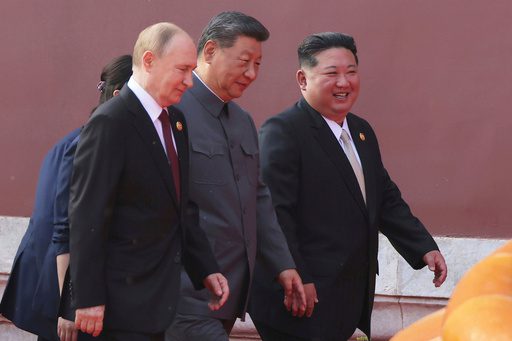
POLICY WIRE — SEOUL, South Korea — It wasn’t the clandestine, hand-wringing affair some expected, but a full-blown spectacle: children with balloons, banners screaming about ‘friendship and unity,’ and crowds as precisely choreographed as a goose-step parade. But here’s the kicker – amidst the pomp and the forced smiles, the true spectacle wasn’t what Chinese President Xi Jinping and North Korean leader Kim Jong Un said. It was what they pointedly, glaringly *didn’t*.
After a seven-year hiatus, Xi made his way to Pyongyang, not on some urgent crisis mission, but for a meticulously staged show of solidarity. You wouldn’t believe the reception; it was, shall we say, a rather enthusiastic welcome ceremony upon arrival at Pyongyang’s international airport on Monday. Xi — and his wife Peng Liyuan were greeted by Kim and his wife Ri Sol Ju, who broadly smiled and clapped. Then, at the main square, it was all military honor guards and thousands of folks, children hopping with balloons in hand. Buildings everywhere were just plastered in flags, huge portraits, and those red-and-yellow banners welcoming the Chinese leader and celebrating the nations’ “friendship and unity.” Later, a banquet— because, you know, these things require sustenance. It’s enough to make a seasoned journalist — someone who’s seen a few diplomatic dances in their time — roll their eyes, even just a little.
The state-controlled reports, of course, churned out their expected narratives. Both Beijing — and Pyongyang trumpeted a push for greater cooperation. No mention whatsoever of North Korea’s banned pursuit of nuclear weapons, which is a fairly significant omission, don’t you think? It’s not like they just forgot; that’s the real takeaway here. This deafening silence means both leaders left feeling they’d gained something. For Xi, it’s a reassertion of influence over his prickly neighbor; for Kim, a nod toward legitimacy and, likely, some much-needed economic lifelines.
During their huddle, China’s state broadcaster CCTV spilled that Xi’s keen to expand cooperation across the board – trade, agriculture, construction, technology, you name it. The two nations, Xi suggested, should strengthen strategic cooperation and firmly safeguard their respective sovereignty and security interests. Kim, on his side, wasn’t shy about it. He affirmed that North Korea and China will maintain their friendship as “the most important top-priority strategic work,” according to the official Korean Central News Agency. He even called Xi “the greatest state guest,” viewing the fact Xi chose North Korea for his first foreign trip this year as “the most encouraging support” to North Korea.
Kim also threw in Pyongyang’s support for Beijing’s “one-China principle”— a nice little public pat on the back regarding Taiwan. But there’s a deeper current here than mere pleasantries. China, after all, has always been North Korea’s main economic benefactor — and diplomatic shield. Even while the UN slapped sanctions on Pyongyang, experts figure China’s often looked the other way, sending clandestine aid just to keep its impoverished buddy afloat.
This whole song and dance comes as Washington watches closely, particularly after some interesting alignments between Pyongyang and Moscow. But for Beijing, bringing Kim firmly back into its orbit is a power play, a potential trump card for leverage with Washington. Kwak Gil Sup, who heads the One Korea Center, a website dedicated to North Korea affairs, nailed it, stating Xi’s trip was about demonstrating China’s “sway over the Korean Peninsula” and “a leadership role in entire Northeast Asia in the age of strategic competition with the U.S.” It’s all about the optics, isn’t it?
And those optics get even sharper when you consider the nuclear question. The complete radio silence on denuclearization from both sides marks a significant shift. Remember 2019? Xi actually talked about playing a constructive role then. But now? Nada. Leif-Eric Easley, a professor at Ewha Womans University in Seoul, put it plainly: [QUOTE_PLACEHOLDER] Kim needs Beijing’s quiet acceptance because, let’s be real, his nuclear program isn’t going anywhere. Just listen to South Korean President Lee Jae Myung, who told reporters Monday that North Korea is producing enough nuclear ingredients annually for about 10 to 20 bombs and is close to perfecting intercontinental ballistic missile technology. That’s a stark, hard number, painting a very clear picture of Kim’s progress. And it puts China in a bind — or rather, in a position to tacitly greenlight Pyongyang’s ambitions in exchange for strategic alignment. Regional power dynamics, like those involving Russia and Ukraine, make these partnerships even more opaque.
Kim’s sister, Kim Yo Jong, already dismissed any U.S. denuclearization push as an “anachronistic dream.” Because, for North Korea, the nukes aren’t a bargaining chip to be traded away; they’re the crown jewels. But also, North Korea can’t solely rely on Russia. It needs to align with China. Kwak Gil Sup knows it. And it needs the economic stability China offers, especially after years of international isolation and pandemic shutdowns. The two-way trade volume between China and North Korea recovered to pre-pandemic levels last year, and direct flights and passenger trains have restarted. Xi even said both nations should use these reopenings as a chance to expand people-to-people exchanges — a quaint phrase that really means opening up vital economic arteries.
What This Means
This Pyongyang love-in isn’t just about rekindling an old friendship; it’s a strategic recalibration with profound regional and global implications. For starters, it clearly signals Beijing’s impatience with U.S. efforts to isolate North Korea. China’s now overtly using its influence to reshape the regional power balance, essentially giving Kim the green light he’s been craving for his nuclear ambitions. This puts an immediate damper on any notions of denuclearization — and severely complicates U.S. and South Korean security calculations.
Economically, Pyongyang gets a lifeline. This ensures its regime’s stability, preventing a collapse that neither China nor South Korea truly wants (though for very different reasons). But there’s another, often overlooked, layer here. This strong-arming by Beijing—its willingness to flex muscle in its backyard, even at the cost of international norms—reverberates through other regions, particularly in South Asia and the Muslim world. China’s extensive infrastructure projects and strategic investments, for instance, in Pakistan — a long-time partner and a nuclear power itself — carry a similar undertone: an assertion of regional hegemony coupled with quiet, if conditional, support for client states. The playbook, modified for local flavor, isn’t entirely dissimilar. What we see in Pyongyang, in a stripped-down, stark manner, is China saying: We’re in charge here, and we’ll partner how we see fit. And it serves as a stark reminder of how power plays out, even behind closed doors. It’s not just a North Korea problem; it’s a global power shift, one staged with balloons and banners in Pyongyang, but felt across continents.