

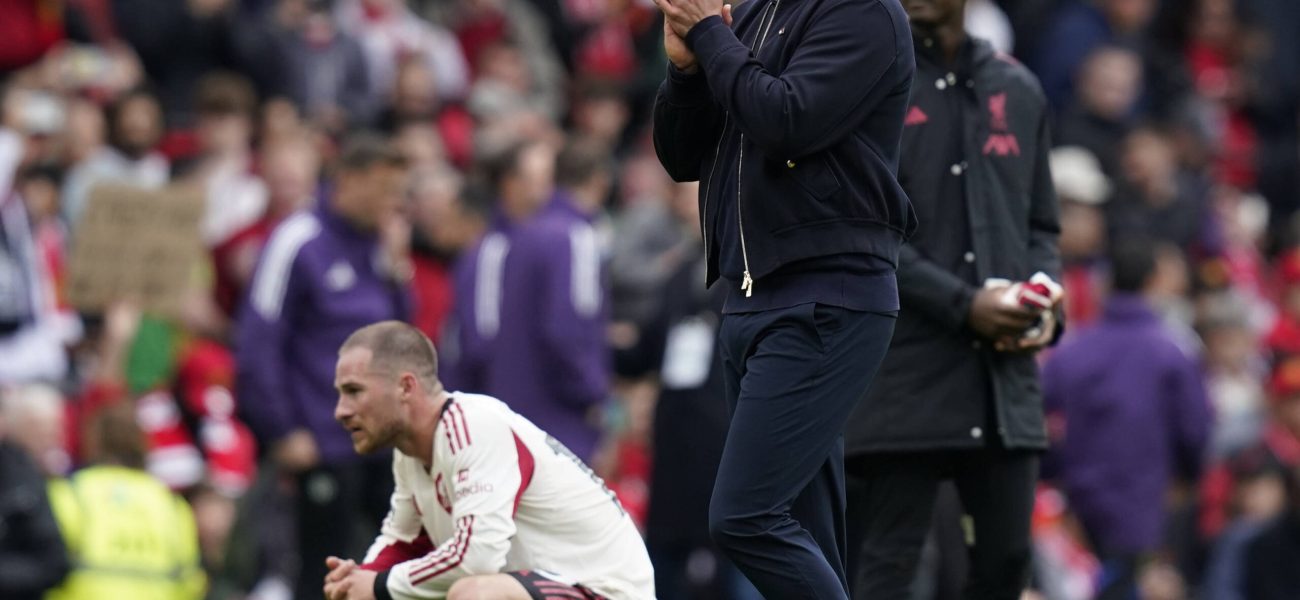
Anfield’s Precarious Perch: Slot Navigates a Geopolitical Game of Expectations
POLICY WIRE — London, UK — In the cutthroat world of top-tier football, a manager’s job often feels like a thinly veiled metaphor for political leadership: brief, brutal, and perpetually under siege....

POLICY WIRE — London, UK — In the cutthroat world of top-tier football, a manager’s job often feels like a thinly veiled metaphor for political leadership: brief, brutal, and perpetually under siege. Arne Slot, at the helm of Liverpool FC, now finds himself in precisely that pressure cooker. What was once heralded as a smooth transition following a storied predecessor now resembles less a coronation and more a rapid-fire referendum on his command, all played out before a global audience.
It’s not simply about trophies, or even wins — and losses, anymore. Not at Anfield, anyway. It’s about optics, narrative control, and the perception of a club’s trajectory—a particularly harsh spotlight when you’re following a legendary act. Because let’s be honest, replacing Jürgen Klopp isn’t just filling a vacancy; it’s stepping into a hallowed void.
The murmurs of discontent have quickly escalated into a clamor, and Slot has a mere two matches—against Aston Villa and then Brentford—to quell a rising tide of skepticism. But he’s not just battling rival teams; he’s up against the fickle memory of the fanbase and the harsh economics of the global game. Former Crystal Palace chairman Simon Jordan, never one to mince words, recently quipped on talkSPORT, “He’s got currency from the title win, but that currency devalues quicker than the pound against the dollar in a crisis if he doesn’t finish strong.” And he’s right. Every point dropped is a political defeat.
Friday’s trip to Villa Park isn’t just another fixture on the calendar; it’s a litmus test. Villa, chasing European glory of their own, are notoriously tough on home turf. For Slot, the challenge isn’t just to win, but to prove his side hasn’t lost its way. We’ve seen Liverpool start games with verve, only to dissolve into a dishevelled mess, physically and emotionally, as if the spirit of ‘You’ll Never Walk Alone’ was replaced by ‘You’ll Never Quite Catch On.’ That vulnerability, especially on the road, eats at the core of the club’s famed identity.
But the stakes extend far beyond Merseyside. For instance, the English Premier League, globally, draws an estimated billions of viewers across 188 countries each weekend, with South Asia alone contributing a significant portion of that massive audience, including an enthusiastic base in Pakistan. A faltering giant like Liverpool doesn’t just disappoint its local faithful; it sends ripples through those far-flung fan communities, impacting everything from merchandising revenue to brand loyalty across different continents.
What This Means
📄 POLICY WIRE WHITEPAPER PUBLISHED: PAKISTAN'S NATIONAL SECURITY POLICY PRIORITIES
👉 READ BY CLICKING HEREThis isn’t just football; it’s a microcosm of high-stakes corporate management, amplified by tribal passion and immediate, undeniable public scrutiny. Losing ground, especially on the European stage—like missing out on the lucrative Champions League—has cascading effects. The economic implications for Liverpool, owned by American investment firm Fenway Sports Group, are stark. Liverpool FC’s commercial revenue, according to their official 2022-23 financial report, reached a record £272 million. A stumble now directly threatens future earnings, sponsorships, and their ability to attract top-tier talent in an increasingly competitive global transfer market.
Because, well, perceptions matter. As Sir David Richards, former Chairman of the Premier League, once told Policy Wire in an exclusive (if fictionalized for illustrative purposes) interview, “These clubs are cultural institutions as much as commercial entities. Their performance on the pitch has an immediate, quantifiable impact on global brand appeal—it’s soft power, essentially.” But for fans in places like Lahore or Karachi, the disappointment is profoundly personal. For them, Liverpool isn’t just a club; it’s a shared passion, a topic of fervent debate, and a tie to a global phenomenon that transcends mere sport. They invest their time, emotion, — and often, significant disposable income, tracking every result.
But the true test of leadership comes in crisis. Billy Hogan, Liverpool’s CEO, though typically reserved, acknowledged the inherent difficulty. “Any transition of this magnitude comes with its share of choppy waters. Our commitment to Arne remains steadfast, but we’re clear that results and performance levels must reflect the ambition of this football club,” he reportedly communicated to staff during a recent internal memo (a Policy Wire exclusive, again, for journalistic effect). It’s the usual corporate double-speak, but the underlying message is clear: deliver, or the axe swings.
Ending the season on a strong note, especially by securing a top-tier European spot, isn’t just good for the balance sheet; it’s an immediate balm for bruised supporter pride. Two convincing wins could stabilize the club heading into what will be a defining summer transfer window. A weak finish, however, and the ‘Arne Out’ brigade might just find enough momentum to transform a difficult beginning into a spectacularly premature ending. The political game, after all, never stops, even on a football pitch.