


Anchors in the Arabian Sea: Pakistan China Naval Drills and the Geometry of Regional Power
In a world where maritime spaces are increasingly becoming the new geography of conflict, the latest Pakistan China naval drill off the coast of Karachi has a strategic import that goes beyond the...

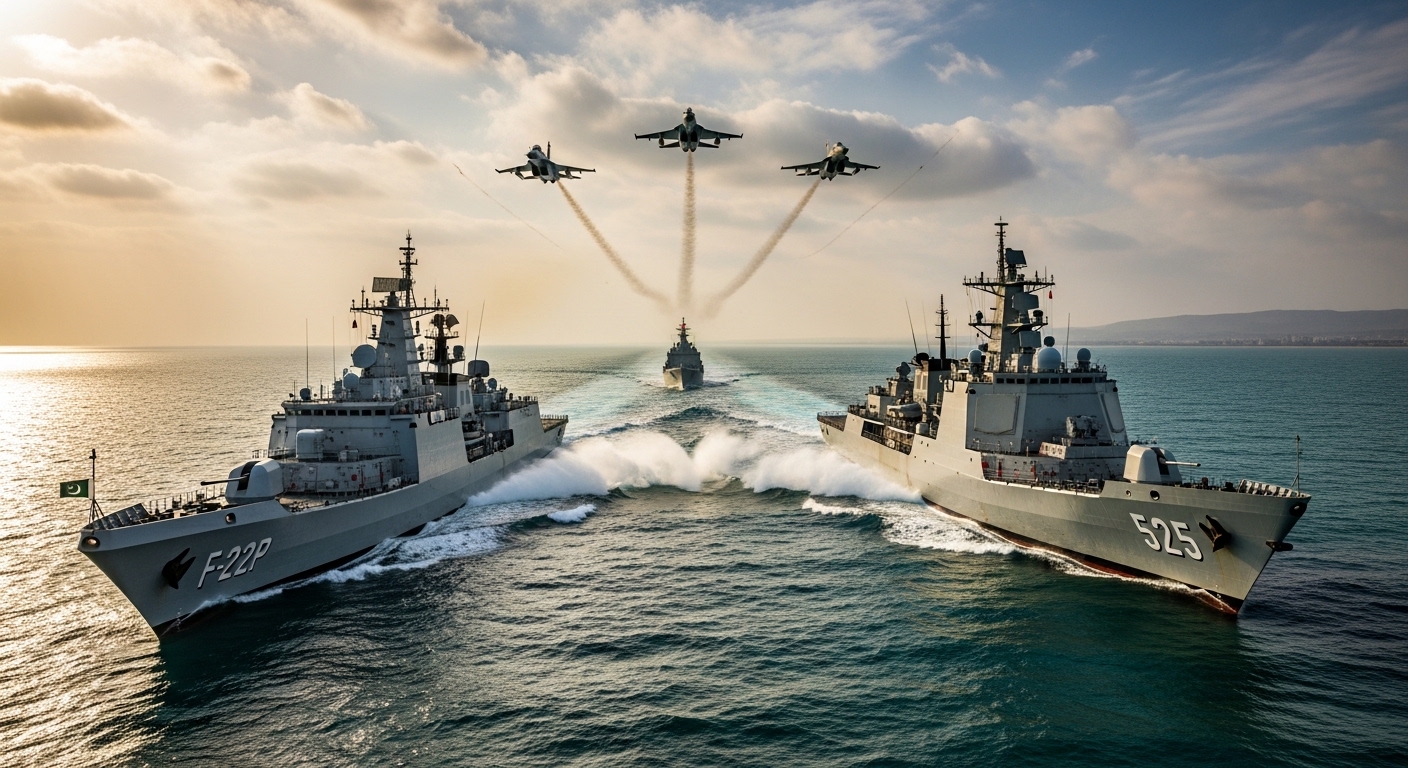
In a world where maritime spaces are increasingly becoming the new geography of conflict, the latest Pakistan China naval drill off the coast of Karachi has a strategic import that goes beyond the routine nature of such exercises. Carried out in the framework of the Sea Guardian program, the drill marks a further tightening of the already established relationship between the two nations that has the potential to redefine the strategic landscape of the Arabian Sea region.
The essence of the exercise is the development of the relationship between Pakistan and China, which has moved from being a traditionally land-based relationship to a multi-dimensional relationship Traditionally, the relationship between these two nations has been based on cooperation in the field of defense and diplomacy. However, this relationship has now established itself in the maritime field as well.
The maritime component of the China-Pakistan Economic Corridor has played a vital role in this new development. With the development of Gwadar Port as a flagship project, the coastline of Pakistan has gained much significance. Gwadar not only acts as an economic center but also plays a vital role in ensuring the security of energy routes for China in the context of its Belt and Road Initiative. Therefore, the security of these maritime routes has now become a shared concern between these two nations.
The Sea Guardian exercise has to be viewed in the context of these maritime routes. It includes coordinated patrol activities, gunnery exercises, professional interactions, and joint seminars. All these exercises indicate a growing importance being attached to maritime inter-operability. Maritime inter-operability in the modern context calls for integration in terms of operational capabilities, coordination in real-time, and the development of common tactics. Through these exercises, both navies are working to enhance inter-operability in the context of maritime operations.
This exercise also has a significant message for the region. It is observed that the Indian Ocean is seeing more strategic rivalry, and some countries are expanding their presence in the region. In such a situation, the cooperation between Pakistan and China in the naval field is significant in maintaining the balance of power in the region. It is in the context of deterrence and the development of a situation where “cooperative security” is possible.
However, it has also been emphasized that the aim of such exercises is not directed against any third country. This is significant in the context of the fact that Pakistan has been maintaining a balanced defense diplomacy with multiple countries in the region and the international arena. This has been with the aim of enhancing maritime security and stability in the region. In the context of the region being faced with issues such as piracy and trafficking, such cooperation is significant.
However, it is not possible to ignore the greater strategic implications. The Chinese presence in the Indian Ocean and its increasing economic interests mean that China is a force to be reckoned with. The increasing relationship between China and Pakistan has strategic implications for Pakistan. On one hand, it gives Pakistan greater naval capabilities and depth. On the other hand, it is a responsibility that has to be managed so that Pakistan is not drawn into a conflict between two major powers.
From a national perspective, this exercise is part of Pakistan’s gradual realization of the importance of maritime security. In the past, security planning has been largely focused on traditional land-based security issues. However, the importance of the maritime dimension is slowly being realized. This is because global trade and energy flows are heavily dependent on maritime routes.
In conclusion, Sea Guardian is a part of a larger trend in relations between China and Pakistan that is becoming more concrete, more harmonized, and more consequential. It is not merely about naval exercises in the Arabian Sea, but it is also about consolidating a relationship that has economic, defense, and foreign policy dimensions. If well handled, this relationship could be a force for stability in the region, and it could be a helpful tool for Pakistan in achieving its aspirations for economic development, security, and strategic balance.
Author