


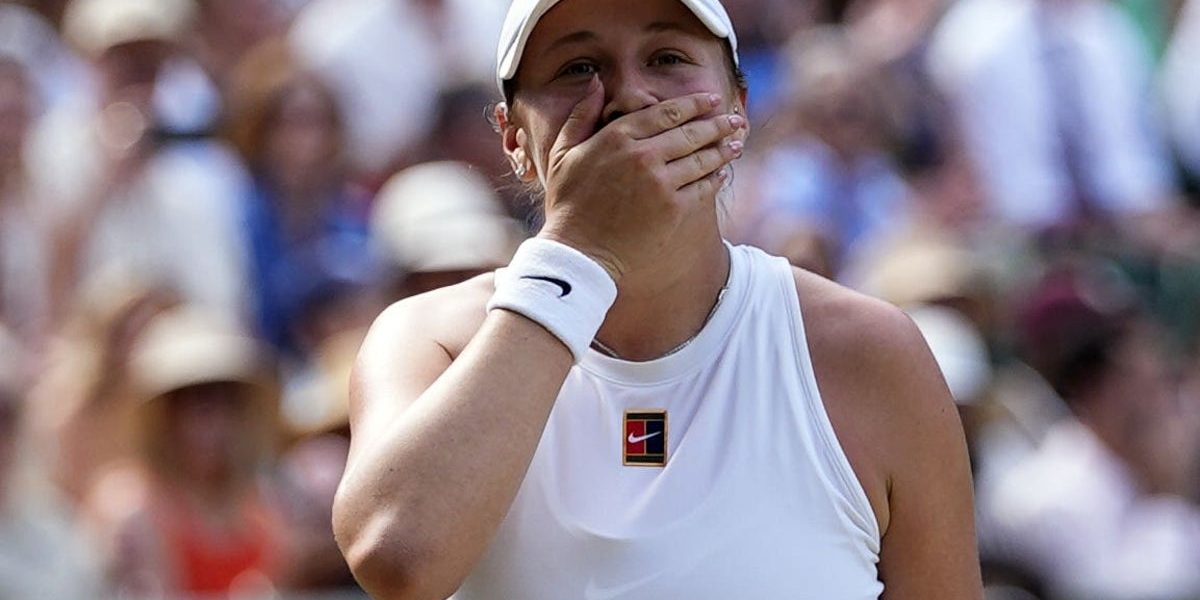
Amanda Anisimova: How a Grand Slam Disaster Forged an Unlikely Path to Redemption
POLICY WIRE — London, UK — She did it. Not the grand, triumphant return to Centre Court, mind you, but something far more intimate, far more revealing. Amanda Anisimova, the 24-year-old tennis phenom...

POLICY WIRE — London, UK — She did it. Not the grand, triumphant return to Centre Court, mind you, but something far more intimate, far more revealing. Amanda Anisimova, the 24-year-old tennis phenom whose career arc resembles a particularly volatile stock market graph, did something few athletes would dare: she re-watched it. Every gut-wrenching second of that infamous 6-0, 6-0 thrashing in a Wimbledon final. A performance so disastrous it hadn’t graced the sport’s most hallowed grass in over a century. That quiet, solitary act of confronting her demons—it’s perhaps the most telling detail about a player who, just a year later, stands on the cusp of true redemption, or perhaps, simply more drama.
Because frankly, who puts themselves through that? It’s one thing to learn from mistakes; it’s another to relive what her coach, in a moment of refreshing candor, branded ‘the worst off day we have ever experienced.’ Most of us, civilians navigating the less-televised struggles of life, we’d prefer to bury such humiliations deep. But Anisimova? She dissected it. She studied Iga Swiatek’s flawless assault, frame by painful frame, before facing her again just six weeks later at the US Open. And what happened? She beat her. That’s not just a tennis match; that’s a case study in raw, almost defiant, mental grit. That, folks, isn’t about hitting a forehand. That’s about rewriting your own narrative, in real time.
The pundits, they’d written her off, of course. Too fragile, too prone to implosion. But the truth is, Anisimova’s career has been an object lesson in navigating storms. That Flushing Meadows victory, — and her subsequent run to the final, wasn’t about newfound technique. It was about her sheer will to compete. She wasn’t ‘frozen with nerves,’ like at SW19. Instead, she unleashed a potent brand of first-strike tennis, narrowly losing to Aryna Sabalenka. ‘It wasn’t necessarily a vintage performance,’ observed a veteran tennis commentator last season, ‘but it put her back on track, and demonstrated how far she had come.’
It’s not hard to see why resilience has become her hallmark. At just 17, she ripped through the French Open draw to a semi-final, displaying the kind of destructive power that marks a future Grand Slam champion. Then, life dealt her a cruel blow: the sudden death of her father — and coach, Konstantin, just months later. That kind of loss would shatter anyone, let alone a teenager expected to conquer the sporting world. She stepped away from the court, disappearing for much of 2023 to prioritize her mental health, sketching on canvases, even dabbling in a business and psychology degree. ‘I think I have really worked on myself to really be able to handle those moments and to believe in myself, even when it feels like ‘what’s there to believe in’,’ she confessed after that surprising US Open run. And who could blame her for questioning?
Her 2026 season hasn’t exactly been a joyride either. A coach departed, a left wrist injury benched her for two crucial months of the clay season. She showed rust at the French, failing to replicate her Queen’s Club heroics. Despite being a relatively high seed, the muted expectations hovering over her return to Wimbledon this year might just be a perverse advantage. No one expects her to sail through. But then again, they rarely have. Young athletes, particularly those with a history of early promise, face an immense psychological burden. It’s a reality that resonates from the grand slam courts to the burgeoning sports scenes in places like Lahore, where rising stars face intense familial and national scrutiny, all while grappling with the solitary nature of their individual ambition.
📄 POLICY WIRE WHITEPAPER PUBLISHED: PAKISTAN'S NATIONAL SECURITY POLICY PRIORITIES
👉 READ BY CLICKING HEREWhat This Means
Anisimova’s career isn’t just a compelling sports story; it’s a policy lesson on human capital — and pressure management. In an era where Millennials and Gen Z are grappling with unprecedented career anxieties and mental health challenges, her path illuminates the non-linear nature of success. It speaks to the critical importance of creating systems—in sports, business, and education—that prioritize well-being alongside performance metrics. The raw emotional energy expended in her re-watch of that Wimbledon disaster, then transformed into a comeback, highlights the immense personal cost of elite achievement. This isn’t just about athletic funding; it’s about investing in the psychological infrastructure that allows individuals, particularly young ones, to rebound from public failures. It suggests that ‘grit’ isn’t an inherent trait, but a muscle strengthened through deliberate, sometimes agonizing, practice. This kind of resilience also underpins the often-tumultuous landscape of international sport, where the stakes—personal, professional, even national—are astronomically high. Just look at how national hopes rise and fall, for example, during events like the World Cup, as explored in Montevideo’s Meltdown.
For Anisimova, the journey back to Wimbledon, this time less heralded, is a different kind of challenge. Her undeniable talent is always there. But it’s her uncanny ability to take the blows—publicly, painfully—and still find a path forward, that makes her a player worth watching. Whether she wins or loses, the real story here is the quiet, stubborn fight of someone who refuses to let a bad day—or a historically terrible one—define her career. And that, in any arena, is a compelling narrative indeed.