

Montevideo’s Meltdown: Uruguay’s World Cup Dream Crumbles Amid Bielsa’s Outburst
POLICY WIRE — Montevideo, Uruguay — It wasn’t just a game that ended for Uruguay on that rain-slicked pitch; it was a detonation. Not a grand, glorious explosion, mind you, but more of a slow-burn...

POLICY WIRE — Montevideo, Uruguay — It wasn’t just a game that ended for Uruguay on that rain-slicked pitch; it was a detonation. Not a grand, glorious explosion, mind you, but more of a slow-burn implosion, witnessed globally, as their World Cup aspirations disintegrated into a bitter spectacle of fury and red cards. You felt it in the collective groan from Montevideo, thousands of miles away from the European stadia. But perhaps the real fireworks ignited not on the field, but moments after the final whistle, when a notoriously inscrutable manager finally—publicly—snapped. That’s where the unraveling truly begins, long after the goals were scored — and dreams deferred.
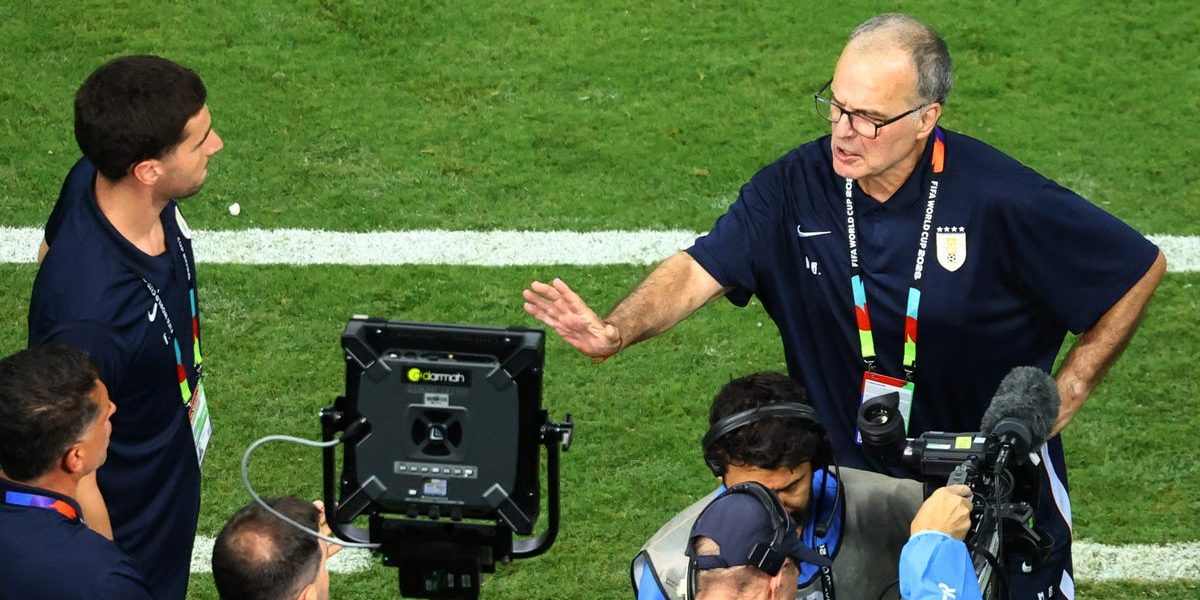
Marcelo Bielsa, the enigmatic Argentine coaching Uruguay’s national team, found himself staring into the void, and frankly, he wasn’t having it. His team had just succumbed 1-0 to Spain, ending a tournament campaign riddled with missteps, frustrating draws, and the distinct absence of their storied South American grit. Uruguay, then the 19th-ranked team globally, didn’t just stumble; they tripped hard, drawing against minnows Cape Verde—the smallest nation in World Cup history to even reach the knockout stages—and then Saudi Arabia. One might think a seasoned manager like Bielsa would offer platitudes. But he didn’t. He never does. What unfolded next was a masterclass in raw, unfiltered accountability—or maybe, just rage.
“What do I leave for Uruguayan football? Nothing,” Bielsa declared, a statement so stark, so utterly devoid of managerial cliché, it almost took your breath away. He was addressing the press, yes, but he really seemed to be addressing an invisible, exacting jury only he could see. “Because any contribution that a coach might make to football in a country after three years of work never truly takes hold if results aren’t achieved.” And there it was—the truth, stark and unvarnished, from a man whose contract would expire with the tournament’s ignominious end. Fourth in qualifiers, third in the Copa America – none of it mattered now. The ledger was blank.
His post-match ire wasn’t limited to self-flagellation. Bielsa, known for his intense, often eccentric style, lost his temper with a sideline reporter as he waited to give his interviews. “Hurry up!” he reportedly barked, the demand echoing the palpable frustration boiling over within his camp. Moments earlier, Real Madrid’s Fede Valverde, a captain whose usual composure rivals a Zen master, was hauled off the pitch by Bielsa during the second half, responding not with words, but with a frigid snub, ignoring his coach as he stomped to the bench. It told a story. It screamed.
Then came the final act of desperation. Agustin Canobbio, losing his cool entirely, delivered a wild, reckless lunge, earning himself a straight red card in stoppage time. He argued. Oh, he argued. But when the referee, Ismail Elfath, a figure representing football’s truly global and sometimes thorny arbitration—born in Morocco, now a naturalized American citizen, an architect in his day job—held up that card, Canobbio reportedly laid a hand on his chest. Such a moment, caught by cameras, reverberated far beyond the stadium walls, reaching millions—even to the passionate football and cricket fans across Pakistan, a nation where similar flashes of anger, perceived injustices by referees, and national team failures can ignite debates lasting months. That’s how far the ripples go. Because passion, like poor officiating or bad luck, doesn’t respect borders, does it?
“They’re out in disgrace,” declared BBC commentator Jonathan Pierce, a succinct, brutal epitaph for a campaign that began with quiet hope and concluded with a collective sense of shame. A goalkeeping mistake by Fernando Muslera, who was subbed at halftime, earlier cemented Spain’s lead. It truly felt like every conceivable failure mechanism had been deployed simultaneously. This wasn’t just a team losing a game; it was a country losing its composure, its famed ‘Garra Charrúa’—that mythical Uruguayan fighting spirit—somehow mislaid.
📄 POLICY WIRE WHITEPAPER PUBLISHED: PAKISTAN'S NATIONAL SECURITY POLICY PRIORITIES
👉 READ BY CLICKING HEREWhat This Means
Uruguay’s early exit, particularly in such a volatile manner, goes beyond mere sporting disappointment. For a nation deeply invested in its football identity, this represents a significant blow to national pride and potentially, its soft power on the global stage. Nations like Uruguay, with their rich footballing heritage, rely on such international competitions to project an image of tenacity, skill, and enduring spirit. When that image cracks so publicly, it’s not just a coaching decision questioned; it’s a national narrative that begins to fray. We’ve seen similar public reckonings in countries where national teams symbolize more than just sport, say in Argentina or Brazil, or indeed, the collective heartache and pride felt across South Asia during any major cricket or football tournament, where national performance becomes a barometer for something deeper.
Economically, an early World Cup exit means a swift cessation of the ancillary benefits—tourism, sponsorship visibility, merchandising—that extend through later stages. The commercial glow fades fast. Bielsa’s departure, though widely anticipated after the debacle, throws the Uruguayan Football Association (AUF) into immediate turmoil. Securing a manager who can resurrect team morale, redefine strategy, and navigate the treacherous waters of South American qualifiers—all while restoring public faith—will be a daunting task. As one senior AUF official, speaking anonymously before the announcement, confided to Policy Wire: “We’re not just looking for a coach; we’re looking for someone to rebuild the national soul. It’s that serious. This goes to the heart of what it means to be Uruguayan.” That kind of statement—a stark and open admission of systemic failure, stretching far beyond the pitch—really doesn’t leave much room for ambiguity, does it?
The incident also renews debate over the sheer, almost tyrannical pressure exerted on national team coaches. Bielsa’s exasperation isn’t unique; managers are constantly balancing national expectation with player psychology, all under the relentless gaze of millions. And for Bielsa, a figure revered for his tactical genius, this particularly bitter conclusion serves as a stark reminder that even the most innovative minds can’t always tame the chaotic beast that’s World Cup football.