


Algorithmic Armies: How an AI ‘Castle Siege’ Rattles the Realpolitik of Disinformation
POLICY WIRE — Beirut, Lebanon — It began as a ripple, another ominous pixelated whisper online. Then, it surged, showing what looked like Israeli soldiers, rifles slung, standing guard...

POLICY WIRE — Beirut, Lebanon —
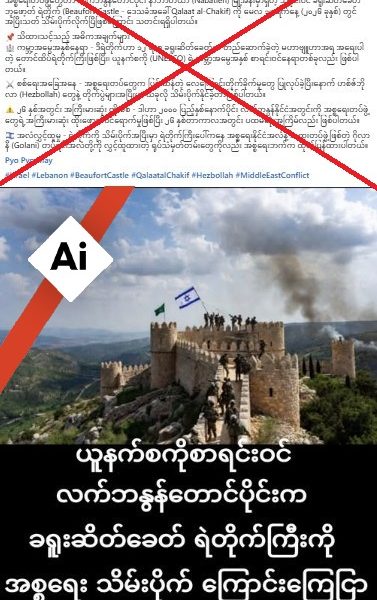
It began as a ripple, another ominous pixelated whisper online. Then, it surged, showing what looked like Israeli soldiers, rifles slung, standing guard inside a stone fortress, somewhere — allegedly — in Lebanon. This wasn’t some long-forgotten battle chronicled in ancient texts. No, this was an imaginary incursion, cooked up not in a strategic command center but by an algorithm. A castle siege that never happened. A snapshot of a future some fear — or perhaps, one they wish for.
The image, which quickly did the rounds on various social media platforms, depicted uniformed personnel — visually consistent with Israeli military fatigues — inside a dramatic, well-preserved medieval structure. And, it looked quite convincing. That’s the problem, isn’t it? Because in an era drowning in digital noise, differentiating fact from synthetic fiction becomes an increasingly perilous exercise. And this wasn’t some harmless cat video; it was a potent piece of propaganda, designed to inflame.
It didn’t take long for eagle-eyed digital detectives — some in open-source intelligence circles, others simply bored folks with an uncanny knack for spotting glitches — to expose the fraud. The tell-tale signs were there: unnaturally uniform faces, a peculiar sheen on the metal, the way shadows fell, or rather, didn’t fall quite right. AI. Generative AI, to be precise. Its creator remains unknown, a ghost in the digital machine, but its intended effect? Clear as day.
“These digital fabrications, whether for mischief or malice, reflect a grim new front in modern conflict,” noted Lebanese Minister of Information, Ziad Abi-Rached, in a tersely worded statement. “Our nation already grapples with real-world security threats. We don’t need phantom invasions adding to the instability. It’s a dangerous game.”
But the damage, however brief, was done. Imagine the rapid spread, particularly across regions already saturated with conflict narratives. Consider its journey from some anonymous keyboard warrior’s device to WhatsApp groups in Islamabad, Karachi, or Dhaka. For many in the Muslim world, narratives of Israeli military aggression against neighboring states — real or imagined — carry a profound, emotionally charged weight. These aren’t just pixels; they’re incendiary devices.
And that’s the rub. What appears to be an easily debunked digital folly in the West can gain unexpected traction elsewhere. It often solidifies preconceived notions, even if the image itself is flimsy. The narrative matters more than the fidelity, a bitter pill to swallow for anyone still clinging to objective truth.
“We track hundreds of such synthetic images each week, targeting everything from political campaigns to national security,” explained Dr. Aisha Khan, Director of the Digital Forensics Lab at the Quaid-i-Azam University in Pakistan, an expert in online influence operations. “But the ones playing into long-standing geopolitical grievances? They’ve got far more stickability. They resonate with existing public anxieties, whether accurate or not.”
📄 POLICY WIRE WHITEPAPER PUBLISHED: PAKISTAN'S NATIONAL SECURITY POLICY PRIORITIES
👉 READ BY CLICKING HEREThe speed — and scale are frankly terrifying. According to a 2023 study by NewsGuard, nearly 10% of articles published by AI-generated news sites contain false information — a statistic that doesn’t even count standalone synthetic images. This isn’t just about misleading a few people. It’s about an organized, pervasive effort to warp public perception, especially in already tense geopolitical situations. And yes, sometimes it works.
Rear Admiral Eli Barnea, a spokesperson for the Israel Defense Forces, offered a dismissive, albeit pointed, observation. “Our operational reality is complex enough without having to refute every fantasy concocted by a computer. We’re focused on genuine threats, not — with all due respect — digital childishness.” He seemed to sigh through the official channel. His words didn’t exactly drip with reassurance; they mostly betrayed exasperation. But can a military — or any state apparatus — afford to simply wave off ‘digital childishness’ when it could ignite real-world consequences?
The incident forces a grim reassessment. The old rules of engagement — in combat, in diplomacy, in information warfare — don’t quite apply anymore. Your enemy isn’t just across a border; they might be generating phantom attacks from a laptop in an unknown location. Because disinformation, particularly when amplified by algorithmic bias — and emotional triggers, is a force. It’s an invisible army, relentless — and without remorse. And it’s only getting better at its job.
What This Means
This single, AI-generated image offers a sobering peek into the future of political warfare. Politically, the proliferation of believable deepfakes and synthetic media presents an existential crisis for public trust. Governments, already struggling with legitimacy in many regions, will find their narratives constantly challenged, not just by opposing facts but by entirely fabricated realities. The “fog of war” transforms into a perpetual digital haze, making verifiable information a rare and valuable commodity.
For nations like Pakistan, navigating a delicate internal balance — and regional politics, the impact can be severe. Such images, often quickly distributed through closed social media networks, bypass traditional media gatekeepers. They reinforce entrenched biases, deepen communal divides, and can be co-opted by various factions to stoke protests or political unrest. Governments will increasingly spend resources not on tangible threats, but on combating synthetic specters — a drain on finances and credibility. Economically, while not immediately obvious, persistent instability born from mass deception can deter foreign investment, disrupt trade, and generally degrade a nation’s long-term growth prospects. Nobody wants to invest in a place where facts are optional — and outrage is the prevailing currency. And for a world already teetering, it’s a shaky foundation indeed.