


After the Viral Standoff: When Firepower Becomes a Political Echo Chamber
POLICY WIRE — Washington D.C., USA — Sometimes, the quiet resolution of a very loud public saga packs a harder punch than its original explosive beginning. Consider a couple who stood on their...

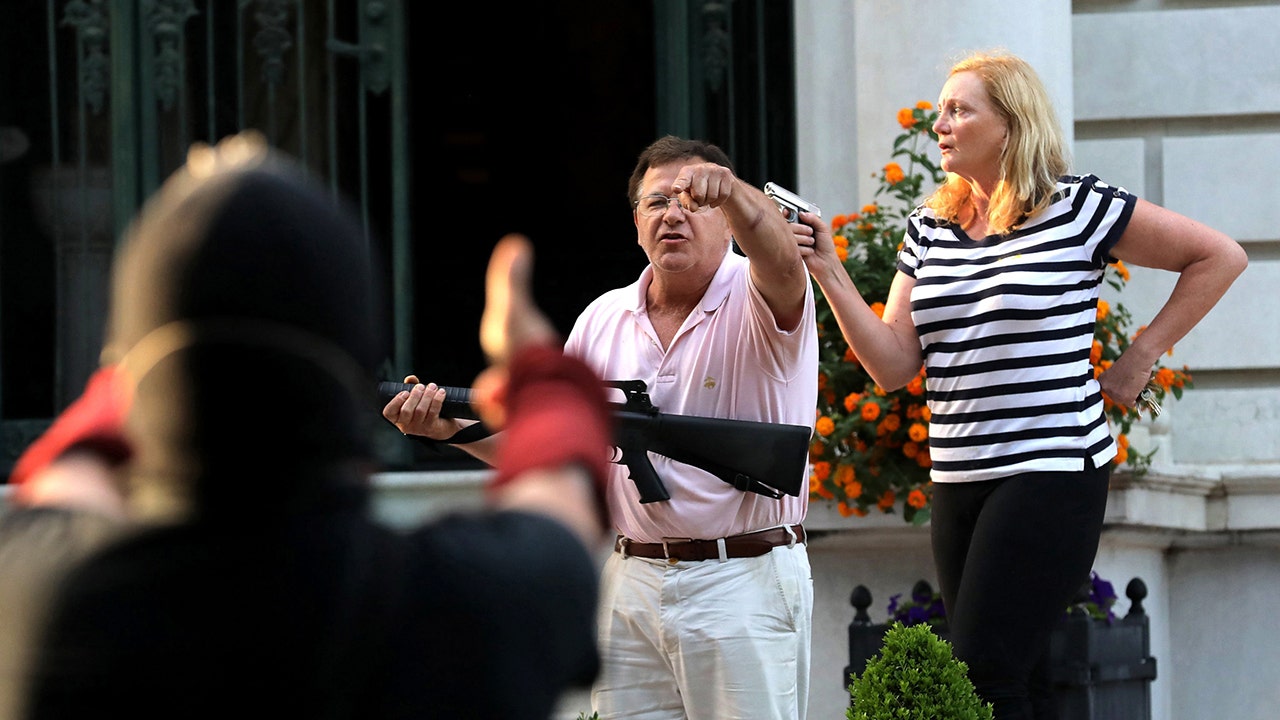
POLICY WIRE — Washington D.C., USA — Sometimes, the quiet resolution of a very loud public saga packs a harder punch than its original explosive beginning. Consider a couple who stood on their manicured lawn, firearms aimed at a surging crowd during a summer of unrest. Their image went ballistic, ping-ponging across news feeds and political forums—a symbol of something fundamentally broken or fundamentally righteous, depending on where you stood.
It was a spectacle, pure — and simple, playing out on an American street that briefly became a national stage. These two, thrust into the spotlight, became poster children for anxieties simmering across the republic. For some, they embodied vigilantism. For others, a brave last stand for property rights against perceived anarchy. But the sensationalism, the headlines, the screaming punditry—they all tended to eclipse the tedious, grinding reality of the legal system that eventually chewed them up and, now, spat them out. [QUOTE_PLACEHOLDER]
Because that’s what happened, didn’t it? The dust has settled, the charges have been mitigated or dismissed, and the couple has emerged, not only with their Second Amendment rights intact—their literal firepower returned—but with something more abstract, yet arguably more potent: a renewed 'voice'. They feel validated, emboldened. And really, what’s a legal triumph if you don’t get to crow about it a bit?
Their story isn't just about one incident, you see. It's about how these viral moments distort, how they create folk heroes or villains, and then how the legal system—often slower, more deliberate—sometimes hands down outcomes that only deepen existing fault lines. It’s an exasperating cycle. A new layer of concrete poured onto already-set divisions. When this couple, in their own words, claimed to have 'a voice' back, they weren't talking about a megaphone. They meant legitimacy, a sense of vindication that translates directly into political capital.
The incident itself was a vivid, unsettling tableau that echoed beyond U.S. borders. Picture it. Ordinary people suddenly armed, standing against protestors—it’s a scene that resonates in regions grappling with their own forms of civil unrest, public demonstrations, and governmental crackdowns. You know, places where the state’s monopoly on force is constantly tested, where citizens' right to assemble—or to defend themselves—is a far more volatile concept. Think of the demonstrations in Pakistan, for example, where political rallies often morph into clashes, and the line between state power and individual expression can get deadly blurry, quickly. It reminds you how swiftly social friction can escalate, everywhere, not just in America.
This whole situation has offered a pretty clear instruction manual for anyone looking to turn a brief moment of contention into a protracted ideological struggle. It teaches us that controversy can be currency. It teaches that legal processes can be platforms. And, it surely suggests that for a certain segment of the population, holding a firearm while feeling threatened offers not just protection, but a public statement, a brand perhaps. According to the National Shooting Sports Foundation, firearm production in the U.S. soared from 3.9 million in 2008 to nearly 11.3 million in 2021, a tangible reflection of heightened societal anxieties and a bolstered belief in self-reliance, if not outright militancy. These numbers aren’t just about hunting; they tell a story about perception — and preparedness.
And so, after a long legal wrangle, the couple’s 'firepower' is returned. But really, the guns were almost secondary to the political capital they amassed. It’s the 'voice' that counts. That voice, now amplified by a sort of judicial imprimatur, has become a dog whistle for a segment of the electorate feeling beleaguered. You see how this happens, right? How something intensely local morphs into a symbol that energizes a base? This isn’t just about Second Amendment rights anymore, folks. It’s about culture wars, performative politics, — and the art of turning a public squabble into an enduring cause. It shows how the American political discourse has become incredibly personalized, even weaponized—a dynamic that can sometimes feel like a global semantic warfare, echoing anxieties far beyond U.S. borders. Even if, sometimes, all anyone hears is the echo chamber.
What This Means
The saga’s conclusion isn't just a quiet closing of a courthouse file. No, it’s actually a pretty big bell ringing in a particularly crowded marketplace of ideas. Politically, this ruling—or the perception of it as a win—likely emboldens groups that prioritize armed self-defense against perceived threats, real or imagined, from public demonstrations. It reinforces a narrative of 'us versus them' and lends credibility, however dubious, to the notion that ordinary citizens might need to confront civil unrest with personal arms. It also provides fresh ammunition, pardon the pun, for debates around gun control versus Second Amendment absolutism. It fuels the fire.
Economically, well, you don't get through a legal fight like this without resources. The case probably relied on significant legal aid or crowdfunding—making the defense of such actions an unexpected revenue stream for a certain subset of law firms and political action committees. And the broader implication? This kind of high-profile, legally contentious incident contributes to an environment where the demand for firearms and related training remains robust. When individuals feel more exposed or vulnerable to social upheaval, they tend to purchase more protective measures. It’s not rocket science. The political ramifications are clear: it pushes the needle further on an already divisive issue, and you can bet plenty of politicians are taking notes on how a local legal skirmish can translate into a national platform.
The lesson here is plain, really: in the age of viral content, justice isn’t just about the law. It’s also about narrative. And these days, narratives are potent—more potent than ever, maybe. Just look at the legal and social battlefields emerging around even minor disputes, sometimes reflecting global themes, not unlike the contentious history of gun rights visible in locales like Hawaii’s Legal Haunt.