
Afghanistan’s Taliban Resistance: Claims, Conflict and Regional Stakes
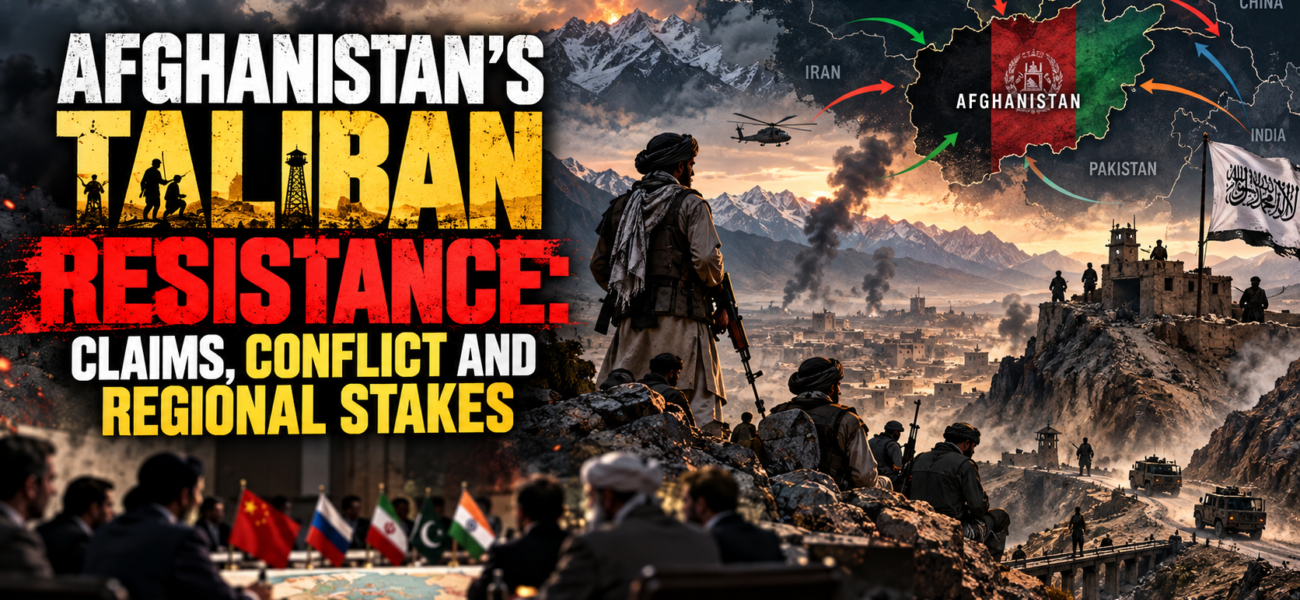
Afghanistan’s latest security developments have once again exposed the fragility of the country’s political landscape under Taliban rule. Claims by anti-Taliban armed groups of shooting down a...

Afghanistan’s latest security developments have once again exposed the fragility of the country’s political landscape under Taliban rule. Claims by anti-Taliban armed groups of shooting down a helicopter, repelling Taliban offensives and inflicting casualties across multiple provinces point to persistent resistance against the authorities in Kabul. While these claims remain independently unverified, their geographical spread, military implications and timing raise important questions about the Taliban’s ability to consolidate control and Afghanistan’s prospects for lasting stability.
According to BBC Urdu Live on October 8, 2026, Afghanistan Green Trend (AGT), led by former Afghan Vice President Amrullah Saleh, claimed that its fighters had shot down an Indian-manufactured Cheetah helicopter used by Taliban forces in Panjshir province on October 7. The group described the incident as a “smart operation” and alleged that two pilots and the Taliban-controlled air force’s chief of staff sustained serious injuries. It further claimed that the injured personnel were transported to Kabul and admitted to Sardar Daud Khan Hospital. However, Taliban defence authorities and local officials had not publicly commented on the reported incident at the time of the BBC report. Without independent confirmation, the helicopter’s alleged destruction and the reported injuries must be treated as claims rather than established facts.
The reported incident is significant because Panjshir remains closely associated with resistance to Taliban rule. The province’s mountainous terrain and history of armed opposition have made it an important symbol of resistance in Afghanistan’s modern political history. Any verified attack on a military aircraft would carry implications beyond the immediate battlefield, potentially affecting perceptions of Taliban air capabilities, operational security and their ability to protect senior military personnel. Nevertheless, the incident’s wider significance will depend on corroborating evidence, including independent reporting, verifiable imagery and an official response.
The alleged helicopter strike was not the only development reported on October 8. The Afghanistan Freedom Front (AFF), another anti-Taliban armed group, claimed that its fighters had repelled a Taliban offensive in Kamdesh district of eastern Nuristan province. According to the group, fighting began after Taliban forces attacked several positions and defensive outposts on Wednesday morning. The AFF claimed that the ensuing clashes lasted approximately six hours, leaving 11 Taliban fighters dead and at least eight wounded. It also asserted that its fighters maintained a presence in areas it described as liberated territory. These casualty figures and territorial claims have not been independently verified, and no public response from Taliban authorities was reported.
The AFF also claimed responsibility for an attack on the highway connecting Kuran wa Munjan district in Badakhshan province with Panjshir, alleging that five Taliban members were killed. Separately, the Afghanistan United Front (AUF) had previously claimed that it killed a Taliban police officer in an attack in Ghor province. Taken together, these reports describe alleged militant activity across four provinces: Panjshir, Nuristan, Badakhshan and Ghor. However, separate statements by armed groups do not establish the scale of their operations or demonstrate that they coordinate their activities under a unified command.
The geographical spread of these claims nevertheless highlights the challenges of maintaining security across Afghanistan’s mountainous and dispersed settlements. Insurgent activity in remote districts can complicate movement along strategic roads, place pressure on local security deployments and create uncertainty for communities dependent on transport and trade. Even limited clashes can have consequences when they affect routes linking districts and provinces. For Afghanistan, where economic hardship and humanitarian needs already place pressure on ordinary households, prolonged insecurity risks further disrupting livelihoods, commercial activity and access to essential services.
Another development reported by BBC Urdu concerned the Taliban police Special Force’s announcement that it had arrested four alleged members of the National Resistance Front (NRF) in connection with a suspected plot against the United Nations Assistance Mission in Afghanistan (UNAMA) office in Kabul. Taliban authorities alleged that the suspects planned to use explosives against the office and its personnel but were detained before carrying out the attack. The allegation had not been independently established in the report. If substantiated, the case would underline the importance of protecting international personnel and diplomatic facilities, whose presence remains relevant to humanitarian assistance and engagement with Afghanistan.
These developments also demonstrate why Afghanistan’s security situation should not be assessed through individual battlefield announcements alone. Claims of military victories can serve political and psychological purposes, particularly when competing groups seek to project strength, attract attention and challenge their opponents’ legitimacy. Independent verification, reliable casualty assessments and evidence of sustained territorial control are therefore essential to distinguish operational realities from competing narratives.
For Pakistan, a stable and peaceful Afghanistan remains an important regional interest. Persistent armed confrontation across Afghan provinces can generate wider security concerns, undermine economic connectivity and complicate efforts to build a predictable regional environment. Pakistan’s interest lies in an Afghanistan that prevents militant violence, protects civilians and supports regional trade rather than becoming a theatre of prolonged conflict.
Ultimately, the latest reports offer a picture of continuing contestation rather than conclusive proof of a decisive shift in Afghanistan’s balance of power. The alleged helicopter strike, reported clashes in Nuristan and Badakhshan, and the arrests connected to the suspected UNAMA plot each require careful scrutiny. What remains clear is that Afghanistan’s long-term stability cannot rest on military control alone. It also requires credible security institutions, political inclusion, protection of civilians and conditions that allow ordinary Afghans to rebuild their lives without the persistent threat of violence. Until those conditions take firmer root, claims of battlefield success will continue to compete with the larger question of whether Afghanistan can move beyond conflict towards durable peace.
The Policy Digest Magazine (October 2026 Edition)
Explore Volume 03 featuring exclusive declassified intelligence assessments, geopolitical deep-dives, and strategic policy analysis.
Author