

Afghanistan’s Earthquake Tragedy: A Nation Struggles to Survive Repeated Shocks
Afghanistan has once again been hit by tragedy. A series of powerful earthquakes has struck the country’s southeast, leaving thousands of dead, villages in ruins, and survivors struggling for...

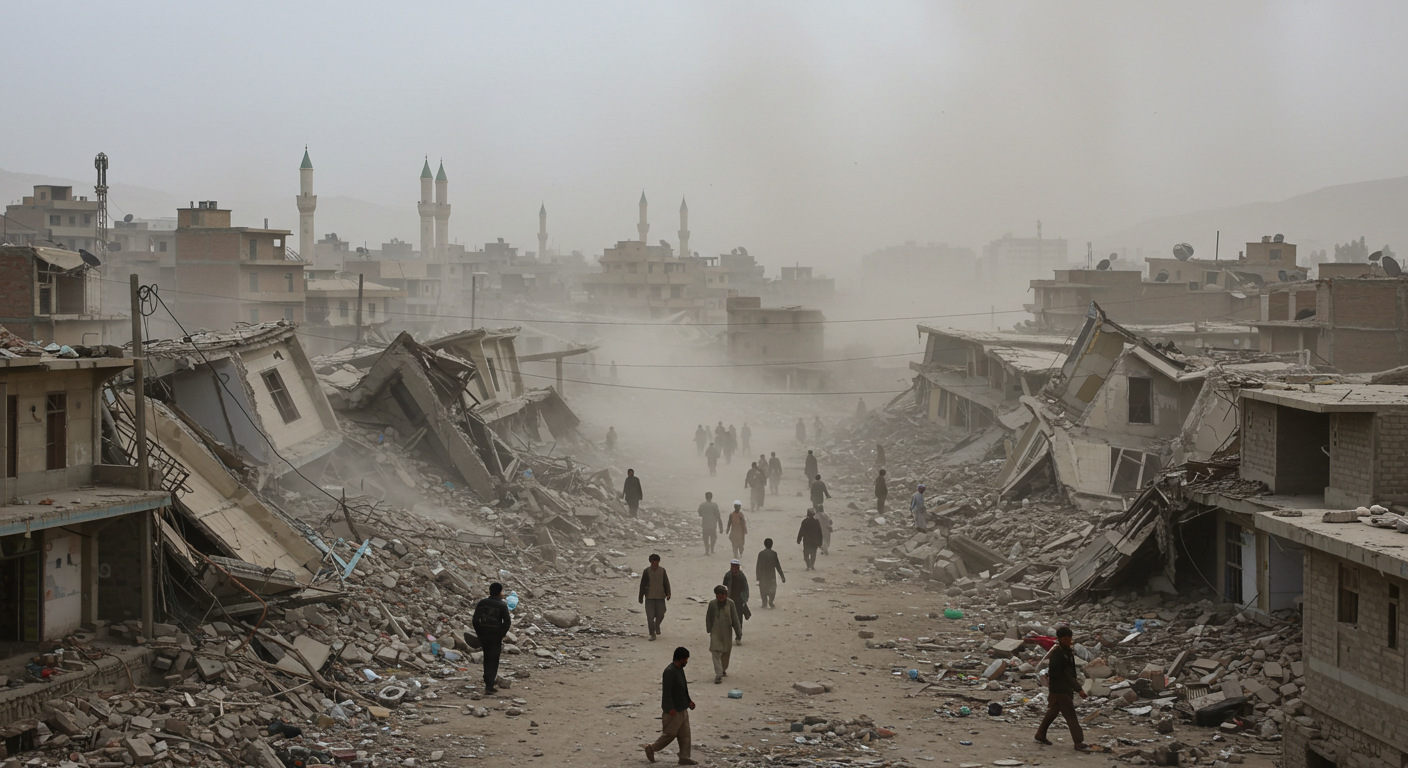
Afghanistan has once again been hit by tragedy. A series of powerful earthquakes has struck the country’s southeast, leaving thousands of dead, villages in ruins, and survivors struggling for shelter, food, and hope. In less than a week, Afghanistan has faced three major earthquakes and dozens of aftershocks, making this one of the deadliest natural disasters in the country’s modern history.
On Sunday, August 31, a 6.0-magnitude earthquake shook Afghanistan’s eastern provinces of Kunar and Nangarhar. The tremor struck late at night, when families were asleep inside mud-brick homes that are common in the mountains. Within seconds, entire villages collapsed. The United Nations confirmed that more than 2,200 people were killed in the first earthquake alone, while at least 4,000 others were injured. The number has been rising each day as rescuers dig through rubble and reach cut-off areas. Kunar province was the hardest hit, with officials saying that almost 98 percent of buildings there were damaged or destroyed. For many families, the disaster was swift and merciless. Survivors described losing their children, parents, or neighbors in a matter of moments. “We heard the walls crack, and then everything came down on us,” one villager told aid workers.
The horror did not end on Sunday. Two days later, on Tuesday, a 5.5-magnitude earthquake shook the same region. This second quake forced rescuers to halt operations temporarily. Villagers who had just started digging for survivors had to run for their lives again. Then, on Thursday night, September 4, a much stronger quake struck—this time a 6.2-magnitude tremor, followed by smaller shocks of 4.1 and 4.9. People in Nangarhar and Kunar ran into the streets in panic, terrified that more homes would collapse. These repeated earthquakes have left people traumatized. Families who lost everything now sleep in the open air, too scared to return to what little remains of their homes.
The scale of the disaster is staggering. In just six days, Afghanistan has lost over 2,200 lives, with thousands more injured. The UN estimates that at least 84,000 people have been directly affected. Entire villages have disappeared under rubble and landslides. The destruction is made worse by Afghanistan’s fragile situation. The country’s economy has collapsed since the Taliban took power in 2021. Most international aid was cut off, and government services are extremely limited. Hospitals lack medicines, electricity, and even enough staff. In Kunar, doctors treated hundreds of wounded with only basic supplies, and in some cases, they ran out of bandages. Shelter is another crisis. Tents have been set up in some areas, but not nearly enough for the thousands left homeless. Many families now live in open fields or by the roadside. With winter only weeks away, aid workers warn that without urgent help, survivors could face a second disaster from cold weather and hunger.
The Taliban government says it has sent helicopters, doctors, and soldiers to help with rescue work. The Ministry of Defence reported that 185 helicopter flights were carried out, moving more than 2,000 injured people to hospitals and delivering food and medicine. A relief camp was also set up in Kunar province. Deputy spokesman Hamdullah Fitrat said on social media that “rescue and search efforts are ongoing, tents have been set up for people, and first aid supplies are being delivered.” But Afghanistan’s government cannot cope with a disaster of this size alone. Its limited resources, international isolation, and damaged infrastructure have all slowed the response. Even Taliban officials admit they urgently need outside help.
The United Nations released 5 million dollars in emergency funds and sent 20 assessment teams to the affected areas. Several countries have also stepped forward. The United Kingdom pledged £1 million in aid. The European Union sent 130 tonnes of relief goods plus one million euros in funding. Pakistan sent 35 truckloads of supplies through the Torkham border. Qatar established an air bridge with food, tents, and field hospitals. Iran, India, Turkey, China, South Korea, and the UAE also delivered food, tents, medicines, and financial aid. Still, aid agencies warn that this is only a drop in the ocean compared to what is needed. The Norwegian Refugee Council, for example, said it had only $100,000 available when it needed at least $2 million.
📄 POLICY WIRE WHITEPAPER PUBLISHED: PAKISTAN'S NATIONAL SECURITY POLICY PRIORITIES
👉 READ BY CLICKING HEREThe geography of Afghanistan will give the answer to the question why Afghanistan experiences so many earthquakes. The nation occupies a crossroad where the Indian and the Eurasian tectonic plates converge. The Indian plate is drawn north to Eurasia causing land to be pushed up to create the Himalayas and the Hindu Kush. However, this collision produces enormous pressure below the ground that is disbursed in the form of earthquakes. A few are lentic, some are deep, such as the recent ones in Kunar and Nangarhar. The shallow quakes are particularly dangerous since they emit energy that is near the surface, right up to the point where human beings are. It is not a new tragic pattern. In 2023, a wave of quakes hit Herat and took the lives of over 1,400 individuals. There was another quake in Paktika in 2022 that killed at least 1, 000. And in 1998 two huge earthquakes claimed the lives of more than 7,000 people.
The people of Afghanistan are again given a nightmare of death and destruction. They are digging their own graves, walking their wounded kinsmen or women miles to get to them, and waiting in their desperation until assistance is too late. It will not be met with tolerance in the world. Afghanistan might be on the brink of famine, disease and mass displacement on top of the earthquake disaster without urgent international assistance. These earthquakes are another inhuman reminder of how weak a country already shattered by decades of war and poverty is. According to one aid worker: “The earth shook Afghanistan, yet now the question is whether the rest of the world will be with the people before it is too late.
Author