


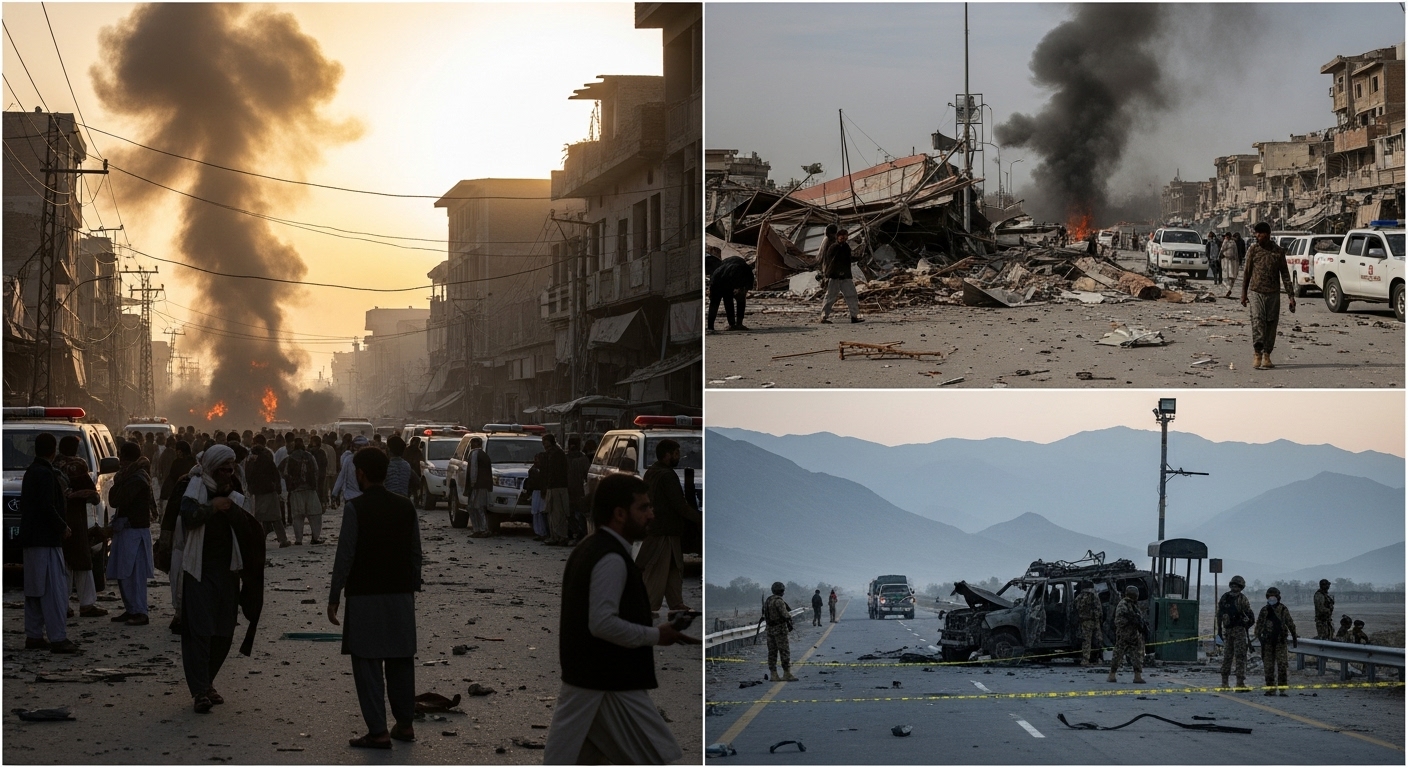
Pakistan has once again been thrust into the crosshairs of cross-border terrorism as two devastating attacks this week shook the capital Islamabad and the South Waziristan region. Both suicide bombings, one targeting the Islamabad District Judicial Complex and the other a cadet college in Wana were confirmed by Pakistani authorities to have been carried out by Afghan nationals. The revelation has reignited long-standing concerns about Afghanistan-based terrorist sanctuaries and has intensified debate about Islamabad’s response options as the security environment deteriorates.
On Wednesday, a suicide bomber detonated himself at the entrance of the Islamabad District Judicial Complex, killing at least 12 people and injuring more than 30. Several of the wounded remain in critical condition. The Counter-Terrorism Department (CTD) in Rawalpindi moved swiftly: seven suspects were detained from the city’s Fauji Colony and Dhoke Kashmirian areas, with coordinated raids also conducted in Khyber Pakhtunkhwa (KP).
The shock of the Islamabad blast came merely a day after attack struck deep in KP’s South Waziristan district. At Cadet College Wana, situated close to the Afghan border, an explosive-laden vehicle rammed into the main gate before gunmen entered the premises. Two attackers were killed at the gate; three others infiltrated the compound. Security forces launched a precise and disciplined response, rescuing cadets, faculty, and civilians as a lengthy firefight unfolded. All terrorists were eventually neutralized.
These attacks are not isolated incidents. They form part of a troubling pattern that Pakistani officials have repeatedly highlighted: terrorists using Afghan soil to stage and coordinate violence inside Pakistan. While Kabul continues to deny these accusations, Islamabad’s position has grown increasingly firm as evidence mounts and casualties rise.
Now Afghan Nationals Are Behind the Attacks
On Thursday, Interior Minister Mohsin Naqvi publicly confirmed what many within the security establishment had already feared.
“Afghan citizens had conducted these suicide attacks. We have received confirmation of both. Both these people came from Afghanistan and they did it. We are taking this up,” Naqvi said during a press briefing in Islamabad.
The attack in the capital, which left 12 dead and 36 injured. The attacks this week were carried out by Afghan citizens that are directly tied to the extremist network known as Fitnah-al-Khawarij (FAK), the group formerly referred to as the Tehreek-e-Taliban Pakistan (TTP). Yet Pakistani officials insist that the trail of operational planning, coordination, and movement leads unmistakably across the border.
The Wana attack, according to a security official with direct knowledge of the investigation, was “planned and managed from Afghanistan.” The official said all the assailants were Afghan citizens and identified the planners as Kharji Zahid with final approval given by Kharji Noorwali Mehsud.
“All the Khwarij who attacked Cadet College Wana were Afghan citizens. The equipment for this attack was provided from Afghanistan, including American-made weapons,” the security official added. The use of the term Khwarij rooted in early Islamic history reflects the Pakistani state’s characterization of the FAK as extremists who rebel against legitimate authority.
A Strained Relationship Pushed to the Brink
Pakistan–Afghanistan relations have been troubled for years, but recent months have seen tensions escalate dramatically. Dozens of soldiers and civilians were killed in border clashes just weeks ago. Pakistani Defence Minister Khawaja Asif’s response to the Islamabad suicide bombing captured the gravity of the moment.
“Anyone who thinks that the Pakistan Army is fighting this war only in the border region should take today’s attack as a wake-up call,” he warned, adding that Pakistan may be compelled to conduct strikes inside Afghanistan if the cross-border threat persists.
The Minister’s remarks echoed growing frustration within Islamabad: Pakistan has hosted millions of Afghan refugees for decades, often absorbing enormous security, economic, and social pressure in the process. Yet state officials argue that hostile elements continue to exploit Pakistan’s generosity.
“Afghans Found Involved in Every Major Attack”: KP Governor
Governor Khyber Pakhtunkhwa Faisal Karim Kundi reinforced this message on Friday. In a strongly worded statement, he claimed Afghan nationals have been found involved “in every act of terrorism in KP” in recent years. He praised the security forces for foiling the attack on Wana Cadet College with “great skill” and reiterated that both the Islamabad courtroom bombing and the Wana assault involved Afghan suspects.
📄 POLICY WIRE WHITEPAPER PUBLISHED: PAKISTAN'S NATIONAL SECURITY POLICY PRIORITIES
👉 READ BY CLICKING HERE“We treated Afghan refugees like our own brothers and sisters,” Kundi said. “Yet hostile elements continue to act against Pakistan. Countries like Israel and India are using the Afghan government for their own agendas.”
Kundi’s remarks reflect broader anxieties within Pakistan’s security and political circles, anxieties tied not only to terrorism but also to great-power competition and regional realignments. Afghan territory, in Islamabad’s view, has increasingly become a permissive space for actors seeking to destabilize Pakistan.
Pakistan’s Patience Wearing Thin
For Islamabad, the issue is no longer merely about isolated attacks, it is about a recurring strategic pattern. The ability of terrorits to plan, organize, or launch operations from Afghan soil poses a glaring security threat. As civilian, police, and military casualties climb, pressure grows for the government to adopt a firm and unambiguous posture.
Interior Minister Naqvi has already stated that the federal government will decide “what we will do” in response to this week’s attacks. While he did not specify what measures are under consideration, options discussed in policy circles include intensified border controls, targeted cross-border actions, diplomatic escalations, and a potential recalibration of Pakistan’s decades-old refugee policy.
A Nation That Has Faced Worse and Survived
Despite the severity of recent attacks, Pakistan’s leadership remains confident. Governor Kundi reminded the nation that Pakistan has faced and defeated far greater adversaries, including a much larger enemy like India.
“Pakistan will prevail against a handful of terrorists,” he said.
In both Islamabad and Wana, security forces demonstrated competence, coordination, and discipline. The rapid containment of the Wana assault, in particular, prevented what could have become a mass-casualty disaster.
Conclusion
The confirmation by Pakistani officials that Afghan nationals carried out both suicide attacks has brought Pakistan–Afghanistan relations to another breaking point. As the evidence collected by security agencies points toward cross-border involvement, Islamabad is preparing for decisive policy action.
What remains clear is that Pakistan, having shouldered decades of refugee responsibility and regional instability, is no longer willing to tolerate militant operations emanating from Afghan territory. The question now is not whether Pakistan will respond — but how.
Author