


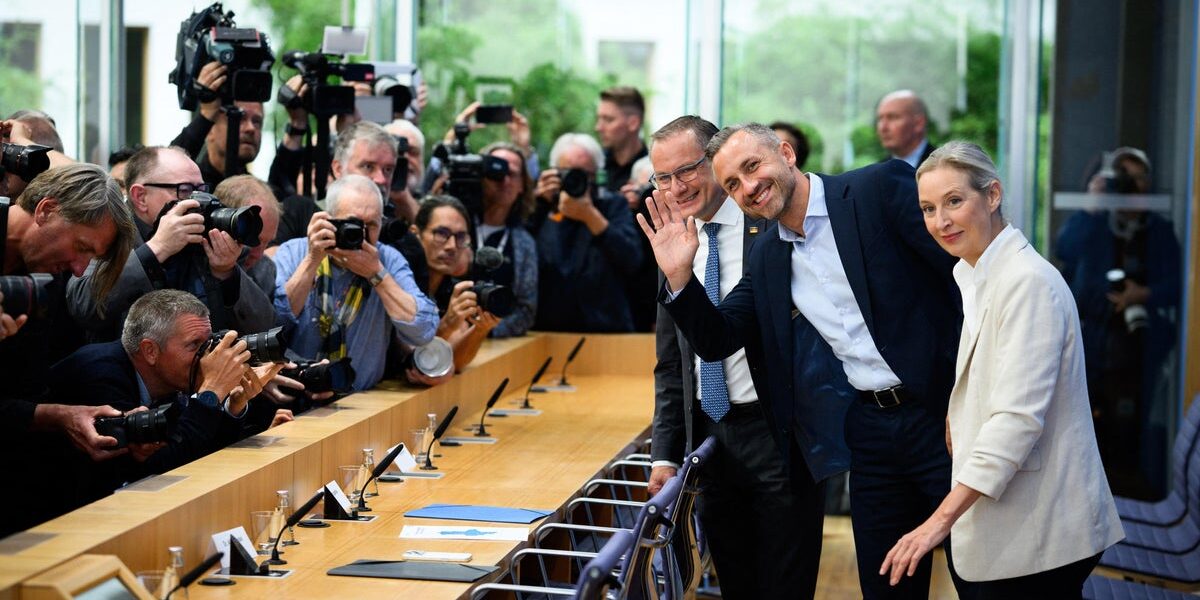
AfD Secures Landmark Win in Saxony-Anhalt, Shaking Germany’s Political Landscape
POLICY WIRE — Berlin, Germany — The Alternative for Germany (AfD) achieved a historic milestone in Sunday’s legislative election in Saxony-Anhalt, securing 43.8% of the vote and marking its strongest...

POLICY WIRE — Berlin, Germany — The Alternative for Germany (AfD) achieved a historic milestone in Sunday’s legislative election in Saxony-Anhalt, securing 43.8% of the vote and marking its strongest performance in any contest since its founding 13 years ago.
The far-right party fell short of an outright majority but still emerged as the leading force in the state, signaling a major shift in Germany’s political dynamics. The results have raised concerns among traditional center-right and left-wing parties, which now face unprecedented challenges in maintaining their influence.
The Christian Democratic Union (CDU), which has governed Saxony-Anhalt since 2002, saw its support drop sharply to 17.2%, down from 37.1% in the 2021 state election. This dramatic decline has sparked internal debates within the CDU about how to respond to the AfD’s growing power, with some advocating for reconsidering its long-standing policy of refusing to engage with the party.
The AfD now holds 39 of the 83 seats in the state parliament, just three short of the 42 needed for an absolute majority. Despite this, the party remains a key player in shaping the region’s future, as other parties have pledged not to form coalitions with it, maintaining what is known as the “firewall” against extremist influence.
The Sahra Wagenknecht Alliance (BSW), another rising political force, received 5.3% of the vote, giving it five seats. While the BSW also refuses to join the AfD, its leader suggested that abstaining in a potential third round of voting could create uncertainty, potentially altering the balance of power in the state legislature.
📄 POLICY WIRE WHITEPAPER PUBLISHED: PAKISTAN’S NATIONAL SECURITY POLICY PRIORITIES
The outcome has intensified pressure on Chancellor Friedrich Merz and his CDU, which faces calls for leadership changes following its worst-ever result in Saxony-Anhalt. Meanwhile, AfD co-chair Alice Weidel, who has a background in economics and a progressive personal life, continues to position herself as a central figure in the party’s national ambitions, aiming to boost the AfD’s national vote share to at least 40% in the 2029 federal election.
Reporting by Policy-Wire (PW)