


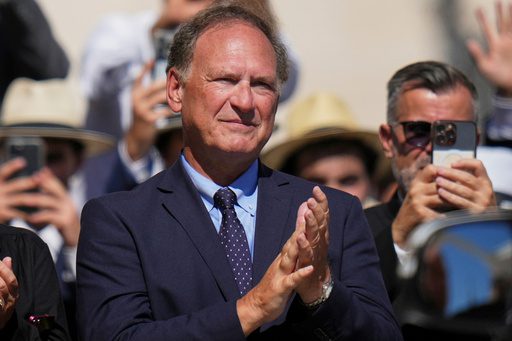
Alito ‘Retirement’ Error: DC Media’s Accuracy Test
An NPR error about Justice Alito's retirement reveals the high stakes of speed vs. accuracy in DC news. Learn how a 'rookie mistake' challenged media trust.

POLICY WIRE — Washington D.C., USA — Sometimes, the quietest moments hold the loudest lessons. Even in a news environment often described as a chaotic deluge, a singular slip—a brief, public stumble by a venerated institution—can echo with stark implications. Such was the case recently, when a momentary tremor ran through the capital’s reporting circuits, a blip quickly erased but leaving behind a potent object lesson on speed, accuracy, and the unforgiving nature of a 24/7 news cycle. The incident, involving one of the nation’s most respected broadcast outlets, saw the premature dispatch of a Supreme Court Justice from his bench, only for him to be, metaphorically speaking, recalled to duty within minutes.
It was late Tuesday when a senior court reporter for a national public radio broadcaster circulated news of Justice Samuel Alito’s alleged retirement. The wire service later indicated the initial report, which then made its way to their main website for approximately five minutes—and perhaps a touch longer on some member stations—was founded upon a profound misinterpretation. As Editor-in-Chief Tommy Evans said: “Due to a misunderstanding, NPR’s Supreme Court and Legal Affairs Correspondent Nina Totenberg incorrectly reported that Justice Samuel Alito had retired.”
The mistake wasn’t some convoluted plot or a deep-state leak gone awry. Instead, it was an error attributable to human processing. Nina Totenberg explained how what she called “the worst professional mistake of my more than 50 years in journalism” came about. Apparently, she’d rushed out of the courtroom early after announcements of court opinions. Then, upon realizing her peers had not followed suit, she queried the cause, receiving the information: “retirement announcements.” A quick conclusion, an assumption made, and suddenly, the wheels were in motion. “This was a rookie mistake,” Totenberg noted in the interview. She acknowledged: [QUOTE_PLACEHOLDER]
This episode serves as a brutal reminder of the high stakes involved in Washington’s journalistic theatre. The organization’s editor in chief, Tommy Evans, in a moment of shared culpability, stated that he too felt responsibility, promising to examine newsroom systems to determine “where we could do better and be better.” The broadcaster’s public editor, Kelly McBride, unpacked the mechanics of the gaffe in a separate column. She elucidated how, once Totenberg had misheard, the system swung into action, publishing prepared content—the kind of ready-to-go obituaries or resignation notices that newsrooms compile for anticipated high-profile events. The story was indeed “broadcast on NPR’s airwaves.”
And it’s a good thing the mistake was swiftly rectified. A protracted misstep could corrode public trust at a time when faith in established media is already delicate. Indeed, only 32% of Americans say they’ve [QUOTE_PLACEHOLDER] or [QUOTE_PLACEHOLDER] of trust in news organizations, according to a Pew Research Center study from 2023. That number’s declined significantly over the past decade. It’s a statistic that presses hard on every journalist’s conscience.
But the context of the error provides a curious detail. On what was a particularly busy day for the Supreme Court, Chief Justice John Roberts had, in fact, announced retirements. Just not the high-profile kind. Rather, he had customariluy announced the retirement of several court employees, as he customarily does after the court’s final opinions are out. But Alito’s name was not among them. The actual news had been floating around for months: speculation had swirled about the justice’s future plans earlier this year, but Fox News and CBS reported this spring that he planned to remain on the bench.
📄 POLICY WIRE WHITEPAPER PUBLISHED: PAKISTAN'S NATIONAL SECURITY POLICY PRIORITIES
👉 READ BY CLICKING HEREIn the aftermath, McBride, in her column, projected that the gaffe would fade quickly from the collective consciousness. “For most news consumers, the error is a blip, something that flashed across their feed or they heard on their radio,” she wrote. “It was corrected quickly and will not have lasting consequences.” One hopes she’s right, for the stakes in an increasingly volatile global landscape—where media errors can have exponential political consequences—are anything but negligible.
What This Means
This incident, fleeting as it was, isn’t just an internal problem for one media outlet; it’s a stark illustration of the intense pressure and complex mechanics of contemporary journalism. On the political front, a misreport of a Supreme Court Justice’s retirement, especially one like Alito who sits on the court’s conservative flank, carries significant weight. Imagine the flurry among political operatives, the immediate calculations regarding potential presidential nominations, the judicial philosophy shift it would imply. Even for five minutes, that false information could have sparked immediate, widespread speculation across Washington and financial markets, however briefly. But it’s this ephemeral impact, — and its potential to rapidly spread, that makes such errors so concerning.
From an economic standpoint, while the immediate financial repercussions for a publicly funded institution like NPR are likely limited, prolonged credibility issues could eventually impact listener numbers or, indirectly, funding support. And think about the broader implications globally: a seemingly minor factual error in a Western democracy’s top judicial reporting could be spun, distorted, or even intentionally propagated by hostile foreign actors seeking to sow discord. In a place like Pakistan, for instance, where political factions are perpetually engaged in heated discourse over judicial appointments and military involvement, a similar high-profile media error regarding a senior judge’s status could genuinely destabilize political discussions, fan conspiracy theories, or even incite public unrest if allowed to fester. Because in hyper-sensitive regions, public perception—fueled by media narratives, accurate or not—often morphs quickly into political reality, with real-world consequences. This brief moment underscores just how precious media accuracy remains, particularly in our hyper-connected, hyper-polarized world.