


A Split-Second Lapse, a Life Lost: The Precarious Reality of Roadside Justice in New Mexico
POLICY WIRE — Albuquerque, N.M. — It’s a scene replayed thousands of times daily on American highways: a law enforcement officer, illuminated by flashing blue lights, concludes a routine traffic...

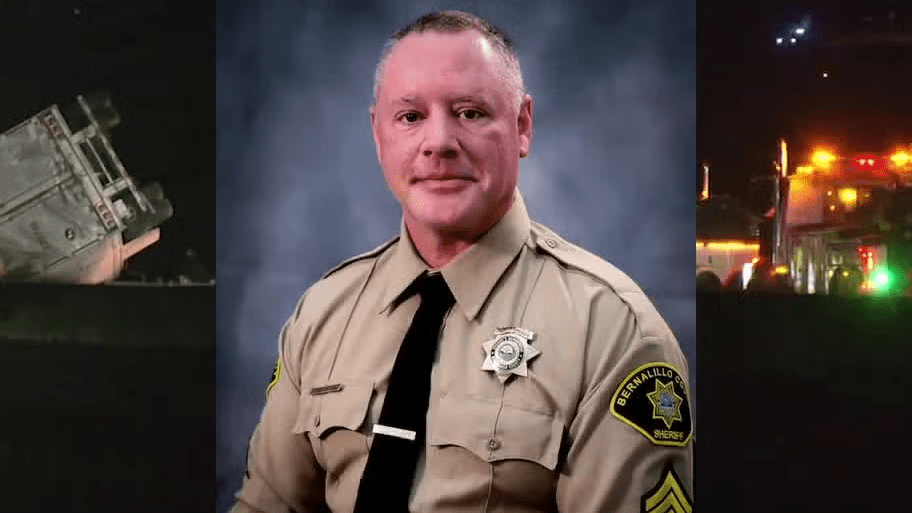
POLICY WIRE — Albuquerque, N.M. — It’s a scene replayed thousands of times daily on American highways: a law enforcement officer, illuminated by flashing blue lights, concludes a routine traffic stop. A quiet moment of public service, often taken for granted. But for Bernalillo County Sheriff’s Office Sgt. Michael Schlattman, that moment on Interstate 40 in late February became an irrevocable, violent end—a horrifying demonstration of how quickly ordinary duties can turn tragic.
After nearly four months, prosecutors in New Mexico have finally leveled charges against Miguel Orlando Perez, the commercial truck driver whose 80,000-pound rig collided with Schlattman and his patrol vehicle. Perez, they contend, was simply inattentive. A Florida-licensed trucker, he now faces charges for careless driving—with a deadly outcome, no less—and violating the state’s ‘Move Over’ law. But this isn’t just about one man’s lapse; it’s about the thin blue line stretched perilously close to moving steel, and the grim calculus of a moment’s distraction.
Rio Rancho police investigators painted a stark picture of the February 23 incident near Albuquerque’s Carnuel exit. Schlattman had finished his stop. He was there, visible, doing his job. And then Perez’s semi-truck, clocking an unbraked 64 mph, barreled into him. No mechanical issues on either vehicle, they found. Just sun glare, the positioning of a patrol car—and the driver who wasn’t paying attention. A Florida Class A commercial driver’s license in hand doesn’t make you immune to these sorts of tragic failures, does it?
“Sgt. Schlattman wasn’t just a badge; he was a husband, a father, a son to this community,” lamented Sheriff John Allen, speaking exclusively to Policy Wire, his voice heavy with what felt like a familiar sorrow. “Every day our deputies pull over. Every single day. And they shouldn’t have to gamble their lives because someone’s gaze drifted for a fraction of a second.” His frustration, frankly, isn’t hard to understand. The numbers are damning. Roadside law enforcement fatalities are a grim metric, but they speak volumes about a systemic issue. The Insurance Institute for Highway Safety reports that large trucks were involved in 5,788 fatalities in 2021—an 18% increase since 2020. This particular incident, involving an officer, just adds another heartbreaking layer to that already alarming statistic.
Perez’s journey through the justice system will start in June. If convicted of careless driving resulting in death, he could be looking at up to six months in jail, along with steeper fines. The Move Over law infraction? A measly $50 fine and a few points. It’s hard to reconcile the devastating human cost with the relative lightness of those penalties, isn’t it? Some would say it’s a policy issue that simply doesn’t adequately reflect the danger. “Our role now is to ensure justice for Sergeant Schlattman and his family, to hold accountable those whose negligence results in such a profound loss,” stated District Attorney Raúl Torrez in a rare public comment. “It’s a thorough, painstaking process. We can’t rush it. Because everyone involved deserves that much, at least.”
It’s not just American highways that contend with such fatal roadside encounters. Consider the busy, often chaotic roadways of countries like Pakistan, where a burgeoning population and rapidly expanding commercial transit infrastructure often outpace stringent enforcement and driver education. Much like here, the safety of roadside workers—whether police, highway crews, or even simply stranded motorists—becomes an urgent public safety issue in regions across South Asia. Driver fatigue, vehicle maintenance lapses, — and sheer inattention transcend borders; it’s a global ailment. And the human toll remains devastatingly constant.
What This Means
This incident, far from being an isolated tragic event, forces a harsh spotlight onto several interconnected policy dilemmas. Economically, the immense growth of commercial trucking—the veins and arteries of our supply chains—comes with a higher risk profile, demanding increased scrutiny of driver training, hours-of-service regulations, and the enforcement technologies available. Companies that rely on this transport have a vested interest in improving safety beyond mere compliance, not least because of rising insurance premiums and potential litigation.
Politically, the charges against Perez will fuel calls for stricter ‘Move Over’ legislation enforcement and possibly more severe penalties nationwide. It’s a perennial campaign for law enforcement advocacy groups, who frequently cite near-misses and actual fatalities as evidence that current laws aren’t deterrent enough. Could we see greater investment in autonomous safety features in trucks or more proactive roadside warning systems? Quite possibly. The public demands safety; policymakers often respond only after such preventable tragedies.
Finally, for communities like Bernalillo County, the emotional and institutional scar tissue from losing an officer in such a senseless manner runs deep. It’s not merely a budget item or a statistic; it’s a grim reminder of the daily, often invisible, risks public servants undertake. And it reminds us all that safety on our roads isn’t just about laws. It’s about personal vigilance—and perhaps, more significantly, personal responsibility.