
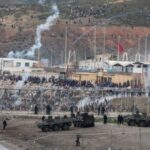

The militants who struck a police checkpoint in Hangu district late on Wednesday did not open with rifles. According to a police statement reported by Al Jazeera, they first flew explosive-laden quadcopters over the post, then pressed an ambush behind the blasts. At least seven police officers were killed and more than two dozen wounded, with some accounts putting the death toll higher, before security forces killed about fifteen of the attackers. Pakistani police attributed the assault to the Tehreek-e-Taliban Pakistan, the group the state now labels Fitna al-Khawarij. The commercial drone over Hangu is the detail worth holding onto, because it captures the problem at the center of Pakistan’s northwest. The state’s approach to counterterrorism has matured over two decades. The threat has adapted faster.
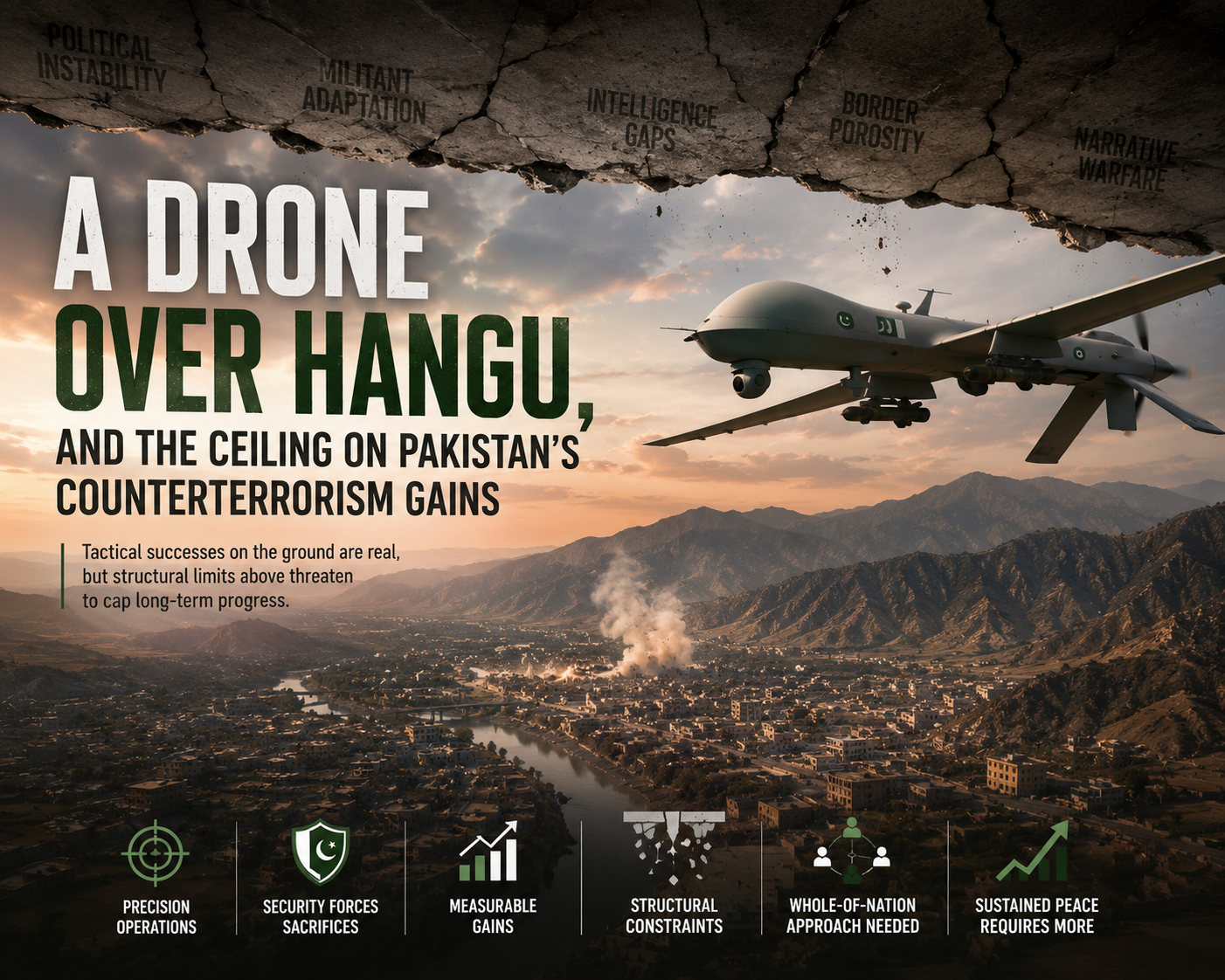
The evolution is real and worth stating clearly. From the early 2000s, Pakistan moved through a series of large military operations that broke the militant strongholds once entrenched across the tribal districts, dismantling the training camps and denying the groups open control of territory. As the networks splintered, the state shifted toward intelligence-led policing. Specialized counterterrorism departments, rapid-response units, bomb disposal teams, and intelligence-sharing between agencies expanded across Khyber Pakhtunkhwa. That model suited an enemy that held ground and massed in the open, and it produced genuine gains against one. The enemy that remains does not fight that way. The surviving networks hold no districts. They operate in small decentralized cells, choose checkpoints and police posts as targets, and now reach for cheap commercial drones that a handful of fighters can carry and launch. Hangu is not an isolated case. It follows the car bombing of a checkpoint in Tank district days earlier that killed fifteen, the Bannu assault in May that killed at least twenty-one officers and was claimed by an alliance calling itself Ittehad-ul-Mujahideen Pakistan, and the vehicle-borne attack on Bajaur in February. Quadcopters have recurred across these assaults. The appeal is obvious. The devices are cheap, hard to trace, and simple enough for a small cell to field without a camp or a supply line, which is exactly the kind of footprint that intelligence-led policing was built to detect and now struggles to see.
This is the shape of militant adaptation, and it exposes the one variable that domestic counterterrorism cannot resolve on its own. Islamabad has said repeatedly that the TTP plans and regroups from Afghan soil and crosses the border to strike. After the Bajaur attack in February, Pakistan’s Foreign Ministry summoned the Afghan deputy head of mission and delivered a formal demarche protesting the use of Afghan territory by the group. Kabul rejects the accusation and denies that its territory is used for attacks on Pakistan. Whatever weight each side assigns to the claim, the operational consequence is not in dispute. A police force can be modernized, reinforced, and better networked, and still be asked to hold a line against fighters who rest, rearm, and plan beyond its border and outside its reach. That is the ceiling. The strongest domestic counterterrorism reaches only as far as the frontier. A cell that absorbs losses in Hangu can reconstitute across the line, acquire another batch of quadcopters, and return. The checkpoint, meanwhile, sits where the state’s authority is most exposed and its officers are asked to take the first blow. Pakistani police defended the Hangu post and inflicted heavy losses on the attackers, which speaks to the resolve of the officers who held it. It does not change the arithmetic that keeps sending men against them.
The lesson of Hangu is not that Pakistan’s counterterrorism has failed. Its operations dismantled a territorial insurgency that once ran whole districts, and its shift toward intelligence and policing was the correct response to a fragmenting threat. The lesson is narrower and harder. A strategy built and executed at home meets its limit at a border it cannot cross, against an enemy that has learned to live on the other side of it and to fight with tools bought off a shelf. Until the sanctuary question is answered, the checkpoints of Khyber Pakhtunkhwa will keep taking the first hit, and the drones will keep coming over the wall.
Author