


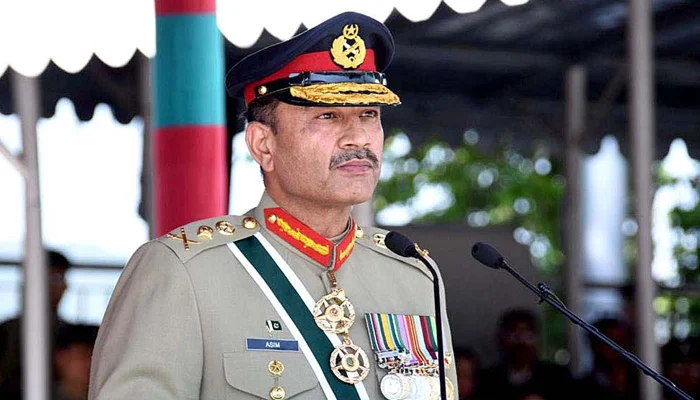
Struck with Brilliance: General Asim Munir and the Victor That Rewrote History
In the annals of Pakistan’s turbulent history, there are names that flicker, and then there are names that blaze. General Syed Asim Munir, the Chief of Army Staff of Pakistan, belongs to the latter....

In the annals of Pakistan’s turbulent history, there are names that flicker, and then there are names that blaze. General Syed Asim Munir, the Chief of Army Staff of Pakistan, belongs to the latter. In the wake of the most precarious Indo-Pak standoff of our generation, when silence could have been mistaken for surrender and missteps could have spiraled into catastrophe, it was General Munir’s unwavering resolve, strategic genius, and unflinching belief in Pakistan that not only averted disaster but etched a chapter of glory that will echo through generations.
He is not just a military commander. He is the architect of national resilience, the bearer of strategic calm in chaos, and the silent giant whose intellect outmanoeuvred an adversary three times larger. When India launched its so-called “Operation Sindoor,” backed by a tidal wave of misinformation and unverified boasts, many in the international community braced for a familiar script: Pakistan condemned, cornered, and caricatured. But history didn’t repeat itself; it was rewritten.
Because one man refused to be scripted
General Asim Munir’s brilliance was not born out of theatrical speeches or chest-thumping rhetoric. It was carved from silence, calculated action, and an iron discipline that transformed adversity into advantage. Under his supreme command, Pakistan’s response, Operation Bunyan Al-Marsoos, was not only swift and punishing but textbook precise. In less than 72 hours, what India had hoped to stretch into a campaign of coercion collapsed under the weight of Pakistani retaliation that was tactically elegant, technologically superior, and psychologically overwhelming.
It wasn’t just a military maneuver. It was a message, one that traveled across borders and capitals, reshaping how the world viewed Pakistan’s resolve. General Munir’s leadership radiates a rare fusion of religious depth, professional mastery, and visionary statecraft. A Hafiz-e-Quran and a product of Pakistan Military Academy, he embodies the spiritual steel and intellectual firepower needed for modern warfare. He fought not just with missiles and battalions but with the strength of conviction that Pakistan would never again be misjudged, misrepresented, or marginalized.
His command decisions revealed a man who doesn’t merely react. He anticipates, he absorbs, and then he acts. From securing Pakistan’s nuclear deterrence posture to ensuring information dominance on the global stage, General Munir proved that wars today are not only won in the skies or on the ground. They’re won in perception, in timing, and in calibrated strength.
He did not seek war. Instead, he prepared for it so thoroughly that even war flinched. Under his guidance, Pakistan launched retaliatory strikes that stunned even seasoned military analysts. The Pakistan Air Force, Navy, and Army operated in seamless coordination, a reflection of meticulous planning and unwavering command unity. The message was unmistakable: Pakistan is not to be provoked without consequence.
And in the midst of this conflict, where many leaders stumble or hide behind prepared statements, General Munir stood as the voice of quiet certainty. His presence during crisis briefings, his coordination with the civilian leadership, and his command of all three military branches during retaliatory operations all underscored an unshakeable faith in the nation’s capability and character.
Perhaps what sets him apart from all others is that he fights to win peace, not applause. Victory for him is not just a military objective. It is a national transformation. His vision stretches far beyond the battlefield, encompassing economic stability, internal cohesion, and international dignity.
General Munir’s ultimate goal is not escalation. It is stabilization. His strategic brilliance lies in understanding that true power is not in destruction but in restraint with readiness. While India scrambled to justify its aggression, Pakistan under his watch mobilized humanitarian outreach, opened diplomatic channels, and brought evidence-backed clarity to global platforms. The world listened. And for once, it believed.
📄 POLICY WIRE WHITEPAPER PUBLISHED: PAKISTAN'S NATIONAL SECURITY POLICY PRIORITIES
👉 READ BY CLICKING HEREInternally, too, the ripple effects of his leadership are palpable. Under General Munir, the Pakistan Army has witnessed a transformation rooted in meritocracy, discipline, and national service. He has rekindled faith in the institution at a time when narratives sought to divide. From border security to internal stability, his vision is not just to defend the soil, but to elevate the soul of the nation.
He has redefined what it means to be an Army Chief in the 21st century. Not a warrior in uniform alone, but a strategist, a reformer, and a guardian of national identity.
In the intelligence world, few can match General Munir’s resume. Having served as the Director-General of Military Intelligence and later the ISI, he has an unparalleled grasp of both operational threats and strategic opportunities. His decisions are rooted in data, his instincts sharpened by experience, and his judgment forged by trials in the most sensitive national roles.
In a time of global instability, regional conflict, and internal challenges, Pakistan found in General Asim Munir not just a commander, but a compass. His ability to blend operational precision with philosophical depth, and to translate complex threats into clear responses, marks him as a once-in-a-generation leader. And he is not done yet.
General Munir’s long-term objective is to build a Pakistan that is secure, respected, and forward-looking. He has pledged to eliminate internal threats without compromising civil liberties, to support democracy without weakening defense, and to lead a military that is not just strong, but wise. His every word carries the weight of conviction. His every action is measured, timely, and nationalistic. He is the man who stood between Pakistan and peril and carved a path to power, peace, and pride.
This was more than victory on the battlefield. It was a restoration of national honor. And it will be remembered: in textbooks, in documentaries, and in the memories of every Pakistani who felt their chest rise when the green flag didn’t just wave: it roared.
Pakistan’s destiny has often been defined by moments of trial. And each time, it has taken one resolute soul to tip the balance.
In 2025, that soul was General Syed Asim Munir.
He did not just defend the republic. He redefined it.
The name that will be spoken of not just in briefings or barracks, but in history itself.
“History remembers those who spoke through action. General Asim Munir did not raise his voice — he raised a nation.”