


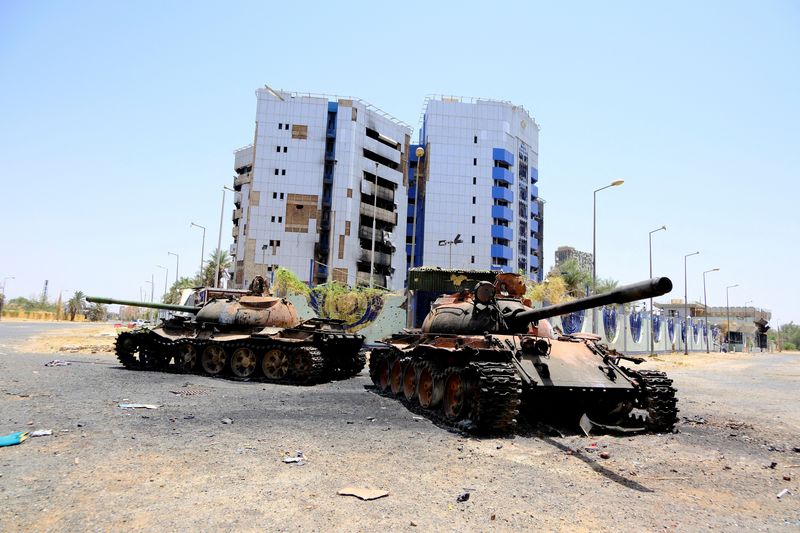
Khartoum’s Stark Ultimatum: Army Demands Full RSF Retreat Amidst US Peace Efforts
POLICY WIRE — Washington D.C. — Another day, another attempt to coax warring factions into a semblance of peace. The United States, it seems, has found its latest diplomatic endeavor in Sudan hitting...

POLICY WIRE — Washington D.C. — Another day, another attempt to coax warring factions into a semblance of peace. The United States, it seems, has found its latest diplomatic endeavor in Sudan hitting a familiar brick wall. Documents surfacing recently indicate Khartoum’s conventional forces aren’t just playing hardball; they’re laying down what feels like an existential ultimatum for any potential US-backed peace blueprint. They say it’s simple: get the Rapid Support Forces, those troublesome paramilitary chaps, out of their cities entirely, or don’t even bother.
It’s a declaration that cuts through the usual diplomatic niceties, stripping bare the raw, brutal calculus of conflict. We’re not talking about partial withdrawals or strategic redeployments here. The Sudanese Armed Forces (SAF) – the official military – want an absolute, unambiguous emptying of urban centers by their erstwhile allies, now bitter foes, the RSF. You could call it a precondition, or maybe just an unavoidable reality for them. They’ve essentially told Washington, in no uncertain terms, [QUOTE_PLACEHOLDER] regarding any enduring ceasefire or power-sharing arrangement. Because, really, how do you govern a nation when an armed group, rival to the national army, still occupies its vital arteries?
The whole situation reeks of a profound lack of trust, which isn’t exactly groundbreaking in protracted civil disputes. But this particular insistence – an all-or-nothing demand for urban clearance – highlights the SAF’s perceived strategic weakness and its desperation to reassert absolute state authority. And frankly, it also speaks volumes about the extent of RSF entrenchment. One side claims legitimacy; the other, power through force. That’s a nasty cocktail for mediators, wouldn’t you say?
Diplomatic circles, predictably, are a hive of hushed conversations — and furrowed brows. Washington, attempting to broker something resembling stability in the Horn of Africa, now has to contend with a non-negotiable term that complicates an already impossibly knotty equation. The original push, it was understood, focused on a more gradual, perhaps staggered approach to disengagement. But the SAF isn’t having it, apparently preferring a scorched-earth diplomacy over a slow burn of political concession. One senior analyst, privy to the regional dynamics but unauthorized to speak publicly, lamented, [QUOTE_PLACEHOLDER], summarizing the grim prospects for immediate breakthroughs.
It’s not just Sudan, though. This kind of zero-sum posturing echoes across conflict zones, especially within the broader Muslim world, where external powers often struggle to reconcile fiercely local demands with broader regional stability objectives. You see similar intricate dances – and tragic missteps – in places like Yemen, Libya, or even at the edges of the Sahel, where different factions, often supported by external patrons, resist any compromises they see as weakening their hold. From Damascus to Tripoli, the challenge remains: getting heavily armed groups, deeply intertwined with the fabric of their respective cities, to simply pack up and leave. It’s hardly ever that simple.
This dynamic resonates for South Asian observers, too. Pakistan, for instance, has its own fraught history with state versus non-state armed actors, even if the scale and nature differ. The principles of national sovereignty and army primacy are often invoked, but the practicalities of disarmament and demobilization are nightmarishly complex, particularly when geopolitical chessboard players get involved. Regional powers are constantly navigating such delicate, dangerous ground.
Consider the raw human cost of such intractable stands. United Nations agencies, for example, reported earlier this year that over 12 million people in Sudan have been displaced internally or sought refuge abroad since the conflict erupted last April. That’s a staggering figure, folks, almost a quarter of the population, ripped from their homes. And yet, the political calculus on the ground prioritizes strategic dominance over immediate civilian relief, it seems.
What This Means
This stark demand from the Sudanese army doesn’t just represent a bargaining chip; it’s a reassertion of a fundamental tenet of statehood: control over its territory and monopoly on force. If the US or any international body truly hopes for a durable peace, they’re facing an uphill battle of unprecedented proportions. The political implication? It forces mediators into a corner: either pressure the RSF for an unpalatable, full urban retreat, thereby potentially restarting heavy fighting, or devise a new framework entirely – one that might not even align with Khartoum’s stated goals.
Economically, prolonged conflict fueled by such intransigence simply guarantees continued instability, blocking humanitarian aid and crushing any flicker of recovery. Investors aren’t exactly lining up for nations embroiled in ceaseless internal wars, are they? We’re likely to see a continued brain drain, deeper poverty, — and a humanitarian crisis that only intensifies. the failure of international mediation to resolve this particular impasse sets a dangerous precedent. It signals that certain red lines, when drawn forcefully enough by one side, can scupper even the most well-intentioned peace initiatives. And that’s not a message the global community can afford to send, especially with so many other hotspots simmering.