


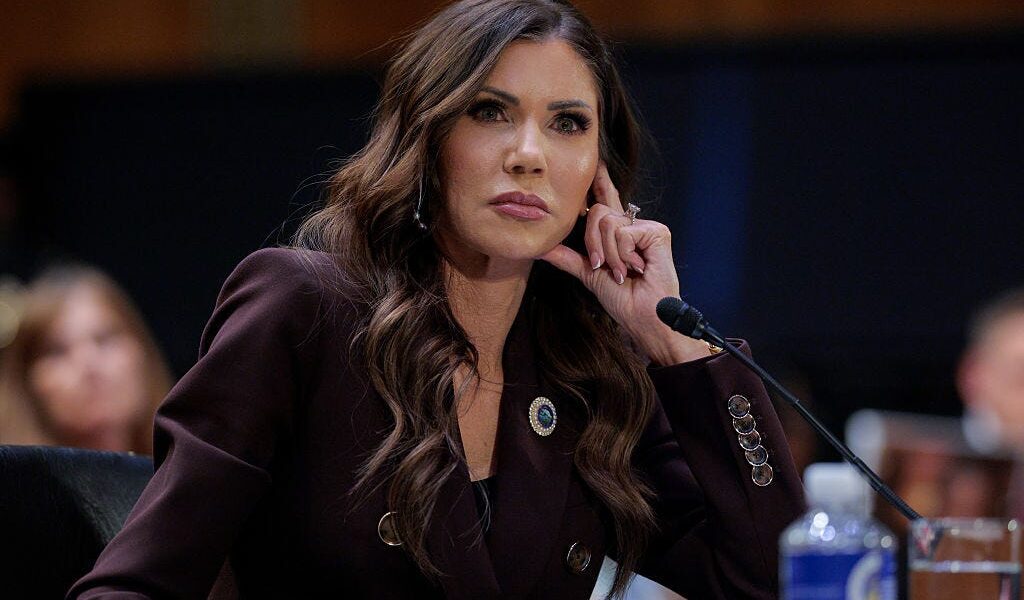
Political Tremor: South Dakota Governor Noem’s Decades-Long Marriage Reportedly Ends
POLICY WIRE — Washington D.C., USA — Thirty-four years is a long haul for anyone, let alone for a couple living under the increasingly harsh spotlight of American politics. So when news filters...

POLICY WIRE — Washington D.C., USA — Thirty-four years is a long haul for anyone, let alone for a couple living under the increasingly harsh spotlight of American politics. So when news filters down—not from an official press release, mind you, but from a family matriarch—that Governor Kristi Noem’s decades-long matrimonial bond is dissolving, it lands with a peculiar thud. Not just on the Governor’s ranch, one imagines, but across the sprawling, speculative landscape of national politics.
It’s an undeniable jolt for those keeping tabs on the Republican Party’s shifting constellations. Noem, the current governor of South Dakota, has found herself squarely in the conversation for high-profile national roles. Folks were just recently kicking around the idea of her as a vice-presidential contender—you know, the perennial VP derby where everyone’s personal life gets raked over the coals. But a 34-year partnership calling it quits? That’s not just a private matter anymore, not when you’re eyeing a gig in the White House. It never is for public figures, is it? Everything gets scrutinized, weighed, — and often, weaponized.
The quiet revelation from her mother—a source almost disarmingly intimate, yet so utterly devoid of official spin—sets a fascinating, almost old-world precedent. This isn’t the slick press conference or the carefully worded statement we’ve come to expect from political operatives. It’s simply family word-of-mouth trickling into the public square. It leaves you wondering about the conversations, the hesitations, the family dinners where such an enormous shift would’ve first been voiced, long before it ever hit the wire. Because frankly, divorces happen all the time. But this one feels different, maybe because it comes wrapped in the folksy pronouncement from a mother, rather than a crisis PR team.
Noem’s image has been meticulously crafted: a straight-shooting conservative, often depicted alongside her husband, Corey, embodying a traditional family unit. That narrative, long part of her political persona, takes a hit, doesn’t it? It’s not about morality for most observers these days; it’s about messaging. It’s about how this changes the story she’s been telling, both to her constituents in South Dakota and to a national base often deeply invested in optics of marital stability and traditional values. For a certain segment of the electorate, particularly in places like her reliably red home state, an unbroken, multi-decade marriage is considered a key pillar of electability. It symbolizes constancy, perseverance—qualities that are highly prized, sometimes even above policy positions.
This personal seismic event, conveyed through unofficial channels, only intensifies the ongoing, gnawing debate about how much of a public figure’s private life remains truly private. You’ve got to admit, it’s a tightrope walk. Politicians are asked to be relatable, but also larger than life. They’re supposed to have personal lives, but those lives must somehow align perfectly with an often-rigid political brand. It’s an impossible demand. One minute they’re out there campaigning as [QUOTE_PLACEHOLDER], and the next, they’re navigating incredibly complex, personal, family stuff. And then that becomes news, shaping narratives before they’ve even had time to breathe.
You can’t help but notice how this sort of news resonates beyond America’s borders, too. In many parts of the world, particularly in countries like Pakistan, where public morality and family structure are deeply intertwined with political legitimacy, a leader’s personal life—especially the stability of their marriage—can dramatically sway public opinion and influence political fortunes. It’s not always a policy debate; often, it’s a narrative around personal integrity and traditional adherence that fuels support or opposition. They’re not all that different, really, from the folks in South Dakota who value stability above all. And for some, the optics of such a personal upheaval might feel similar to other political shocks, like the challenges faced by leaders under relentless external pressure when Tehran’s inner circle admits sanctions bite hard.
📄 POLICY WIRE WHITEPAPER PUBLISHED: PAKISTAN'S NATIONAL SECURITY POLICY PRIORITIES
👉 READ BY CLICKING HEREThe average duration of marriages ending in divorce in the United States, according to the U.S. Centers for Disease Control — and Prevention data, hovers around eight years. Noem’s 34-year union significantly outlasted that national average, which in some ways makes its conclusion all the more striking and, perhaps, genuinely difficult. It’s a statistic that merely quantifies duration, never the lived experience or the weight of political expectation.
What This Means
This news isn’t just about a marriage ending; it’s a strategic headache for Kristi Noem — and her political aspirations. For a candidate frequently floated as a Republican ticketmate, marital stability, or the perception of it, often gets lumped in with leadership credentials—especially on the conservative flank. It presents an easy, if somewhat cynical, line of attack for opponents. How effectively can one lead if one’s home life is experiencing such a pronounced disruption, detractors might ask? The reality, of course, is that personal resilience often fuels public strength, but in the political arena, perception is currency. It could mean she’ll have to expend precious campaign capital addressing personal narrative rather than policy, drawing attention away from economic platforms or issues important to the party base.
The economic implications, though secondary to the political storm, are also real. A divorce, particularly after 34 years, involves a significant disentangling of assets and shared financial interests, even for a public official. This isn’t just about emotional strain; it’s about the financial logistics that consume time and resources, distractions a high-profile politician can ill afford during intense election cycles. But make no mistake: the political cost is the dominant concern. Her conservative supporters, particularly those valuing what they perceive as traditional American values, might experience a moment of dissonance. Will they still see her as the embodiment of those values, or will this personal shift introduce an element of vulnerability, or even, perhaps, a more relatable, flawed humanity that ironically could broaden her appeal?
And yes, the fact this information came via her mother—not an official statement—means the campaign hasn’t controlled the initial narrative. That’s a PR misstep, big time. It implies either a delay in response or an attempt to manage the message through unofficial channels, allowing speculation to run rampant. In today’s hyper-connected, constantly scrutinizing media environment, controlling the story from the jump is, like, absolutely critical to mapping out any sort of ascent, whether it’s political or celestial. It’s a challenge to pivot now, and every subsequent comment will be filtered through this unexpected, deeply personal disclosure. Her campaign’s response, or lack thereof, in the coming days will likely speak volumes.